Bancassurance 2.0: The Digital Compact Redefining APAC Bank-Insurer Distribution
Executive Summary
Bancassurance remains one of Asia-Pacific's most valuable distribution channels, accounting for a disproportionately large share of new life-insurance premiums across the region - more than half of new business in several key markets (Swiss Re Institute, 2024). Yet the model that built it - long-tenure exclusive partnerships, branch-based advisers, upfront commissions - is misaligned with how APAC customers now buy, price and service protection. Digital-native distribution, embedded finance, and open-data regimes are compressing margins on the branch model while creating a new one: a digital compact between banks and insurers built on shared APIs, joint customer intelligence, and product factories that publish insurance into bank journeys in real time.
Winners in this shift will not simply digitise the old partnership. They will re-contract it. This article sets out why the shift is happening now, what a Bancassurance 2.0 operating model looks like, and how BFSI leaders in APAC should sequence the rebuild.
Introduction
For two decades, bancassurance has been the quiet workhorse of Asian financial services. It gave banks a low-capital fee stream, gave insurers scale distribution without a captive agency force, and gave regulators a comparatively controlled channel to expand protection coverage. Estimates from Swiss Re Institute (2024) place bancassurance at roughly 50-70% of new individual life premium in Hong Kong, Singapore, Malaysia and Vietnam, and above 40% across much of ASEAN - a market share few other channels approach.
That workhorse is now stressed. Digital wallets and superapps are collecting the same customer moments - a car purchase, a mortgage drawdown, an outbound flight - and monetising them with embedded protection at a fraction of the acquisition cost. Regulators from the Monetary Authority of Singapore (MAS) to the Australian Prudential Regulation Authority (APRA), the Insurance Regulatory and Development Authority of India (IRDAI) and Indonesia's Otoritas Jasa Keuangan (OJK) are simultaneously tightening conduct expectations around suitability, disclosure and remuneration. And customers, particularly in Southeast Asia, are increasingly under-30 and mobile-first: a segment that the exclusive branch model was never designed to serve.
The question for BFSI leaders is no longer whether bancassurance needs to be rebuilt. It is how to rebuild it without collapsing the fee stream that funds the transformation.
Industry Context: Why the Old Compact Is Breaking
Three shifts, converging over the past 24 months, explain the pressure.
First, the economics are moving. McKinsey (2024) estimates that global insurance distribution costs have risen by 12-15% in real terms since 2019, while conversion rates in traditional branch bancassurance have declined as branch footfall falls. In several APAC markets, branch transactions per customer have halved since 2019 (BCG, 2024). The unit economics of a physically-distributed protection product are eroding, even as customer demand for protection - health, mortgage life, travel, cyber, SME liability - expands.
Second, the regulatory perimeter is changing. MAS's Balanced Scorecard framework, IRDAI's revised Bancassurance and Corporate Agent regulations, and APRA's ongoing focus on remuneration structures under the Financial Accountability Regime (FAR) are all narrowing the space in which upfront-commission, single-insurer models can operate. In parallel, open-finance regimes - Singapore's SGFinDex, Australia's Consumer Data Right (CDR) extension into non-bank data, India's Account Aggregator framework - are giving customers portable financial data. That data changes who can underwrite them, at what price, and from which distributor.
Third, competitors are no longer other banks. Grab, GoTo, Ant International and regional digital banks are packaging insurance into checkout, credit and lifestyle journeys. Capco (2024) estimates embedded insurance premiums in Asia will grow at a compound annual rate of 26% between 2024 and 2030, reaching more than USD 100 billion in annualised gross written premium. That growth is being captured by whoever owns the moment of transaction - not by whoever owns the branch.
Current Challenges
Speaking with BFSI leaders across the region surfaces a consistent set of Bancassurance 1.0 constraints.
Bank and insurer systems are joined at the middle layer, not the data layer. Illustrations, applications and issuance run through proprietary insurer front-ends bolted onto bank branches; the underlying customer, policy and claims data lives in siloed systems that cannot support real-time recommendation, dynamic pricing or straight-through underwriting.
Product portfolios are optimised for the seller, not the journey. Long-form participating and unit-linked products, designed for face-to-face illustration, do not compress into a mobile home-loan journey where a customer expects a mortgage-life quote in under two minutes.
Adviser incentives remain tuned to upfront commissions and one-year persistency, even as regulators push toward longer-term suitability outcomes. This creates conduct risk and forces expensive rework - MAS's Balanced Scorecard results have consistently flagged bancassurance as the highest-defect channel by weighted sample.
Data-sharing is contract-heavy and consent-light. Most partnerships still operate under fixed-scope data schedules negotiated in the exclusive agreement, not under dynamic, customer-owned consent frameworks. As open-finance frameworks mature, that gap becomes a competitive disadvantage.
Key Trends Shaping Bancassurance 2.0
Five trends are actively reshaping the model.
1. API-based product factories. Insurers such as AIA, Prudential, Allianz and FWD are publishing rate cards, risk questions and issuance flows via APIs that banks can compose into their own journeys. This decouples product from channel and enables multi-insurer panels within a single bank interface - closer to a marketplace than an exclusive lock-in.
2. Embedded and contextual protection. Rather than sell an annual policy at the branch, banks are triggering micro-cover offers at the transaction - travel insurance at the point of foreign-currency purchase, cyber cover with card top-ups, top-up mortgage-life at re-fix. Deloitte (2024) reports that embedded protection converts at 3-5x the rate of standalone digital sales.
3. Shared customer intelligence and consent. The most advanced bank-insurer partnerships in Singapore, Hong Kong and Australia are now operating on a joint customer-360, governed by consent artefacts issued through the bank's identity fabric. This changes the underlying commercial model from a lead-referral fee to a shared risk-and-reward pool.
4. Adviser augmentation, not replacement. Contrary to the "digital kills the adviser" narrative, the highest-productivity bancassurance forces in APAC are those equipped with AI copilots that pre-qualify leads, generate compliant needs-analysis, and draft suitability memos. BCG (2024) benchmarks copilot-equipped advisers as producing 20-30% more qualified opportunities per week without an increase in complaint rates.
5. Claims as a distribution moment. Straight-through claims - image-based motor claims, wearables-driven health claims, parametric weather covers - are becoming the strongest driver of renewal and cross-sell. Insurers are increasingly willing to expose claims data back to the bank partner in near real time, because it lifts the shared retention curve.
Strategic Analysis: Rebuilding the Compact
Bancassurance 2.0 is not a technology programme. It is a re-contracting of the bank-insurer relationship, supported by four architectural moves.
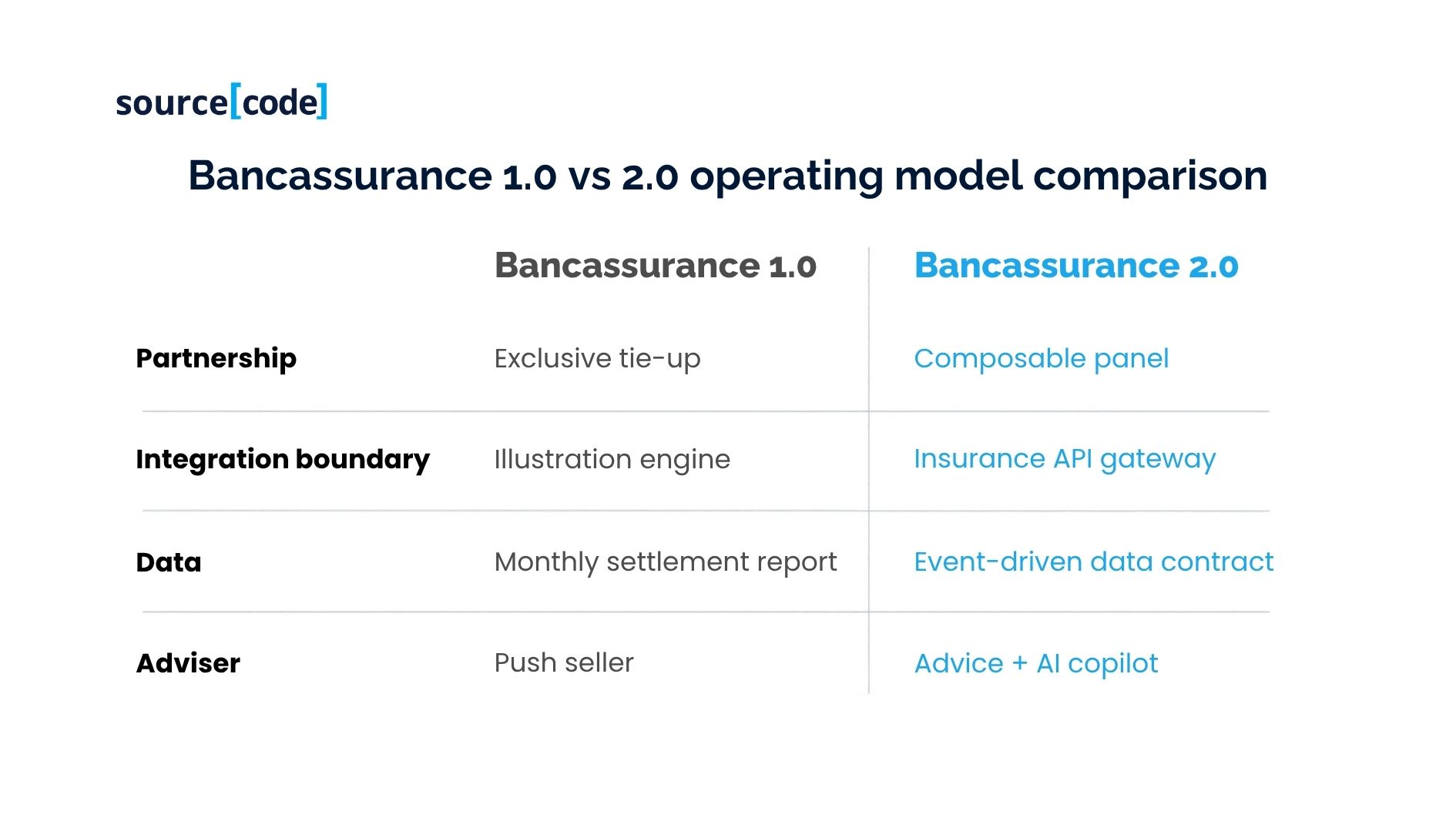
Move one: shift from exclusivity to composable panels. Long, exclusive tie-ups are losing regulatory sympathy and customer relevance. The direction of travel across the region is toward semi-open architectures - typically two-to-four insurer panels per product line - with the bank owning the customer interface and orchestration. This is closer to the model already common in Australia and India for general insurance, extending now into life and health.
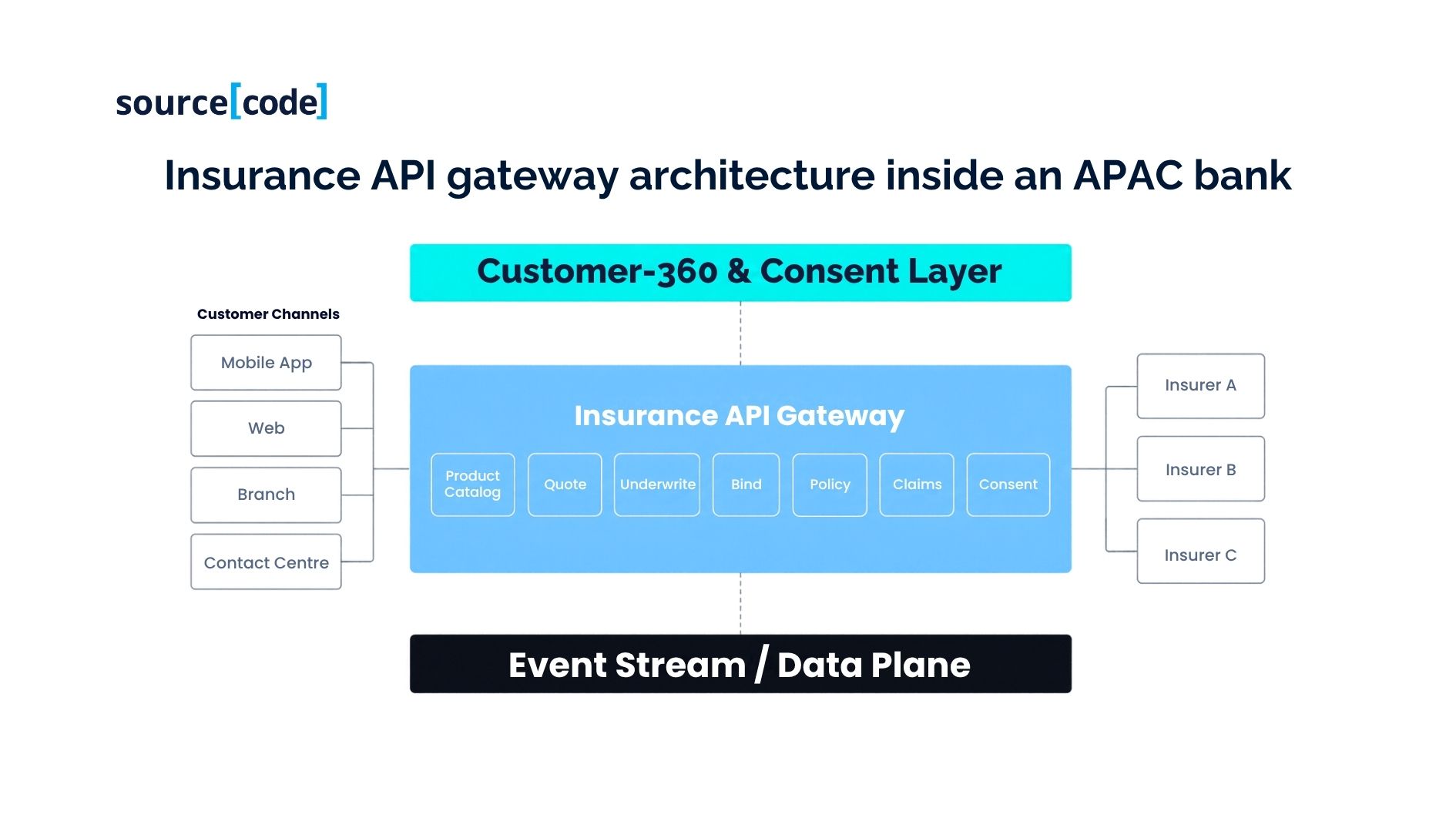
Move two: move the integration boundary up the stack. In Bancassurance 1.0, the integration point was the illustration engine. In Bancassurance 2.0, it is the customer-360 and consent layer. Practically, this means banks need an internal insurance API gateway that abstracts each insurer's product, quote, underwriting, issuance and claims APIs into a canonical set of services the bank's channels can consume - irrespective of the partner behind them.
Move three: engineer a joint data plane, not a joint reporting pack. The commercial upside of the digital compact - dynamic pricing, real-time cross-sell, portfolio steering - depends on both sides operating from the same event stream. The most durable partnerships in the region have moved from monthly settlement reports to event-driven data contracts that specify exactly which events (quote issued, policy bound, claim paid) are shared, in what form, under whose consent, and to what commercial effect.
Move four: re-price the adviser. The economics only rebalance when in-branch advisers move from being commission-driven push-sellers to needs-based advice specialists supported by AI. That transition requires investment in copilots, revised scorecards weighted on retention and suitability, and - often - a smaller, higher-skilled adviser cohort.
Real-World Examples
The market is already moving.
DBS in Singapore and Hong Kong has extended its long-standing partnership with Manulife into an API-connected journey stack, exposing insurance quotes inside its digibank app and wealth management flows and reporting significant uplift in digital-originated protection premium (DBS, Annual Report 2023).
Standard Chartered operates a multi-market bancassurance partnership with Prudential across nine Asian markets, with an explicit shift toward digitally-originated protection and adviser augmentation (Prudential plc, Annual Report 2023).
HDFC Bank and HDFC Life in India have deepened data integration through the group's unified customer platform, with roughly 60% of new individual policies now sourced or serviced digitally (HDFC Life Investor Presentation, FY2024).
CIMB and Sun Life in ASEAN have extended a regional multi-country partnership focused on digital enrolment and joint segment analytics (Sun Life, News Release, 2023).
Bank Central Asia and BCA Life in Indonesia have rolled out digital-first micro-protection integrated into everyday banking, aligned with OJK's push to increase insurance penetration from Indonesia's persistently low ~3% of GDP (OJK Insurance Statistics, 2023).
The pattern is consistent: multi-market, API-anchored, data-shared, adviser-augmented. The exceptions - pure exclusive, branch-only, upfront-heavy tie-ups - are increasingly the ones underperforming on both growth and complaint metrics.
Actionable Recommendations
BFSI leaders on both sides of the compact should sequence the rebuild deliberately.
Start with a joint economic re-baseline. Model the current partnership on a fully-loaded basis - including cost of adviser time, servicing, remediation and capital held against conduct risk - before designing the target state. Most partnerships underestimate the real cost-to-serve of Bancassurance 1.0 by 15-25% and therefore under-invest in the transition.
Define the target customer moments before the target technology. Identify the six-to-ten highest-value protection moments in the bank's customer journey (mortgage drawdown, card issuance, wealth review, SME loan approval, travel FX, health checkpoint) and design end-to-end journeys for each, backwards into the API stack.
Stand up an insurance API gateway inside the bank. Treat insurer connectivity as a platform capability, not a per-deal integration. This is the single biggest architectural lever for switching from exclusive to composable panels without multiplying operational cost.
Rewrite the data and consent schedule. Replace the fixed-scope data appendix with an event-driven, consent-anchored data contract. Involve the bank's data protection officer and the insurer's chief actuary in the same room - a rare but necessary conversation.
Re-tool the adviser force. Roll out an AI copilot that generates compliant needs analyses, product comparisons and suitability memos; rebalance scorecards to reward two-year persistency and complaint-free suitability, not first-year premium.
Instrument conduct in real time. Move complaint, mis-selling and persistency signals into a live dashboard shared between bank compliance, insurer conduct and the joint steering committee. Regulators in Singapore, Hong Kong and Australia are increasingly clear that they expect real-time conduct oversight, not quarterly retrospection.
The sourceCode Perspective
At sourceCode, we work with banks and insurers across APAC on the engineering foundations that Bancassurance 2.0 depends on: composable product platforms, insurer API gateways, event-driven data planes, consent-aware customer-360 architectures, and AI copilot rollouts for advisory forces. The pattern we see repeatedly is that the technology is not the hardest part. The hardest parts are the joint operating model, the shared data contract, and the disciplined engineering that translates a re-negotiated partnership into production-grade capability, safely and at scale.
Our BFSI engineering teams help partners move deliberately from a proof-of-concept - a single embedded journey, a single insurer, a single market - to a repeatable platform capable of onboarding new insurers, new products and new markets in weeks, not quarters. We do this with a technology-agnostic approach, aligned to each institution's existing core, cloud and data investments.
Conclusion
Bancassurance is not going away in APAC. If anything, an ageing population, widening protection gaps, and the rise of embedded finance are expanding the addressable opportunity. What is going away is the assumption that the channel can continue to run on a 1990s operating model. The banks and insurers that treat this decade as an opportunity to re-contract - technically, commercially and behaviourally - will capture disproportionate share of a market that Swiss Re Institute (2024) estimates could add more than USD 400 billion in APAC gross written premium by 2030. The rest will watch that premium flow to whoever owns the moment of transaction.
Looking to explore what a re-contracted, API-native bancassurance partnership could look like in your market? Talk with sourceCode about the engineering foundations for Bancassurance 2.0.
FAQ
What is Bancassurance 2.0? Bancassurance 2.0 is the API-enabled, data-shared, multi-insurer evolution of the traditional bank-insurer distribution model. It replaces exclusive branch-anchored partnerships with composable, event-driven partnerships integrated into digital customer journeys.
Why is bancassurance under pressure in APAC now? Three forces are converging: falling branch traffic and rising unit-cost of physical distribution, tightening regulatory expectations on suitability and remuneration, and the rise of embedded insurance from superapps and digital banks.
How large is bancassurance in APAC? According to Swiss Re Institute (2024), bancassurance accounts for 50-70% of new individual life premium in several APAC markets including Hong Kong, Singapore, Malaysia and Vietnam, and more than 40% across much of ASEAN.
What is an insurance API gateway? An internal bank capability that abstracts each partner insurer's product, quote, underwriting, issuance and claims APIs into a canonical set of services the bank's channels can consume - regardless of the insurer behind them.
Does digital bancassurance eliminate the adviser? No. Evidence from BCG (2024) shows that advisers equipped with AI copilots produce 20-30% more qualified opportunities per week without an increase in complaint rates. The adviser role shifts from push-seller to needs-based advisory.
References
APRA (2023) Financial Accountability Regime: Information Paper. Australian Prudential Regulation Authority.
BCG (2024) Global Insurance Report 2024: The Productivity Imperative. Boston Consulting Group.
Capco (2024) Embedded Insurance in Asia: 2024 Outlook. Capco Intelligence.
DBS Group Holdings (2024) Annual Report 2023. DBS Group Holdings Ltd.
Deloitte (2024) 2024 Global Insurance Outlook. Deloitte Center for Financial Services.
HDFC Life (2024) FY2024 Investor Presentation. HDFC Life Insurance Company Ltd.
IRDAI (2023) Insurance Regulatory and Development Authority of India - Annual Report 2022-23. IRDAI.
MAS (2024) Guidelines on the Balanced Scorecard Framework. Monetary Authority of Singapore.
McKinsey & Company (2024) Global Insurance Report 2024. McKinsey Financial Services Practice.
OJK (2024) Indonesian Insurance Statistics 2023. Otoritas Jasa Keuangan.
Prudential plc (2024) Annual Report 2023. Prudential plc.
Sun Life Financial (2023) News Release: Regional Bancassurance Partnership Extension. Sun Life Financial Inc.
Swiss Re Institute (2024) sigma 3/2024: World Insurance. Swiss Re Institute.