How CFOs Are Actually Allocating the 2026 AI Budget (And What It Means for Vendor Selection)
sourceCode | BFSI Technology Insight | 6 October 2026
Key Takeaways
-
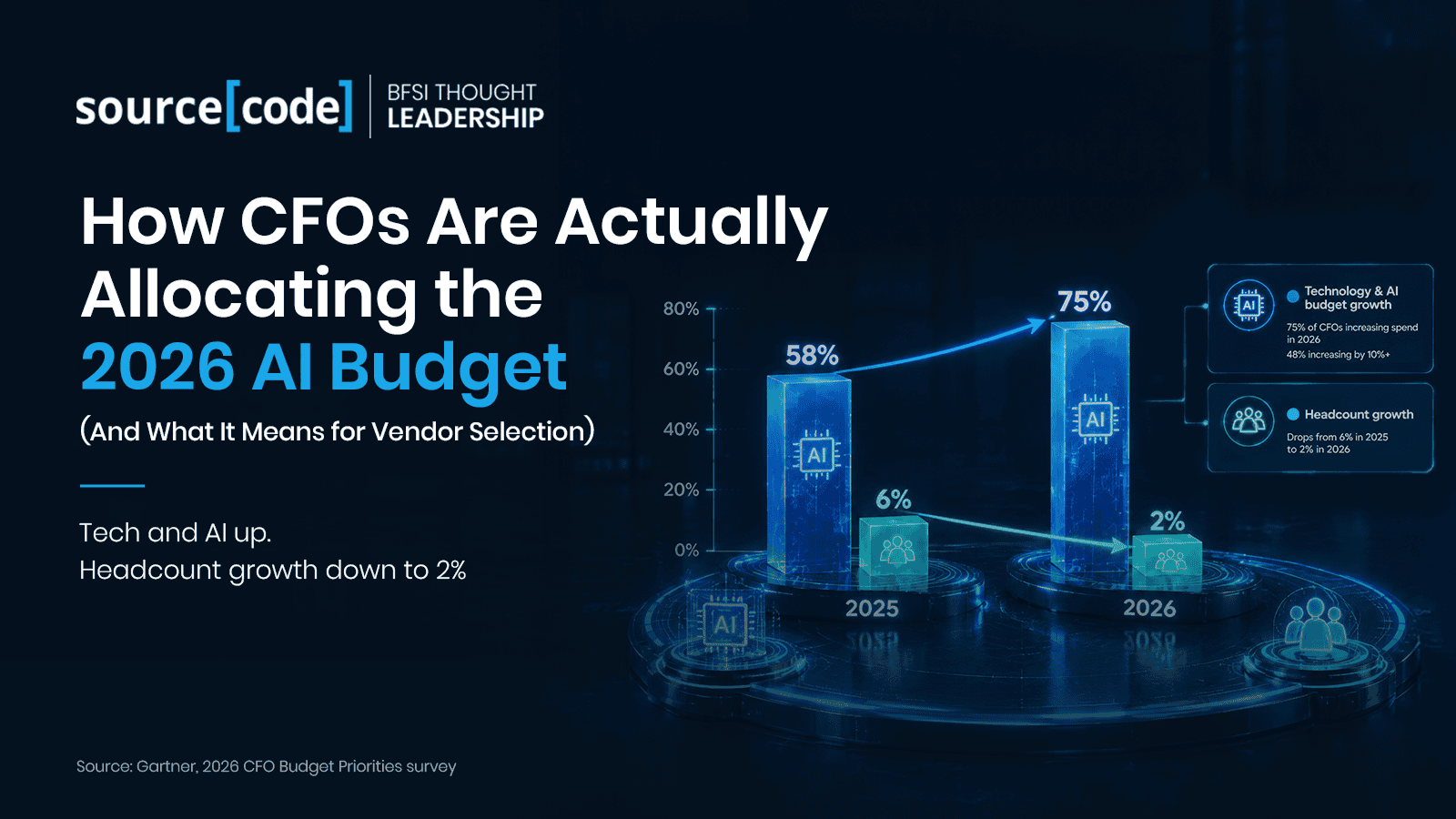
Gartner's October 2025 survey of 300+ CFOs confirms a genuine structural shift: 75% are raising technology budgets for 2026 (48% by 10%+), while expected headcount growth collapses from 6% to 2% - technology has displaced labour as the primary lever for capacity growth.
-
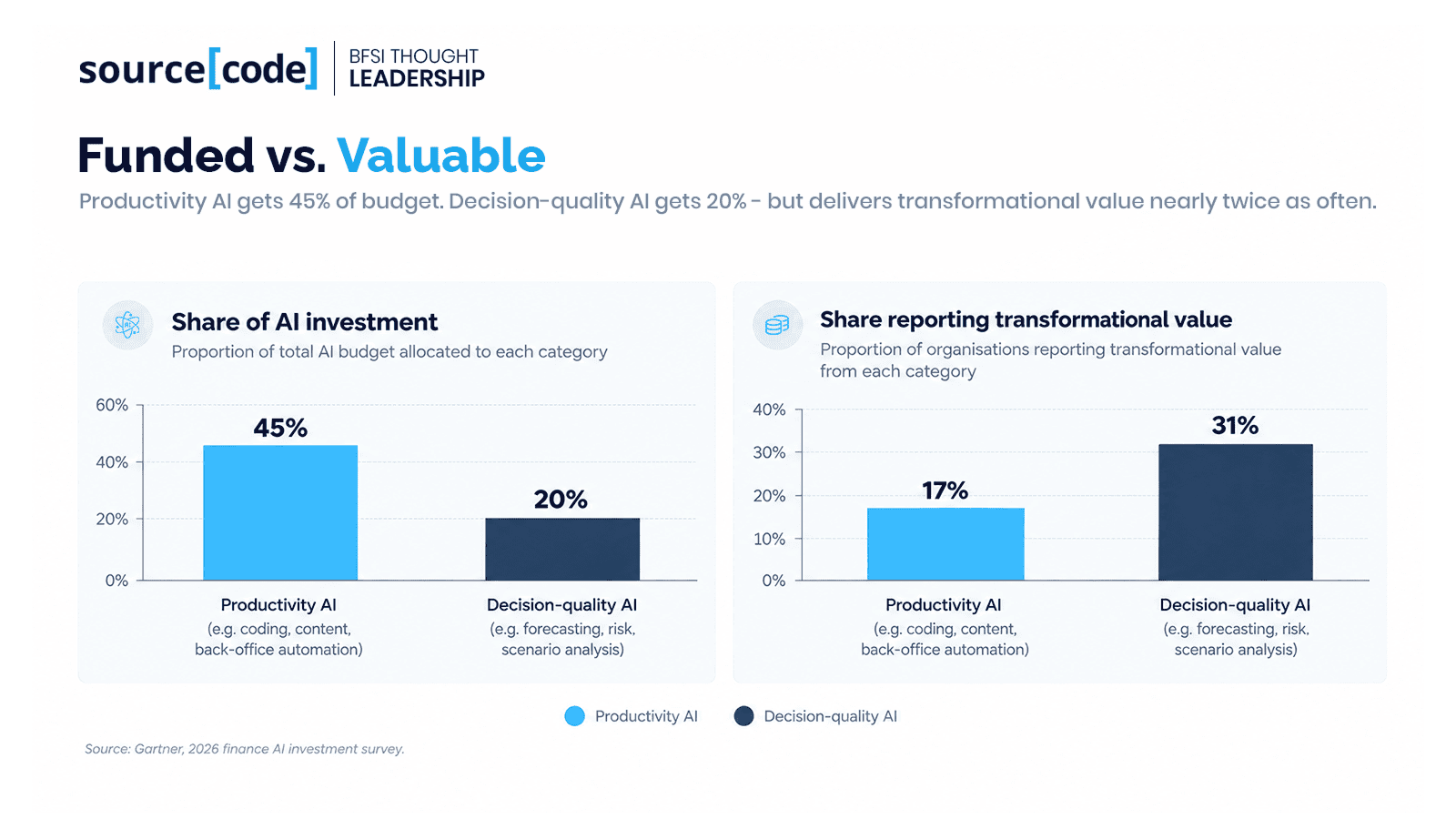
The more important - and less reported - finding sits one layer down: within growing AI budgets, Gartner's 2026 finance-AI research shows CFOs are concentrating spend on fast-payback, narrow-scope use cases (45% of investment) and starving harder-to-prove, higher-value decision-support use cases (20% of investment) - even though the latter deliver transformational value nearly twice as often.
-
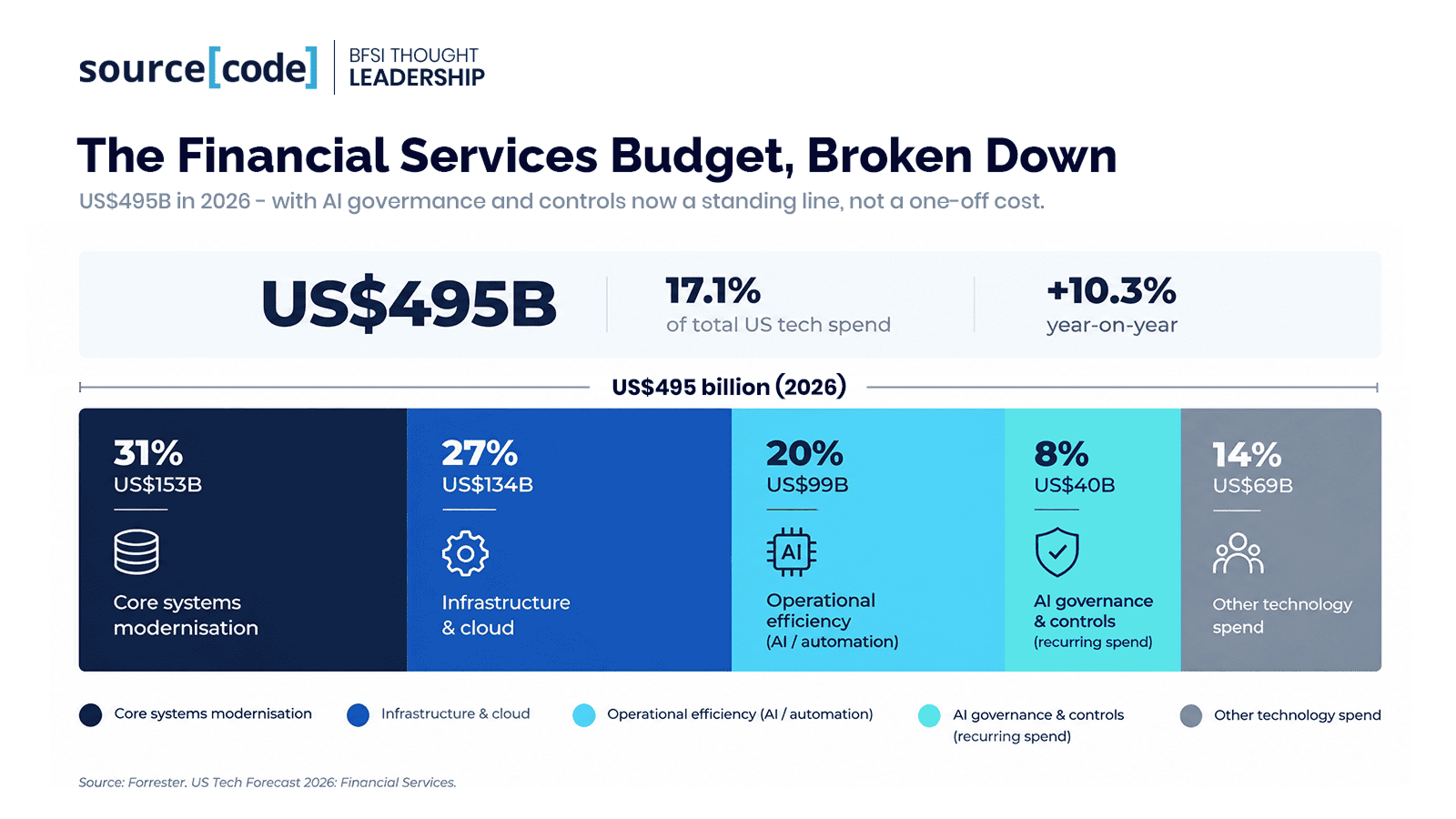
In financial services specifically, Forrester puts 2026 US BFSI technology budgets at US$495 billion (17.1% of all US tech spend, up 10.3% year-on-year), with a distinct, recurring line for AI governance and controls that has no equivalent in most other industries' budgets.
-
The practical consequence for vendors: a pitch built for "innovation budget" logic - built around capability and roadmap - is being evaluated against proof-of-value and governance criteria it was never designed to answer, regardless of how compelling the underlying technology is.
-
This article verifies the underlying Gartner, Forrester, PwC and KPMG research directly (not via press summary) and offers a decision framework - the Budget Lane Framework - for mapping any AI initiative against the specific budget category a CFO is protecting this cycle.
Introduction
Every vendor selling into financial services in 2026 has heard some version of the same boardroom anecdote: the CFO is finally excited about AI. Budgets are up, headcount plans are down, and technology has moved from a cost centre to be managed to a growth lever to be funded. That much is true, and it is backed by real survey data, not sentiment.
What most vendors get wrong is assuming that a bigger, friendlier AI budget behaves like a bigger, friendlier version of the innovation budget they are used to pitching into. It does not. The 2026 CFO budget cycle is not simply "more money for AI." It is a redrawn set of lanes, each with its own proof standard, its own time horizon and its own approval owner - and a growing share of AI spend in financial services carries an entirely separate, non-negotiable compliance and governance line that most vendor pitch decks do not address at all.
This piece verifies what Gartner's 2026 CFO research actually says (not the popular paraphrase of it), adds the financial-services-specific budget data from Forrester, PwC and KPMG, and sets out a framework for reading which lane a given AI pitch is actually competing in.
The Evidence: What CFOs Are Actually Doing With the 2026 Budget
Gartner's headline 2026 CFO budget research is based on a survey of more than 300 CFOs and finance leaders conducted in October 2025 (Gartner, 2026a). Three findings from that survey are well corroborated across CFO Dive, CIO Dive, HR Dive and the-cfo.io, each independently reporting the same underlying Gartner figures (CFO Dive, 2026; CIO Dive, 2026; HR Dive, 2026; the-cfo.io, 2026):
-
75% of CFOs plan to increase technology budgets in 2026, with 48% planning increases of 10% or more.
-
Expected headcount growth is collapsing, from 6% in 2025 to 2% in 2026; the share of CFOs planning staff increases of 4-9% fell from 31% to 21%.
-
Within finance functions specifically, nearly 60% of CFOs plan to increase AI investment by 10% or more, yet 47% still allocate only 1-5% of total finance technology spend to AI, and just 7% allocate more than 20%.
Gartner's own framing of this is direct: Nauman Abbasi, VP Analyst at Gartner, describes it as "a structural pivot from labor expansion to optimization driven by automation and AI that deliver productivity gains without proportional increases in headcount" (Gartner, 2026a). That is the correct, verified version of the "AI budget replacing headcount budget" claim - and it holds up. It is not, however, the whole story, and reporting on it typically stops here.
A separate Gartner survey - 204 finance leaders surveyed in early 2026, reported in "Gartner Survey Shows 45% of CFOs Say Their AI Investments Lean Toward Productivity, While 20% Say These Investments Lean Toward Decision Quality" - shows what happens once that money actually lands inside a finance or technology budget (Gartner, 2026c). Forty-five percent of AI investment leans toward productivity: individual output gains, transactional workflow streamlining, faster processing. Only 20% leans toward decision quality: forecasting, risk assessment, strategic modelling. The counter-intuitive part is what happens next: 31% of decision-quality investments report "significant or transformational value," against only 17% of productivity investments. CFOs are, by their own reported data, underfunding the category of AI spend most likely to pay off at a transformational level, while overfunding the category most likely to deliver a modest, provable win. Gartner's Shankar Keshav frames the resulting tension directly: "Boards place greater emphasis on investments that drive growth, improve decision-making and deliver competitive advantage," creating what Gartner terms a "perception gap" between finance leaders reporting AI progress and boards seeing limited strategic impact (Gartner, 2026c).
A third, more recent Gartner release adds the mechanism behind this pattern. Based on 160 senior finance leaders surveyed January-April 2026 in Gartner's "Current State of AI in Finance, 2026" research, quick-return use cases - data extraction, accounts payable/receivable automation, report creation - typically reach measurable value in 9-10 months. Complex use cases - data management, insight generation, forecasting - take materially longer to mature. Gartner's Marco Steecker's conclusion is the clearest single statement of the actual 2026 dynamic: "AI adoption has reached a point where CFOs must adopt more deliberate portfolio management" (Gartner, 2026d). Notably, this same research identifies low AI literacy - not talent scarcity - as the primary barrier finance leaders now report to scaling AI further.
On the framing in the brief for this piece: the working assumption was that CFO budget authority is being "ring-fenced against a narrow set of provable-return categories." The verified research supports a more precise version of that claim: the ring-fencing is not by category (e.g., "fraud" gets funded, "forecasting" does not); it is by proof horizon. Anything that can demonstrate value inside roughly a 9-12 month window, at individual or workflow level, clears the bar far more easily than anything that requires a longer maturation period to prove - regardless of the eventual size of the payoff. That distinction matters enormously for how a vendor should build a business case, and it is the basis for the framework later in this piece.
In financial services specifically, the picture is bigger and structurally different again. Forrester's "US Tech Forecast 2026: What It Means For Financial Services" puts US financial services technology budgets, including staff costs, at US$495 billion in 2026 - 17.1% of Forrester's projected total US technology spend of US$2.9 trillion, and 10.3% growth year-on-year (Forrester, cited in Marketscale, 2026). Forrester attributes that growth to two categories: operational efficiency (agentic AI, virtual agents, legacy modernisation) and AI governance and controls - observability, explainability, guardrail enforcement and bias-reduction infrastructure - which it explicitly frames as recurring operating cost, not a one-off implementation line (Marketscale, 2026). That second category has no real equivalent in most other industries' 2026 budgets and is the clearest financial-services-specific evidence of a genuinely separate, protected budget lane.
PwC's Banking CFO Insights research (PwC, 2026) is consistent with this: 58% of financial services executives report tying compensation to AI-enabled productivity gains, and 91% say technology and AI tools are increasingly important for navigating current uncertainty. PwC names three metrics banking CFOs are actually using to justify continued AI investment - cost reduction, operational efficiency and capacity liberation - a narrower, more operational set than most vendor value propositions are built around. (PwC's page did not disclose the underlying survey's sample size or fielding dates, so this should be read as directionally consistent with Gartner's findings rather than independently powered evidence.)
Why This Is Happening
Three forces are compounding, not one.
First, the labour economics are real. Gartner's compensation data shows pay growth slowing from 6.1% (2024) to 4.5% (2026) alongside the headcount collapse described above - CFOs are not simply trimming discretionary cost, they are re-pricing the marginal unit of capacity, and automation is now cheaper at the margin than the next hire in many finance and operations functions.
Second, board scrutiny of AI spend has caught up with the enthusiasm. Gartner's July 2026 research found 87% of finance leaders feel pressured to tie AI spending to measurable business outcomes within a year, while only 22% have actually done so (Gartner, 2026c). That gap between pressure and delivery pushes budget owners toward whatever can be measured fastest - which is precisely why productivity use cases with a 9-10 month payback window are winning the allocation fight even when they are not, by Gartner's own data, the highest-value category.
Third, in financial services, the governance layer is not optional. Regulatory, legal and ethical uncertainty is one of the top three barriers to AI deployment identified in KPMG's 2026 Banking Technology Survey, alongside integration with existing systems and poor data quality (KPMG, 2026). Where a general-industry vendor can treat governance as a differentiator, a BFSI vendor is competing against a line item the CFO's office is already obligated to fund. That changes the negotiation from "should we spend on this" to "does this initiative reduce or add to a cost we are carrying regardless."
What Most Vendors Get Wrong
The recurring error is not technical, it is structural: vendor pitches are built and rehearsed against a CTO's or innovation lead's evaluation criteria - capability breadth, roadmap ambition, architectural elegance - and then presented, largely unchanged, in a room where the actual approval owner is applying a completely different test.
A few specific patterns follow from the verified data above:
- Pitching "decision intelligence" value with a productivity-tool proof structure. Gartner's data shows decision-quality AI investments deliver transformational value at nearly double the rate of productivity investments (31% vs 17%), but are funded at less than half the rate (20% vs 45%) (Gartner, 2026c). Vendors selling genuinely strategic decision-support capability often make the mistake of trying to prove it the way a productivity tool proves itself - a fast pilot ROI number - which understates the case and invites exactly the wrong comparison.
- Treating governance and explainability as a value-add rather than as budget infrastructure. In BFSI specifically, Forrester's data indicates this is now a standing, recurring line, not a feature (Marketscale, 2026). A vendor that cannot show how its product fits inside an institution's existing model governance, audit and explainability obligations is asking the CFO's office to create new governance overhead - the single fastest way to move a pitch out of an active budget lane and into a "revisit next cycle" holding pattern.
- Assuming the innovation budget owner is still the effective decision-maker. With headcount growth collapsing and technology budgets absorbing that growth (Gartner, 2026a), CFOs are exercising far more direct oversight of technology spend than the org chart historically implied. A pitch that has not been pressure-tested against finance's proof standard - not the CTO's - is arriving in front of the actual buyer for the first time at the point of approval, which is the most expensive place to discover a mismatch.
- Underestimating vendor churn risk from the buyer's side. A September 2026 survey of 172 finance and procurement professionals by SpendHound (a SaaS spend-management vendor; the sample skewed heavily toward software and technology companies, with financial services at only 7%) found 76% of respondents actively reconsidering existing vendor relationships because of AI capability gaps, and 57% not confident they are paying a fair price for AI tools at all (SpendHound, cited in Business Wire, 2026). This should be read as a vendor-commissioned, cross-industry data point rather than BFSI-specific evidence, but it corroborates the broader pattern: incumbency is a weaker moat in 2026 than it was two budget cycles ago, and price-value scrutiny is rising in parallel with budget growth, not in spite of it.
Implications for Vendor Selection and Deal Structuring
The practical consequence is that "get on the technology roadmap" is no longer sufficient as a commercial objective. A vendor needs to know, before the pitch is built, which budget lane the initiative is actually being evaluated against, because the evidence each lane requires is different in kind, not just in degree.
Gartner's April 2026 research on margin outcomes reinforces this at the portfolio level: organisations that manage AI and technology as a coordinated portfolio - rather than a series of isolated pilots - are projected to unlock an additional 10 points of margin growth by 2029, but only where investment is explicitly aligned to business outcomes and "supported by strong governance, explainability and data readiness" (Gartner, 2026b). Mike Helsel's framing is blunt: "CFOs will not unlock margin gains from AI by chasing isolated pilots: the biggest returns will come from managing finance technology as a portfolio" (Gartner, 2026b). That has a direct implication for deal structuring: a vendor that only ever shows up with a point solution, however good, is asking to be evaluated as a pilot - the exact category Gartner's own research says underperforms.
For BFSI specifically, this means procurement conversations increasingly involve three separate proof requirements running in parallel: a productivity-lane business case (fast, measurable, usually finance-owned), a governance and controls case (compliance and risk-owned, largely non-negotiable), and - far less often funded, but disproportionately valuable when it lands - a decision-quality case that has to be sponsored at a level above the initial evaluator, because it does not fit the fast-proof template the rest of the budget is optimised for.
A Decision Framework: The Budget Lane Framework
To make this operational rather than descriptive, sourceCode uses a simple three-lane model for classifying any AI initiative against the budget category a CFO is actually protecting this cycle, rather than the category a vendor assumes it is competing in.
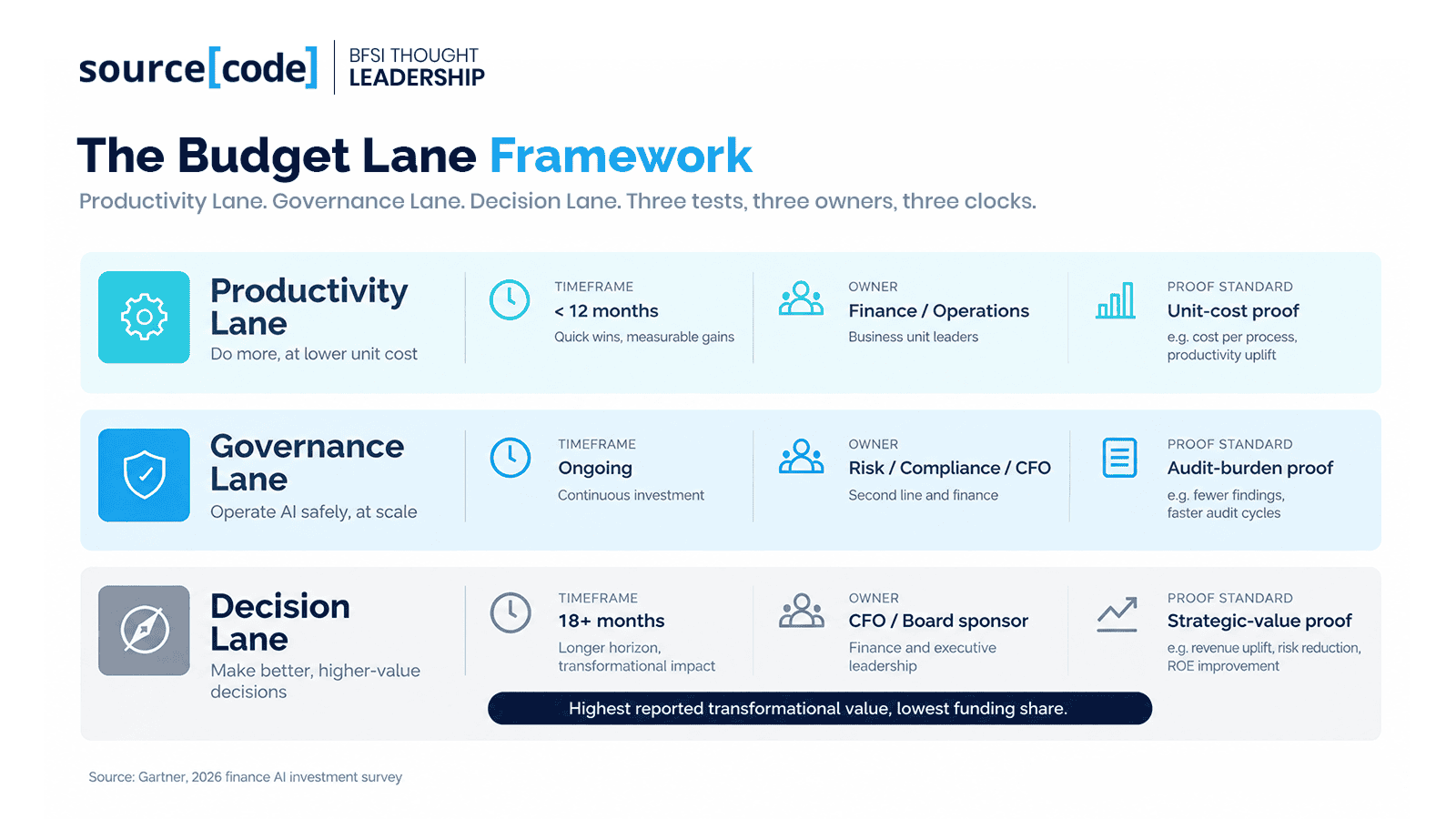
Lane 1 - Productivity Lane. Time-to-value target: under 12 months. Owner: finance or operations. Proof standard: unit-level cost or cycle-time reduction, individually attributable. This is where 45% of surveyed AI investment currently sits (Gartner, 2026c), and where competition is most intense precisely because it is the easiest lane to get approved. A pitch here needs a narrow, fast, defensible number - not a platform story.
Lane 2 - Governance Lane. Time-to-value target: not applicable in the usual sense - value is risk-adjusted, not productivity-adjusted. Owner: risk, compliance, and increasingly the CFO's office directly, given Forrester's data that this is now a standing BFSI budget line (Marketscale, 2026). A pitch here needs to demonstrate that it reduces the institution's existing governance burden (audit trail, explainability, model risk documentation) rather than adding to it. This lane rarely competes on price; it competes on whether the vendor can be trusted not to create new obligations.
Lane 3 - Decision Lane. Time-to-value target: 18 months or longer. Owner: CFO or board-adjacent sponsor, because the evaluation horizon exceeds any single budget cycle. Proof standard: not a fast pilot ROI figure but a credible, staged case for improved forecasting, risk assessment or strategic decision quality - the category Gartner shows delivers transformational value almost twice as often as productivity spend, despite being funded at less than half the rate (Gartner, 2026c). A pitch here that tries to borrow Lane 1's fast-proof template will almost always underperform its actual value, because it is being measured against the wrong clock.
The framework's practical use is diagnostic: before building a business case, identify which lane the buyer's own budget process has actually assigned the initiative to - not which lane the vendor would prefer - and build the evidence package to that lane's standard specifically.
Counterargument and Nuance
None of this should be read as a claim that CFOs are becoming uniformly conservative about AI, or that the productivity/decision-quality split is a stable, permanent structure. Two qualifications matter.
First, Gartner's own August 2025 baseline survey found only 36% of CFOs confident in their ability to drive enterprise AI impact at all, and only 44% confident about accelerating AI use within finance specifically (Gartner, 2025). Some of the observed concentration in fast-payback, low-complexity use cases may reflect capability and confidence constraints as much as deliberate portfolio discipline - CFOs may be funding what they can currently govern and measure, not necessarily what they believe is highest-value. That is a different, more transitional dynamic than a settled allocation doctrine, and it is likely to shift as finance teams' own AI literacy improves - Gartner's own research names low AI literacy as the current binding constraint (Gartner, 2026d).
Second, the financial-services-specific governance-spend finding rests on a single secondary rendering of a paywalled Forrester report (via Marketscale) rather than a directly verified Forrester publication or a second independent outlet reporting the same figures. The direction of the finding - that BFSI carries a distinct, recurring AI governance cost line - is consistent with KPMG's independently reported finding that regulatory and ethical uncertainty is a top-three deployment barrier for banks (KPMG, 2026), but the specific dollar figures from Forrester should be treated as indicative rather than fully corroborated pending direct access to the underlying report.
The sourceCode Perspective
Working alongside BFSI technology and finance teams through recent budget cycles, the pattern that stands out is less about total AI budget - which is genuinely growing, as the data above confirms - and more about who is now asking the second and third questions in an evaluation. A CTO or innovation sponsor might be satisfied with a strong pilot result. The CFO's office, increasingly the effective gate for anything beyond a small trial, tends to ask what happens to this line item if it does not renew, whether it changes the institution's audit posture, and whether the vendor's roadmap creates dependency risk.
Those are not objections to be handled at the end of a sales cycle; they are the actual specification the initiative has to be designed against from the outset. Vendors that treat the governance and total-cost conversation as something to get through, rather than as the primary evidence the CFO's office is weighing, consistently take longer to close and are more exposed at renewal - which lines up with the vendor-reconsideration data cited above, even allowing for that survey's limitations. Talk to us!
Conclusion
The 2026 CFO budget cycle in financial services is not simply larger for technology and smaller for headcount, though it is verifiably both of those things. It is also more segmented: a fast-provable productivity lane absorbing the bulk of near-term spend, a governance and controls lane that functions more like regulatory overhead than discretionary investment, and a smaller, harder-to-access decision-quality lane that the data suggests is disproportionately valuable but structurally under-resourced. Vendors that can correctly identify which lane a given initiative is actually competing in - and build the proof case to that lane's specific standard - are working with the CFO's real approval logic rather than against it.
Map your current AI initiative against the budget lane your CFO is most likely protecting this cycle before your next pitch, not after the first objection surfaces.
FAQ
What percentage of CFOs are increasing AI or technology budgets in 2026? According to Gartner's October 2025 survey of more than 300 CFOs, 75% plan to increase technology budgets in 2026, with 48% planning increases of 10% or more (Gartner, 2026a).
Is headcount actually shrinking in 2026 finance and technology budgets? Expected headcount growth is not shrinking in absolute terms but is collapsing in rate - from 6% expected growth in 2025 to 2% in 2026, per the same Gartner survey (Gartner, 2026a).
How are CFOs splitting AI investment between productivity and decision-support use cases? Gartner's 2026 research on 204 finance leaders found 45% of AI investment leans toward productivity use cases versus 20% toward decision-quality use cases, even though decision-quality investments report transformational value almost twice as often (31% vs 17%) (Gartner, 2026c).
How large is the financial services technology budget in the US for 2026? Forrester forecasts US financial services technology budgets, including staff costs, at US$495 billion in 2026 - 17.1% of total US technology spend, up 10.3% year-on-year (Forrester, cited in Marketscale, 2026).
What should vendors change about how they pitch AI to financial services CFOs? Identify which budget lane an initiative sits in - fast-payback productivity, mandatory governance and controls, or longer-horizon decision quality - and build the evidence case to that lane's specific proof standard rather than a generic ROI narrative.
Reference List
Business Wire (2026) 57% of Finance Leaders Are Not Confident They're Paying a Fair Price for AI, as republished by FinancialContent, 28 September. Available at: https://www.financialcontent.com/article/bizwire-2026-9-28-57-of-finance-leaders-are-not-confident-theyre-paying-a-fair-price-for-ai (Accessed: 6 October 2026).
CFO Dive (2026) Most CFOs expect larger IT budgets, 'collapsing' staff growth: Gartner. Available at: https://www.cfodive.com/news/75percent-cfos-anticipate-bigger-tech-budgets-this-year-gartner/812254/ (Accessed: 6 October 2026).
CFO Dive (2026) Finance AI spending is stuck on efficiency gains, Gartner says. Available at: https://www.cfodive.com/news/finance-ai-spending-stuck-efficiency-gains-gartner-warns/825736/ (Accessed: 6 October 2026).
CIO Dive (2026) Most finance chiefs expect larger IT budgets, 'collapsing' staff growth: Gartner. Available at: https://www.ciodive.com/news/tech-budgets-cuts-2026-gartner/812385/ (Accessed: 6 October 2026).
Gartner (2025) Gartner Survey Shows Top Priorities for CFOs in 2026 Include Cost Optimization, Improved Forecasting, and Funding Growth Opportunities, 12 August. Available at: https://www.gartner.com/en/newsroom/press-releases/2025-08-12-gartner-survey-shows-top-priorities-for-cfos-in-2026-include-cost-optimization (Accessed: 6 October 2026).
Gartner (2026a) Gartner Research Reveals CFOs' Budget Plans Prioritize Growth Functions, Technology and AI in 2026, 10 February. Available at: https://www.gartner.com/en/newsroom/press-releases/2026-02-10-gartner-research-reveals-cfos-budget-plans-prioritize-grotwth-functions-tech-and-ai-in-2026 (Accessed: 6 October 2026).
Gartner (2026b) Gartner Predicts By 2029, CFOs Who Implement Strategic AI Deployment Will Add 10 Margin Points of Growth, 28 April. Available at: https://www.gartner.com/en/newsroom/press-releases/2026-04-28-gartnerpredicts-by-2029-cfos-who-implement-strategic-ai-deploymnt-will-add-10-margin-points-of-growth (Accessed: 6 October 2026).
Gartner (2026c) Gartner Survey Shows 45% of CFOs Say Their AI Investments Lean Toward Productivity, While 20% Say These Investments Lean Toward Decision Quality, 20 July. Available at: https://www.gartner.com/en/newsroom/press-releases/2026-07-20-gartner-survey-shows-45-percent-of-cfos-say-their-ai-investments-lean-towwards-productivity-while-20-percent-say-these-investments-lean-towards-decision-quality (Accessed: 6 October 2026).
Gartner (2026d) Gartner Says CFOs Must Take a More Disciplined Approach to Finance AI Investment, 24 September. Available at: https://www.gartner.com/en/newsroom/press-releases/2026-09-24-gartner-says-cfos-must-take-a-more-disciplined-approach (Accessed: 6 October 2026).
HR Dive (2026) Most CFOs say they expect larger IT budgets but 'collapsing' staff growth. Available at: https://www.hrdive.com/news/75percent-cfos-anticipate-bigger-tech-budgets-this-year-gartner/812428/ (Accessed: 6 October 2026).
KPMG (2026) 2026 Banking Technology Survey. Available at: https://kpmg.com/us/en/articles/kpmg-banking-industry-technology-survey-results.html (Accessed: 6 October 2026).
Marketscale (2026) Financial services will outspend most US industries in 2026, and H1 B2B tech buying shows where the contracts are moving. Available at: https://www.marketscale.com/industries/software-and-technology/financial-services-will-outspend-most-us-industries-in-2026-and-h1-b2b-tech-buying-shows-where-the-contracts-are-moving (Accessed: 6 October 2026).
PwC (2026) Banking CFO insights: 2026 banking trends and outlook. Available at: https://www.pwc.com/us/en/industries/financial-services/banking-capital-markets/banking-cfo-insights-trends.html (Accessed: 6 October 2026).
the-cfo.io (2026) 2026 Budget Analysis: CFOs Pivot to AI and Tech Over Headcount, 17 February. Available at: https://the-cfo.io/2026/02/17/2026-cfo-budget-benchmarks-ai-technology-investment/ (Accessed: 6 October 2026).