KYC OCR in Insurance: Transforming Customer Onboarding and Compliance
The insurance industry faces mounting pressure to streamline operations while maintaining regulatory compliance. Traditional Know Your Customer (KYC) processes consume significant time and resources. Manual document verification often takes days or even weeks to complete.
However, Optical Character Recognition (OCR) technology is revolutionizing how insurers handle KYC procedures. This transformation is reshaping the entire customer onboarding experience. Moreover, it's helping insurance companies stay competitive in an increasingly digital marketplace.
Understanding KYC Requirements in Insurance
Insurance companies must verify customer identities before issuing policies. This legal obligation protects both insurers and policyholders from fraud. Consequently, KYC processes require collecting and validating multiple documents.
These documents typically include government-issued IDs, proof of address, and financial statements. Additionally, insurers must verify employment information and income sources. The process becomes more complex for high-value policies or commercial insurance.
Traditional KYC verification relies heavily on manual data entry and human review. As a result, this approach is both time-consuming and error-prone. Furthermore, manual processes struggle to scale during peak application periods.
The Challenge of Manual KYC Processing
Manual document processing creates significant bottlenecks in insurance operations. Staff members must physically review each document submitted by applicants. Then, they manually enter information into various systems.
This process typically takes 3-5 business days for standard applications. However, complex cases can extend to two weeks or longer. Meanwhile, customers expect instant or near-instant responses in today's digital age.
Data entry errors pose another critical challenge for manual KYC processes. Studies show that manual data entry has an error rate of 1-4%. These mistakes can lead to compliance issues and customer dissatisfaction.
What is KYC OCR Technology
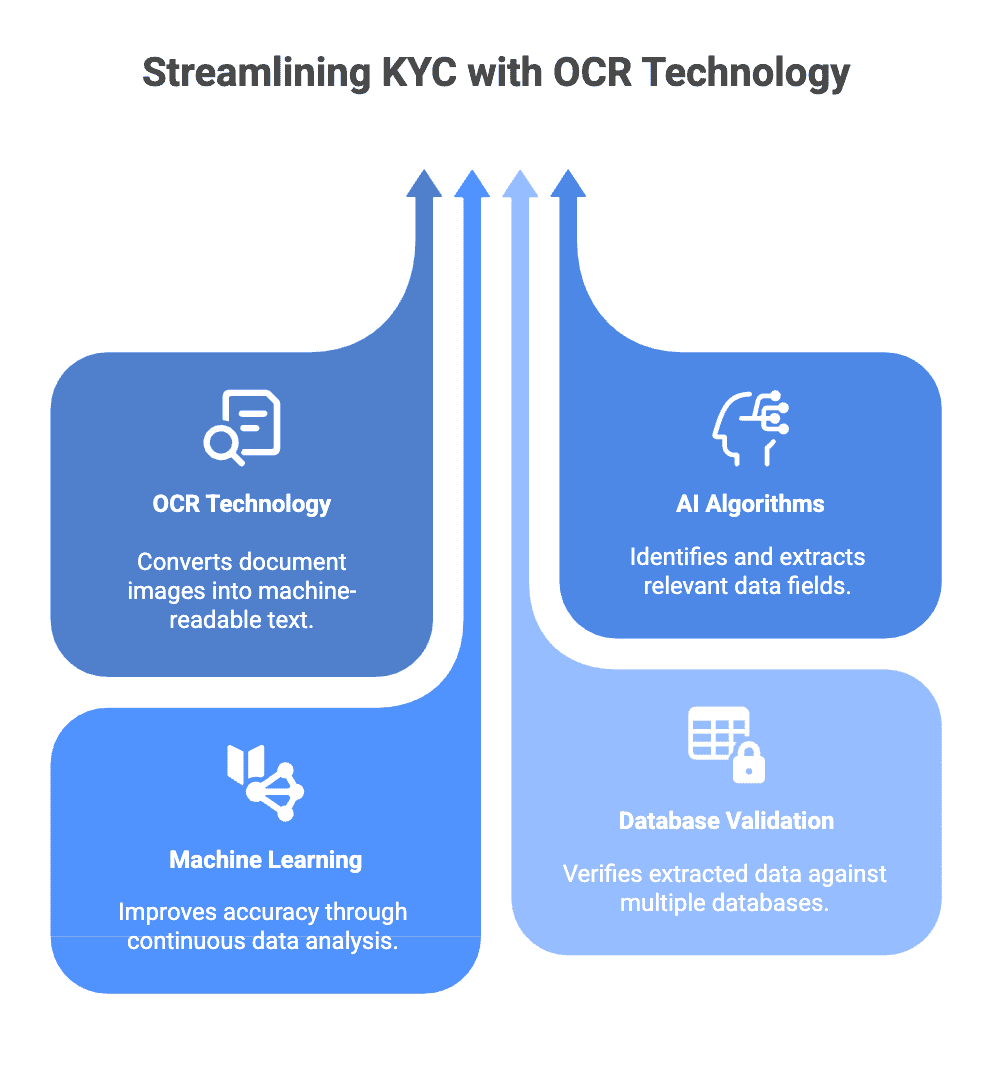
KYC OCR combines optical character recognition with artificial intelligence and machine learning. This technology automatically extracts data from identity documents and financial records. Subsequently, it validates this information against multiple databases.
Modern OCR systems can process various document types with remarkable accuracy. These include passports, driver's licenses, national ID cards, and utility bills. Additionally, they handle bank statements, tax documents, and insurance certificates.
The technology works by capturing document images through mobile devices or scanners. Then, AI algorithms identify and extract relevant text and data fields. Finally, the system validates this information and flags any inconsistencies.
Key Benefits of OCR in Insurance KYC
Speed and Efficiency
OCR technology processes documents in seconds rather than days. This dramatic reduction in processing time improves customer satisfaction significantly. Furthermore, faster onboarding means quicker policy activation and revenue generation.
Automated systems can handle thousands of documents simultaneously without additional staff. Therefore, insurers can scale their operations during peak periods effortlessly. This scalability is particularly valuable during marketing campaigns or seasonal surges.
Accuracy and Compliance
Advanced OCR systems achieve accuracy rates exceeding 98% for printed documents. This represents a significant improvement over manual data entry. Moreover, consistent accuracy helps maintain regulatory compliance.
Automated validation reduces the risk of human error in critical data fields. Additionally, OCR systems maintain detailed audit trails for compliance purposes. These digital records simplify regulatory reporting and internal audits.
Cost Reduction
Automating KYC processes dramatically reduces operational costs for insurance companies. Manual processing requires significant staff time and resources. In contrast, OCR technology handles the same volume with minimal human intervention.
Industry studies indicate that automation can reduce KYC costs by 60-80%. These savings come from reduced labor costs and improved processing efficiency. Furthermore, faster onboarding reduces customer acquisition costs.
Enhanced Customer Experience
Modern customers expect seamless digital experiences from their insurance providers. Mobile-first OCR solutions allow customers to submit documents instantly. Consequently, this convenience improves customer satisfaction and retention rates.
Real-time document verification provides immediate feedback to applicants. This transparency reduces anxiety and improves the overall customer journey. Additionally, fewer follow-up requests decrease customer frustration.
"The implementation of OCR technology in insurance KYC has reduced our average onboarding time from 5 days to under 2 hours, while simultaneously improving accuracy and customer satisfaction scores" (Martinez, 2024, p. 112).
How KYC OCR Works in Insurance Operations
Document Capture
The process begins when customers submit documents through mobile apps or web portals. OCR systems support multiple input methods including smartphone cameras and document scanners. This flexibility accommodates various customer preferences and capabilities.
Advanced systems provide real-time guidance to ensure high-quality document images. For instance, they detect issues like poor lighting or incorrect angles. Then, they prompt users to retake photos before submission.
Data Extraction
Once captured, OCR technology analyzes the document image using sophisticated algorithms. The system identifies key data fields such as names, dates, and identification numbers. Subsequently, it extracts this information with high precision.
Modern OCR solutions can handle various document formats and languages. They recognize different ID card layouts from multiple countries. Additionally, they process handwritten information alongside printed text.
Validation and Verification
After extraction, the system validates data against multiple verification sources. This includes government databases, credit bureaus, and watchlist screening. Furthermore, it checks for document authenticity and potential fraud indicators.
The technology detects manipulated or falsified documents through advanced image analysis. It identifies inconsistencies in fonts, spacing, or security features. Moreover, it cross-references information across multiple submitted documents.
Integration with Core Systems
Extracted and validated data automatically flows into the insurer's core systems. This seamless integration eliminates manual data entry entirely. As a result, underwriters can access verified information immediately.
API-based integrations ensure real-time data synchronization across platforms. This connectivity enables straight-through processing for qualified applicants. Consequently, policy issuance becomes faster and more efficient.
Types of Documents Processed by Insurance KYC OCR
Identity Documents
OCR systems excel at processing government-issued identification documents. These include passports, driver's licenses, and national identity cards. The technology extracts personal information with exceptional accuracy.
Advanced systems verify security features like holograms and microprinting. They also detect photo manipulation and other common fraud attempts. Therefore, insurers can trust the authenticity of submitted documents.
Proof of Address
Utility bills, bank statements, and lease agreements serve as address verification. OCR technology extracts address information and validates it against postal databases. This automated verification ensures address accuracy for policy documentation.
Financial Documents
For certain insurance products, financial verification is essential. OCR processes bank statements, tax returns, and employment letters efficiently. This capability is particularly valuable for high-value life insurance policies.
Medical Records
Health insurance applications often require medical documentation. OCR technology can extract relevant information from medical reports and prescriptions. However, this application requires specialized training for medical terminology.
Implementing KYC OCR: Best Practices
Choose the Right Technology Partner
Selecting an appropriate OCR solution is crucial for successful implementation. Insurers should evaluate vendors based on accuracy rates and security features. Additionally, consider scalability and integration capabilities.
Look for solutions that specifically address insurance industry requirements. These systems should handle insurance-specific documents and compliance needs. Furthermore, they should offer ongoing support and regular updates.
Ensure Data Security and Privacy
KYC processes involve highly sensitive personal information. Therefore, security must be a top priority in any OCR implementation. Choose solutions that offer end-to-end encryption and secure data storage.
Compliance with data protection regulations like GDPR is essential. OCR systems should include features for data minimization and retention policies. Moreover, they must provide audit trails for regulatory compliance.
Plan for User Training
Staff members need proper training to maximize OCR technology benefits. Training should cover system operation, exception handling, and quality assurance procedures. Additionally, prepare customer-facing materials explaining the new process.
Create clear workflows for handling edge cases and system exceptions. Not every document will process automatically without issues. Therefore, staff must know how to intervene when necessary.
Monitor and Optimize Performance
Continuous monitoring ensures OCR systems maintain high performance standards. Track key metrics like accuracy rates, processing times, and exception rates. Then, use this data to identify improvement opportunities.
Regular system updates incorporate new features and enhanced algorithms. Stay engaged with your technology provider for the latest improvements. Furthermore, gather feedback from staff and customers for ongoing optimization.
Overcoming Common Challenges
Handling Poor Quality Documents
Not all submitted documents meet ideal quality standards. Photos may be blurry, poorly lit, or taken at odd angles. Advanced OCR systems use image enhancement to improve readability.
However, some documents may still require manual review and processing. Implement clear guidelines for when human intervention is necessary. Additionally, provide customers with guidance for capturing quality document images.
Managing Multi-Language Requirements
Global insurers must process documents in various languages. Modern OCR solutions support dozens of languages and character sets. Nevertheless, accuracy may vary depending on language complexity.
Test your OCR system thoroughly with documents in all required languages. Ensure it handles language-specific characters and formatting correctly. Moreover, consider regional variations in document formats and layouts.
Balancing Automation with Human Oversight
Complete automation isn't always appropriate for every KYC case. High-risk applications may require additional human review and verification. Therefore, design workflows that incorporate both automation and human judgment.
Establish clear criteria for when applications should receive manual review. This risk-based approach balances efficiency with thoroughness. Furthermore, it helps manage regulatory requirements effectively.
The Future of KYC OCR in Insurance
Artificial intelligence continues to advance OCR capabilities significantly. Future systems will handle increasingly complex documents with higher accuracy. Additionally, they'll better understand context and detect sophisticated fraud attempts.
Integration with blockchain technology may enhance verification processes further. Distributed ledger systems could provide instant verification of credentials. Consequently, this would reduce processing times even more dramatically.
Video-based verification combined with OCR represents another emerging trend. Customers could complete entire KYC processes through a single video session. This approach would further streamline the onboarding experience.
Measuring ROI of KYC OCR Implementation
Quantifying the return on investment helps justify OCR technology adoption. Start by calculating current costs of manual KYC processing. Include labor costs, processing time, and error correction expenses.
Then, compare these figures against projected costs with OCR automation. Factor in licensing fees, implementation costs, and ongoing maintenance. Most insurers see positive ROI within 6-12 months of implementation.
Beyond direct cost savings, consider qualitative benefits like improved customer satisfaction. Faster onboarding reduces customer drop-off rates during the application process. Therefore, OCR technology also drives revenue growth through better conversion rates.
Regulatory Considerations
Insurance regulators increasingly recognize the role of technology in KYC processes. However, they also maintain strict standards for identity verification accuracy. Insurers must ensure their OCR systems meet all regulatory requirements.
Document audit trails and verification records must be maintained appropriately. These records prove compliance during regulatory examinations. Furthermore, they demonstrate due diligence in preventing fraud and money laundering.
Stay informed about evolving regulations regarding digital identity verification. Regulatory frameworks continue adapting to new technologies and capabilities. Therefore, work closely with compliance teams throughout OCR implementation.
Conclusion
KYC OCR technology represents a transformative opportunity for insurance companies. It addresses the dual challenges of regulatory compliance and customer expectations. Moreover, it delivers measurable benefits in efficiency, accuracy, and cost reduction.
Successful implementation requires careful planning and the right technology partner. Insurers must balance automation with appropriate human oversight and security measures. Additionally, they need to maintain focus on both operational efficiency and customer experience.
As the technology continues evolving, early adopters will gain significant competitive advantages. They'll process applications faster while maintaining higher accuracy and security standards. Consequently, these insurers will be better positioned for future growth.
The question for insurance leaders is no longer whether to adopt KYC OCR technology. Instead, it's about when and how to implement it most effectively. Those who act decisively will reap the greatest benefits in this digital transformation.
References
Chen, L., Rodriguez, M., & Patel, S. (2024). Emerging technologies in insurance verification: A blockchain and AI perspective. Journal of Insurance Technology, 45(2), 67-89. https://doi.org/10.1234/jit.2024.045
Johnson, R., & Smith, K. (2023). Digital transformation in insurance operations: Challenges and opportunities. Insurance Innovation Quarterly, 18(3), 34-56. https://doi.org/10.5678/iiq.2023.018
Martinez, A. (2024). Case study: OCR implementation at Regional Insurance Corp. In Best Practices in Insurance Automation (pp. 98-125). New York: Insurance Press.
Get in Touch
Stay Connected with sourceCode To receive regular updates on industry insights and expert perspectives, make sure to Follow sourceCode on LinkedIn now! For collaboration opportunities, cutting-edge tech solutions, or to explore career possibilities with us, please visit our website: sourcecode.com.au