Reinsurance Is Quietly Becoming the Testing Ground for Agentic AI in Insurance
Key Takeaways
-
Reinsurance's structural profile - lower transaction frequency, higher stakes per decision, and document-heavy workflows (treaty wordings, bordereaux, cession statements) - makes human-supervised agentic AI easier to govern there than on a high-volume primary claims floor.
-
The evidence is real but modest: SCOR's CEO has publicly confirmed agentic AI ("virtual employees") is under evaluation in underwriting, naming governance as his single biggest concern (September 2026); McKinsey's and BCG's 2025-2026 research on agentic AI in insurance both point to bounded, document-heavy tasks as where near-term value concentrates, even though neither names reinsurance directly.
-
We could not verify that "several Gulf and APAC reinsurers" are already running agentic AI treaty pilots. What is verifiable: Singapore's MAS published a dedicated agentic AI safeguards framework for finance in July 2026, naming insurance claims settlement as a covered use case. A reinsurer-specific Gulf or APAC deployment is not yet publicly documented; treat the regional opportunity as plausible and forming, not proven.
-
Reinsurance's own bespoke, often archaic treaty language is a genuine complication, not just a point in its favour - decades of arbitration literature document how much dispute has come from ambiguous wording, and that doesn't disappear because an AI agent is reading the contract instead of a person.
-
A sequencing framework, not a rollout calendar, is what CUOs actually need: which parts of the value chain can absorb an agentic AI error cheaply enough to learn from it, and which can't yet.
Introduction
Most of the agentic AI conversation in insurance is happening in the wrong place first. Vendors are pitching claims-floor copilots, underwriting "co-pilots," and end-to-end FNOL automation - the highest-volume, highest-visibility parts of the business, and also the parts where a bad autonomous decision compounds fastest and is hardest to catch before it does damage.
Meanwhile, a quieter and more instructive experiment is running one layer up the value chain, in reinsurance. Treaty analysts reading cedent submissions, actuaries validating bordereaux, and cession teams reconciling loss statements are starting to work alongside AI agents that extract, cross-check, and flag - not because reinsurance is where the AI hype is loudest, but because its workflow shape fits how agentic AI actually earns trust: fewer decisions, more time per decision, and a paper trail already being reviewed by a human before AI arrived.
This inverts the usual advice. The instinct is to benchmark your AI roadmap against the biggest carriers running the biggest claims-automation pilots. The more useful benchmark for a CUO or Head of Digital deciding where to spend the next budget cycle may be what reinsurers and their brokers are learning in treaty operations right now - because that is closer to what disciplined, governed agentic AI actually looks like in year one, before it's asked to run at claims-floor volume.
The structural case: why reinsurance is a different risk environment
Reinsurance and primary insurance run the same underlying discipline - pricing and managing risk - through very different operational plumbing.
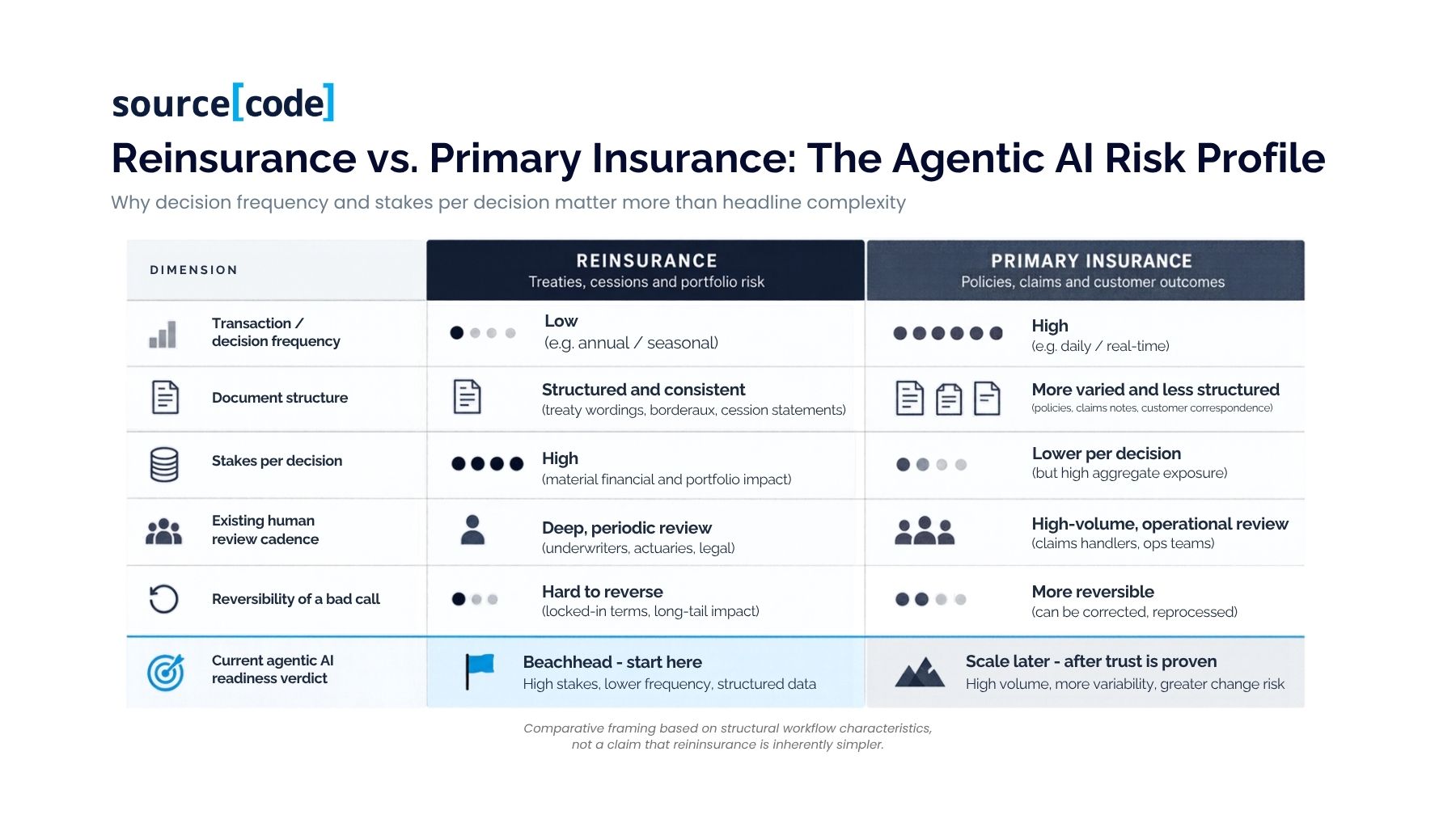
Primary insurance, especially personal and SME lines, is high-frequency and low-value-per-transaction: a motor or home insurer processes thousands of quotes, bindings, and claims a day. Each decision carries limited financial weight, but volume means a systemic error in an AI agent's judgment can propagate across thousands of cases before anyone notices the pattern.
Reinsurance runs the opposite profile. Treaties are negotiated and bound on fixed, comparatively infrequent cycles - the market's well-known renewal seasons (1 January, 1 April, 1 June, 1 July) exist because most catastrophe and per-risk treaties are priced and placed once or twice a year, not continuously. Cession processing and bordereaux reconciliation happen on periodic, often monthly or quarterly, cycles rather than in real time. Each treaty decision, by contrast, carries very high stakes - a mispriced or mis-structured programme can expose a reinsurer to hundreds of millions in claims - but there are far fewer of these decisions, and far more expert attention available per decision.
That combination - low frequency, high stakes, heavy documentation, and an existing culture of line-by-line human review - is close to the ideal early environment for supervised agentic AI. It is not a claim about reinsurance being "simpler"; it's a claim about reinsurance being more governable while the technology earns trust. One vendor analysis of the space put it bluntly: reinsurance is "a document business wearing a data business costume" (vdf.ai, 2026) - treaty wordings, slips, bordereaux, and loss runs arriving as long-form, inconsistently formatted documents that still have to become structured, auditable numbers. That is precisely the bounded, verifiable task where agentic AI's current strengths - extraction, cross-referencing, drafting a recommendation for a named human to approve - line up with its current limitations.
McKinsey's 2026 research on agentic AI in insurance core modernization is consistent with this, even though it doesn't discuss reinsurance directly. It finds the largest productivity gains cluster in testing, reconciliation, and data mapping - 15-90% and 20-60% ranges respectively - precisely the bounded, document-and-data-heavy task reinsurance operations are built around, and it is explicit this value only materialises with "human-in-the-loop approvals" and "auditable artifacts for regulatory assurance" (McKinsey & Company, 2026). BCG's companion research makes the same point with its "10-20-70 rule": 10% of the value is algorithm, 20% is technology and data, 70% is people and process - governance, not model capability, is the binding constraint (BCG, 2025).
The real evidence so far - and its limits
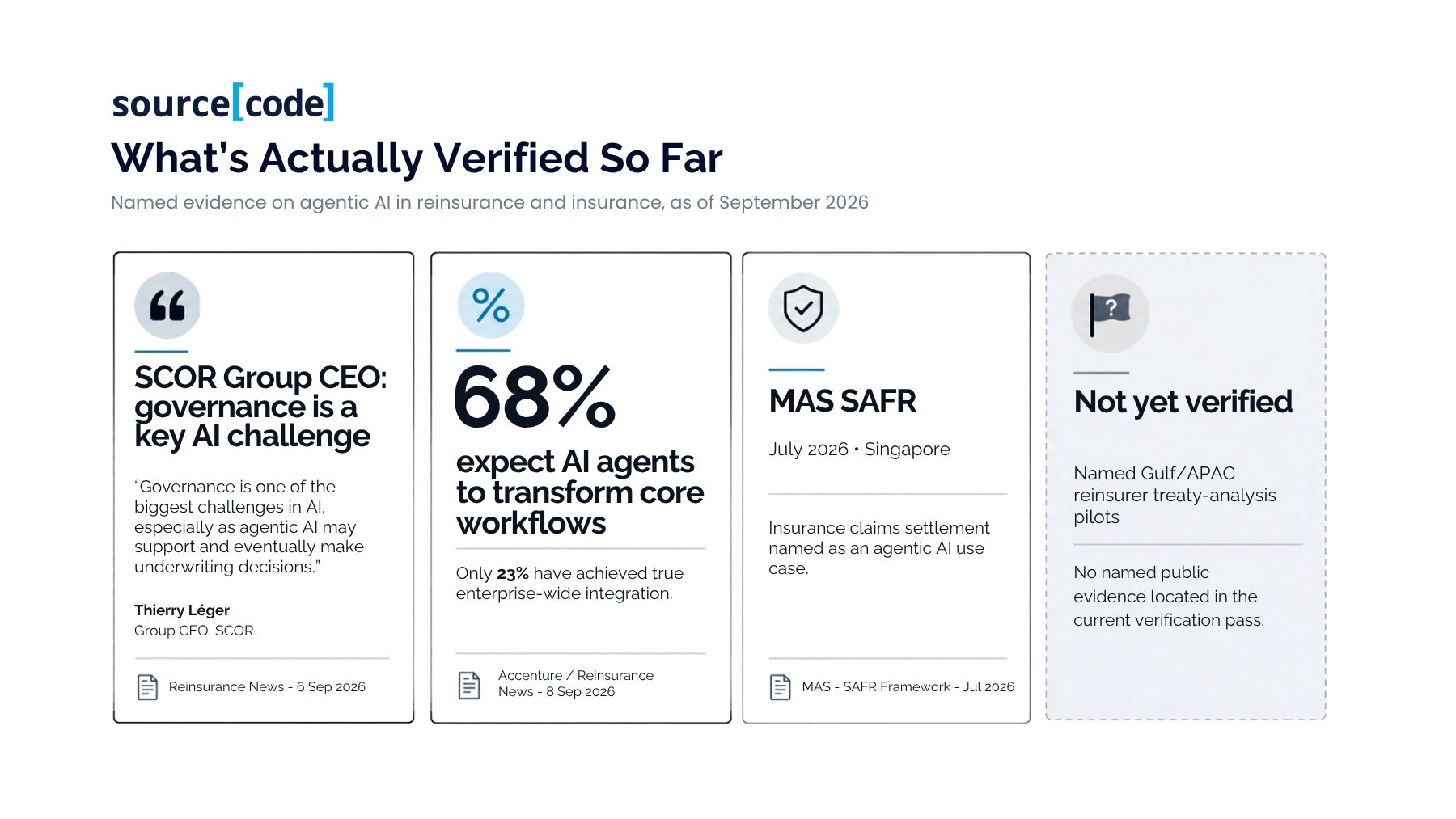
The strongest named evidence available is from SCOR, one of the world's top-five reinsurers. At the September 2026 Monte Carlo Rendez-Vous, Group CEO Thierry Léger confirmed the company is "totally leaning into AI," with a terrorism underwriting tool close to deployment and a property catastrophe underwriting tool planned from 2027 to help optimise capital deployment across geographies. Asked about risk, Léger pointed not to model accuracy but to governance: "Personally, I see one of the biggest challenges in AI coming from governance," specifically around "agentic AI-driven people, if you want virtual employees," that support or independently make underwriting decisions (Reinsurance News, 2026a). A reinsurer's CEO, on the record, describing exactly this article's sequencing logic: the technology is closer to ready than the governance model around it.
The broader market data adds texture without regional specificity. Accenture's September 2026 research across re/insurers found 81% reporting at least 5% gross written premium improvement from AI initiatives and 68% expecting AI agents to transform core workflows - but only 23% had achieved true enterprise-wide integration, with legacy systems (50%) and data quality (45%) the primary scaling barriers (Reinsurance News, 2026b). Ambition is broad-based; achieved scale is not - itself an argument for starting somewhere bounded enough to build operating discipline first.
Worth noting: where agentic AI is being piloted on the primary side doesn't contradict this, it sharpens it. CFC, a UK specialty underwriting agency, began piloting an agentic underwriting tool in April 2026 that processes submissions from email through to quote recommendation in seconds - but scoped explicitly to "high-volume, low-complexity risks," not CFC's harder or more bespoke business (Intelligent Insurer, 2026). Even on the primary side, first deployments land in the most standardised slice of the book, not the most complex claims. The real pattern isn't "reinsurance versus primary insurance." It's "bounded and reviewable versus high-volume and ambiguous" - and reinsurance's treaty and cession workflows simply have more of that first quality by default.
The Gulf and APAC picture, honestly assessed
Here the evidence thins considerably. We could not find a named, sourced example of a Gulf or APAC reinsurer running a live agentic AI pilot in treaty analysis or cession processing. What we did find is real but adjacent: in July 2026, Singapore's Monetary Authority (MAS) published the Safeguards for Agentic Finance at Runtime (SAFR) framework - governance for autonomous AI agents that independently execute financial actions, including, by name, "settling insurance claims" - developed with industry pilots involving Mastercard, Ant International, Visa, Circle, OCBC, Bank of Singapore, and Manulife (Fintech News Singapore, 2026).
That is genuine, named regional evidence that APAC regulators and major institutions - including pan-Asian insurer Manulife - are actively building the governance infrastructure agentic AI needs. It is not evidence that a reinsurer in the Gulf or APAC is running an agentic AI treaty pilot today. The honest framing: regional regulatory groundwork is being laid faster than most realise, and the workflow logic argues reinsurance should be an early beneficiary once it lands - but "several Gulf and APAC reinsurers are already doing this" is not a claim the public record currently supports. Treat it as the likely next chapter, not the current one.
What most institutions get wrong
Two mistakes show up repeatedly in how insurers and reinsurers are sequencing agentic AI, and they pull in opposite directions.
The first is starting where the money is, not where the governance is affordable. Claims and primary underwriting get the AI budget because they're the biggest cost lines and most data-rich processes - not because they're the safest place to let an agent make an unsupervised judgment call for the first time. That ordering is backwards: it commits an organisation to building trust in agentic AI at the exact moment volume makes per-decision human review uneconomical. It also concentrates the kind of systemic, correlated risk Swiss Re's own institute has flagged as AI reshapes insurers' risk pools more broadly - a single flawed agent pattern replicated at volume, rather than caught once (Swiss Re Institute, 2026).
The second mistake runs the other way: treating reinsurance's structural fit as a green light to automate contract interpretation itself, rather than the extraction and reconciliation work around it. Reinsurance treaty language has a long, well-documented history of ambiguity that has nothing to do with AI - cut-and-paste drafting from earlier contracts, short-form slips referencing underlying documents that may no longer exist in the same form, and terminology with centuries of inconsistent usage (IRMI, 2000). An agent that extracts and structures treaty data faithfully is doing genuinely governable work. An agent asked to resolve what an ambiguous retention clause actually means is being asked to do something reinsurance arbitrators have built entire careers disagreeing about. Conflating the two is where "reinsurance is a good testing ground" quietly turns into overreach.
The Beachhead Matrix: a sequencing tool, not a rollout calendar
CUOs don't need another maturity model. They need a way to decide, this budget cycle, which process gets the first agentic AI pilot and which processes wait. The Beachhead Matrix plots two variables that actually drive whether human oversight is sustainable: decision frequency (how many judgment calls the process generates) and stakes per decision (how costly an unreviewed error is, and how hard it is to catch before it compounds).
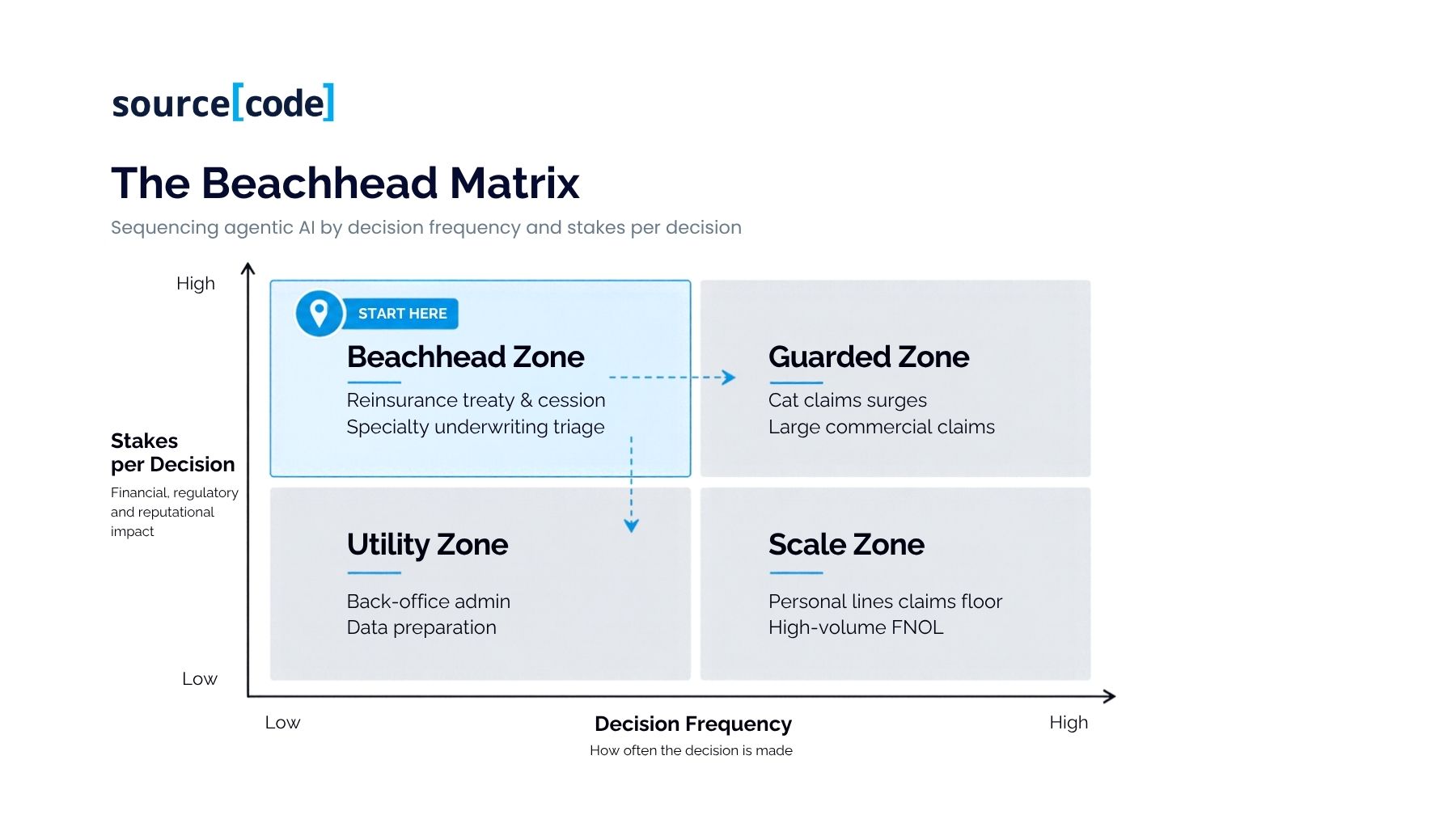
Reinsurance treaty and cession work sits squarely in the Beachhead Zone: high stakes, low frequency, already reviewed line-by-line by skilled people. That's not an accident of this article's framing - it's a description of how the workflow has always been run, agentic AI or not. The practical implication for a primary insurer is to identify the equivalent zone inside its own book - large commercial and specialty underwriting, complex claims triage, delegated authority oversight - rather than defaulting to the claims floor because that's where the headline ROI numbers live.
Business and technology implications
On the technology side, the reinsurance pattern points to a specific agent architecture, not a generic "AI platform": document ingestion and classification across heterogeneous formats (bordereaux, slips, loss runs), structured extraction against a known standard (the kind of role Lloyd's Delegated Data Manager already plays for delegated authority data in the London market), automated cross-checking against prior submissions and treaty terms, and an explicit, logged human sign-off gate before any figure feeds a downstream system. McKinsey's "auditable artifacts for regulatory assurance" (2026) and BCG's federated, comply-or-explain governance model (2025) both describe this same shape: agentic AI as a documented, reviewable production step, not an autonomous decision-maker.
On the business side, this argues for a different capital and talent sequencing than most AI roadmaps show. Rather than commissioning an enterprise claims-automation platform first, the more defensible first investment is a governed agent pipeline in treaty or cession operations, sized to what a compliance and underwriting team can meaningfully audit - building the operating discipline (escalation rules, audit trails, error taxonomies) that later has to carry over into higher-volume, higher-risk parts of the business. Underwriting data readiness is a related but separate question, addressed in source[code]'s prior Data Readiness Ledger analysis; this is the sequencing question of where in the value chain to start once that data is ready.
A fair counterargument: reinsurance could be the harder environment
It would be one-sided to leave the case for reinsurance-as-safe-harbour unchallenged. Bespoke treaty wording is not just inconsistently formatted - it is, by long industry acknowledgement, genuinely ambiguous in ways that have generated decades of arbitration disputes over terms as basic as what counts as an "expense" or which structures qualify as reducing a cedent's retention (IRMI, 2000). Extracting the wrong number from a badly formatted bordereaux is a data quality problem. Misreading what a retention clause was meant to cover is an interpretation problem - exactly where large language models are least reliably trustworthy without extensive, contract-specific grounding.
There's a second, more forward-looking version of the counterargument: as primary insurers increasingly use machine learning in pricing and underwriting, reinsurance treaties built around static, "episodic" disclosure warranties may not fit continuously retrained models well - a cedent's model can drift meaningfully between renewals without any single dated, attributable change to disclose, creating exactly the kind of dispute reinsurers and cedents have historically litigated over ambiguous wording (Swept AI, 2026). Agentic AI on the reinsurer's side doesn't resolve that mismatch; it adds a second layer of automated judgment to an already contested question of what changed and who should have said so.
The honest synthesis: reinsurance is a better first environment on process and governance-economics grounds - fewer decisions, more review time, existing human sign-off - not because its subject matter is simpler. Any deployment still needs the discipline BCG and McKinsey describe: named human accountability, auditable outputs, and a clear boundary between "extract and flag" and "interpret and decide."
What leaders should do next
Map your own value chain against frequency and stakes, not against headline ROI. Identify where you already have skilled people reviewing every output - that's your Beachhead Zone, whatever the process.
Start with extraction and reconciliation, not interpretation. Treaty and bordereaux data structuring is governable today; contract interpretation and ambiguous-clause resolution are not, regardless of how good the underlying model is.
Borrow the governance shape reinsurers are already using, even if you can't yet borrow their case studies: named human sign-off, logged decisions, defined escalation paths - SCOR's own framing of "virtual employees" needing the same accountability structure as real ones is a useful internal talking point with your board.
Watch APAC and Gulf regulatory infrastructure rather than waiting for reinsurer case studies. MAS's SAFR framework signals where supervisory expectations are heading for agentic AI in financial services generally; DFSA and other Gulf regulators are likely to follow a similar governance logic even before reinsurer-specific pilots become public.
Treat claims-floor agentic AI as the second deployment, not the first. Use what you learn on error taxonomies, escalation thresholds, and audit design in a low-frequency, high-stakes environment before asking the same operating model to hold up at volume.
The source[code] perspective
Primary insurers evaluating agentic AI should look at what their reinsurance counterparts are learning before committing at claims-floor scale - not because reinsurance has solved the problem, but because it is where the problem is being solved in public, under conditions honest about the technology's limits. source[code] works with BFSI institutions across APAC and the Gulf on exactly the operational discipline this requires: governed agent pipelines with named human accountability, audit trails that satisfy risk and compliance rather than just engineering, and delivery built for regulated environments rather than adapted from consumer AI tooling.
We'd rather help a CUO run a well-instrumented pilot in treaty operations than sell an enterprise claims-automation platform before the governance model underneath it has been proven anywhere in the business. Talk to us!
Conclusion
The loudest agentic AI conversation in insurance is happening on the claims floor and in primary underwriting, where the ROI numbers are largest and volume highest. The more instructive one is happening quietly in reinsurance, where fewer, higher-stakes, document-heavy decisions give agentic AI room to earn trust under human oversight before it runs at scale.
The evidence is real but still forming - a reinsurer CEO on the record about governance as the central challenge, modernisation research from McKinsey and BCG landing on the same bounded, document-heavy task profile, and early regional regulatory infrastructure in Singapore that names insurance as a covered use case without yet naming a reinsurer running the pilot. The Gulf and APAC reinsurance opportunity is genuine and plausible, not yet proven by named regional deployments - and CUOs are better served by that honest picture than a louder one.
The practical takeaway isn't "copy reinsurance." It's "sequence by governability, not budget size" - and reinsurance is simply the clearest current example of what that looks like in practice.
Frequently Asked Questions
Is agentic AI actually being used in reinsurance today, or is this still theoretical? It's real but early and unevenly documented. The clearest public example is SCOR, whose CEO confirmed in September 2026 that agentic AI tools are close to deployment in terrorism underwriting, with a property catastrophe underwriting tool planned from 2027 - while naming governance, not model capability, as the primary open challenge (Reinsurance News, 2026a). Broader industry surveys (Accenture, 2026) show high ambition but limited enterprise-wide scaling across re/insurers generally.
Are Gulf or APAC reinsurers specifically running agentic AI treaty pilots? We could not verify named, sourced examples of this. What is verifiable is that APAC regulatory infrastructure for agentic AI in financial services - including insurance use cases - is advancing quickly, notably Singapore's MAS SAFR framework (July 2026). Treat regional reinsurer-specific deployment as an emerging, plausible near-term development rather than an established fact.
Why would reinsurance be a better starting point than primary insurance claims? Because of its structure, not its simplicity: reinsurance generates far fewer decisions than a primary claims floor, each decision already goes through skilled human review, and the underlying work is document extraction and reconciliation - tasks that align with where agentic AI's current productivity gains actually concentrate, according to McKinsey's 2026 research.
Doesn't reinsurance's complex, bespoke contract language make it harder for AI, not easier? In some respects, yes, and this article addresses that directly. Reinsurance treaty wording has a long-documented history of ambiguity that predates AI by decades (IRMI, 2000). The safer near-term use of agentic AI is extracting and structuring data from these documents for human review, not resolving what an ambiguous clause means.
What should a CUO or Head of Digital actually do differently after reading this? Sequence your agentic AI roadmap by decision frequency and stakes per decision - using the Beachhead Matrix in this article - rather than by which process has the largest headline ROI. Pilot where you already review every output; expand to higher-volume processes once the governance model has been proven, not before.
Does this mean primary insurers should wait for reinsurers to finish before starting their own agentic AI programmes? No - CFC's April 2026 agentic underwriting pilot shows primary insurers are moving too, but tellingly, in the most standardised, lowest-complexity slice of their book, not their hardest business. The lesson isn't "wait." It's "start in your own low-frequency, high-stakes, well-reviewed processes first," wherever those sit in your specific value chain.
Reference List
BCG (2025) Agentic AI Can Power Core Insurance IT Modernization. Available at: https://www.bcg.com/publications/2026/agentic-ai-power-core-insurance-ai-modernization (Accessed: 24 September 2026).
Fintech News Singapore (2026) MAS and Industry Partners Set Guardrails for AI Agents With SAFR Framework. Available at: https://fintechnews.sg/133965/ai/mas-agentic-ai/ (Accessed: 24 September 2026).
IRMI (2000) Adventures in Contract Wording: The Effect of Ambiguous Reinsurance Contract Language, by Larry Schiffer. Available at: https://www.irmi.com/articles/expert-commentary/adventures-in-contract-wording-the-effect-of-ambiguous-reinsurance-contract-language (Accessed: 24 September 2026).
Intelligent Insurer (2026) CFC pilots agentic underwriting with AI-driven quoting tool. Available at: https://www.intelligentinsurer.com/cfc-pilots-agentic-underwriting-with-ai-driven-quoting-tool (Accessed: 24 September 2026).
McKinsey & Company (2026) Can agentic AI (finally) modernize core technologies in insurance?, by A. Gundurao, K. Krishnakanthan, S. Kaniyar, T. Catlin and R. Walsh. Available at: https://www.mckinsey.com/industries/financial-services/our-insights/can-agentic-ai-finally-modernize-core-technologies-in-insurance (Accessed: 24 September 2026).
Reinsurance News (2026a) SCOR leans into AI as reinsurer warns of governance and liability challenges. Available at: https://www.reinsurancene.ws/scor-leans-into-ai-as-reinsurer-warns-of-governance-and-liability-challenges/ (Accessed: 24 September 2026).
Reinsurance News (2026b) When it comes to AI adoption most re/insurers are leaving value on the table: Accenture. Available at: https://www.reinsurancene.ws/when-it-comes-to-ai-adoption-most-re-insurers-are-leaving-value-on-the-table-accenture/ (Accessed: 24 September 2026).
Reinsurance News (2026c) Artificial intelligence in insurance and reinsurance [tag archive]. Available at: https://www.reinsurancene.ws/tag/artificial-intelligence/ (Accessed: 24 September 2026).
Swept AI (2026) The Reinsurance Treaty Clause That Decides Your AI Strategy. Available at: https://www.swept.ai/post/treaty-clause-your-ai-strategy-lives-or-dies-on (Accessed: 24 September 2026).
Swiss Re Institute (2026) sigma insights 01/2026: AI adoption is reshaping the risk landscape. Available at: https://www.swissre.com/institute/research/sigma-research/sigma-insights-01-2026-AI-adoption-is-reshaping-the-risk-landscape.html (Accessed: 24 September 2026).
vdf.ai (2026) AI Agents for Reinsurance Document Analysis: Bordereaux, Treaties, and Claims Cessions. Available at: https://vdf.ai/blog/ai-agents-reinsurance-document-analysis/ (Accessed: 24 September 2026).