Embedded Insurance Is Growing Faster Than the Core Systems Behind It
Key Takeaways
-
Independent market research firms disagree sharply on the size of the embedded insurance market, but they agree on the shape of the curve: 29-30% compound annual growth globally, with Asia-Pacific growing faster than any other region.
-
That growth is built on an assumption most core policy administration systems don't yet meet: instant, API-native policy issuance and event-driven claims triggers, not nightly batch files and manual endorsements.
-
Roland Berger's analysis of core insurance system transformation programmes found that around half fail to hit time or budget targets, and many core systems still cannot provide the real-time data access embedded partnerships depend on.
-
A genuine counterargument exists: insurance-as-a-service platforms and API middleware have let carriers run embedded programmes on ageing cores for years - but that workaround has limits, and it shifts risk rather than removing it.
-
Distribution partnerships are typically diligenced commercially and legally before they're diligenced technically. Testing core-system API readiness against a defined standard, before signing, is the cheaper mistake to make.
Introduction
Embedded insurance is one of the few genuinely fast-growing distribution models in a financial services industry not known for genuine fast growth. Every serious market forecast - however much the underlying numbers diverge - points to sustained global growth above 29% a year through the early 2030s, with Asia-Pacific out in front (Mordor Intelligence, 2026; Straits Research, 2026). Boards have noticed. Digital and innovation leaders across the region are under pressure to find a distribution partner, sign a deal, and show a slide with an embedded revenue line on it.
The thesis embedded in most of those growth forecasts is rarely stated out loud: it assumes the carrier side of the partnership can issue a bindable policy in real time, expose that policy's status to a partner platform via API, and trigger a claim the moment a defined event occurs - a flight delay, a device failure, a shipment loss. Most core policy administration systems in the region were not built to do any of that. They were built to support an agent or a call centre, running on batch cycles measured in hours, not milliseconds. The gap between what the growth story assumes and what the infrastructure can deliver is not a technicality. It is the actual risk in the deal.
The Growth Is Real And The Numbers Disagree On Almost Everything Except Direction
Two of the more frequently cited embedded insurance market forecasts - Mordor Intelligence and Straits Research - illustrate both the opportunity and a genuine measurement problem in this category. Mordor Intelligence sizes the global embedded insurance market at USD 18.09 billion in 2026, growing to USD 68.12 billion by 2031, a 30.37% CAGR, with online and API-first placement already holding 76.38% of distribution revenue in 2025 (Mordor Intelligence, 2026). Straits Research sizes the same category at USD 145.59 billion in 2026, rising to USD 1,137.43 billion by 2034 - a 29.3% CAGR off a base roughly eight times larger (Straits Research, 2026).
Those figures are not reconcilable without knowing exactly what each firm counts as "embedded" premium, and neither publishes a methodology detailed enough to fully explain an 8x gap in base size. That divergence is itself a useful data point for a technology leader: this is still a category without a stable, agreed definition of what counts as embedded distribution, let alone a mature measurement standard for it. Treat any single embedded insurance market-size figure with appropriate scepticism - but don't let the disagreement obscure the one thing both firms, and McKinsey, agree on: the growth rate is real, it is compounding in the high twenties to low thirties percent, and Asia-Pacific is the fastest-growing region in both datasets - 19.37% CAGR through 2031 per Mordor Intelligence, 31.2% per Straits Research, against a global average in the high twenties.
McKinsey's regional analysis adds the demand-side reason why: embedded insurance in Asia is projected to reach USD 270 billion in gross written premium by 2030, with roughly two-thirds of that growth coming from a structural shift away from traditional agent and broker channels rather than from new-to-insurance demand alone (McKinsey & Company, 2023). The same analysis puts the region's mortality protection gap at USD 83 trillion and notes that life insurance penetration across most Asian markets runs at roughly 2.5 times below the US level, non-life at roughly seven times below - with 95% of consumers now digitally active and digitally engaged consumers 37% more likely to buy non-life cover online. The demand case for embedded distribution in APAC is unusually strong. The question this article is concerned with is whether the supply side - the core systems sitting behind that distribution - can actually deliver it.
The infrastructure question isn't unique to Asia-Pacific, which is worth noting for context. Deloitte's US-focused analysis models a scenario in which just 20% of the personal auto insurance market shifting to embedded distribution would divert at least USD 50 billion in premium away from traditional channels, against a global embedded insurance opportunity it estimates could reach as high as USD 700 billion by 2030 (Deloitte Insights, 2023). Wherever the growth happens, the assumption baked into the number is the same one this article is testing: that the carrier side can actually issue, service and pay claims on that volume in real time.
What An Embedded Partnership Actually Asks Of A Core System
"Embedded insurance" is a distribution label, but it is an infrastructure commitment. When a digital platform - a marketplace, a lender, a telco, an OEM - agrees to sell insurance inside its own checkout or app flow, it is not agreeing to send the carrier leads. It is agreeing to a service-level contract, usually written into commercial terms, that the carrier's systems will:
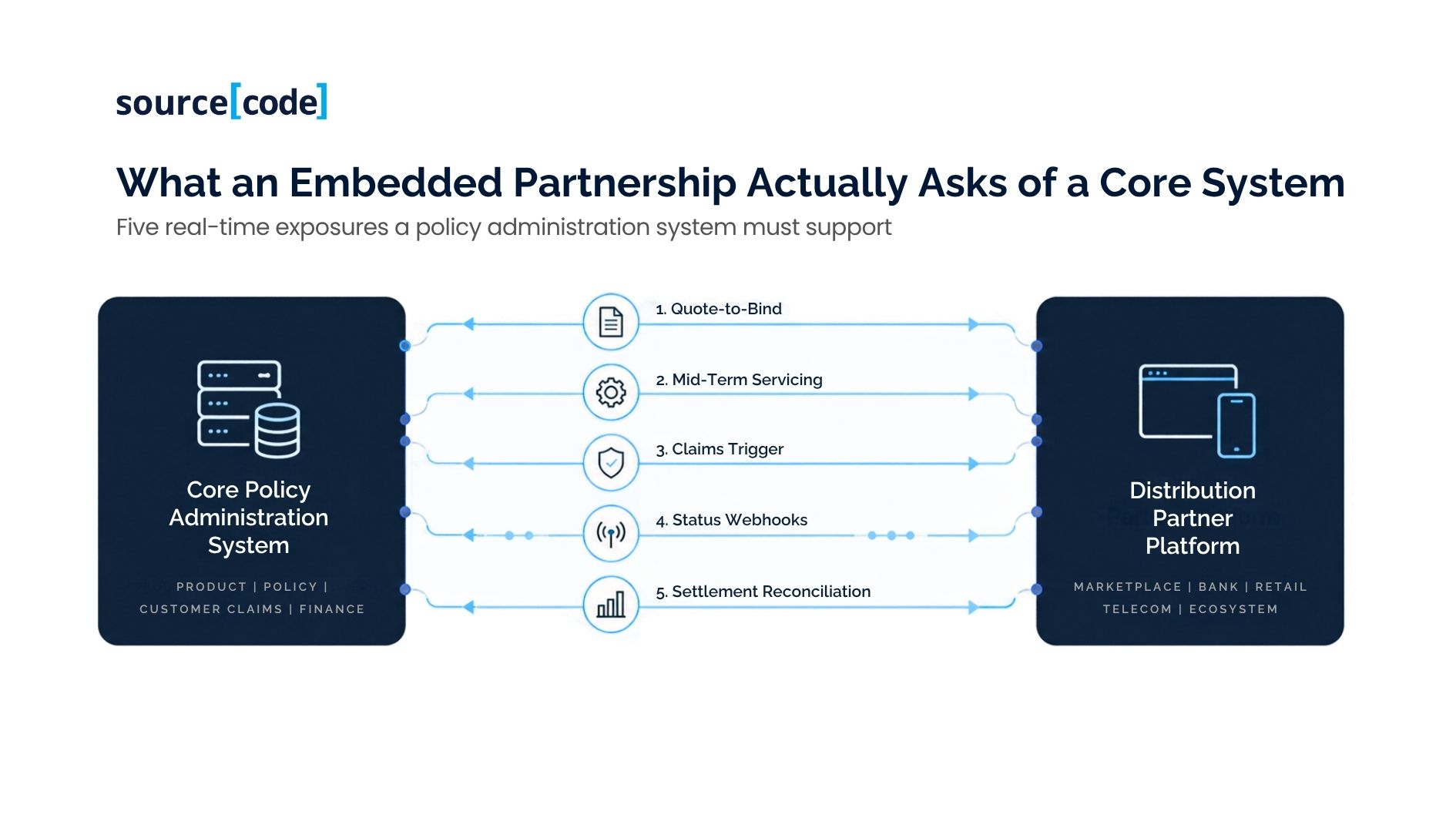
- Quote and bind in real time. A customer completing a purchase expects a bindable policy in the same flow, in seconds - not a reference number and a follow-up email.
- Accept and process mid-term changes via API. Cancellations, limit changes, and endorsements need to flow without a service-desk ticket, because the partner's customer never sees the carrier directly.
- Expose policy and claims status as events. The partner platform needs to know, in near real time, that a policy has bound, lapsed, or that a claim has been lodged or paid - typically via webhooks or an event stream, not a batch file the partner has to poll for.
- Trigger and, where the product allows, settle claims automatically. Parametric and near-parametric embedded products (flight delay, weather, device protection) are commercially attractive precisely because the claims trigger is automatic. That automation lives or dies on the core system's ability to consume a third-party data event and act on it without manual adjudication.
- Reconcile commission and premium data automatically. Multi-party embedded arrangements - carrier, platform, sometimes an MGA or reinsurer in between - need settlement data that reconciles without a monthly manual bordereau.
None of this is exotic in isolation. What makes it hard is that most core policy administration platforms in APAC were architected around a single distribution assumption - an intermediary keying data into the system - and everything downstream, from underwriting rules to document generation to reinsurance bordereaux, was built around that assumption running on a daily or nightly cycle.
Where The Growth Story Quietly Assumes A Capability Most Cores Don't Have
This is the part of the embedded insurance conversation that gets skipped in most strategy decks, because it isn't a distribution problem, it's an infrastructure one, and infrastructure problems don't fit neatly into a partnerships roadmap.
Roland Berger's analysis of core insurance system (CIS) transformation programmes is blunt about the state of the underlying technology: many core systems "were designed for an era of stable, paper-driven operations," and continue to "constrain real-time risk scoring and advanced analytics" - the same limitation that constrains real-time policy issuance and claims triggering (Roland Berger, 2026). The same analysis quantifies what fixing this actually costs: full core transformation programmes typically run from EUR 20 million to more than EUR 100 million over two to five years, and around half of them fail to hit their original time or budget targets - with underestimated data migration complexity and unclear programme ownership as the most common causes (Roland Berger, 2026).
That is the number that belongs next to every embedded distribution pitch: a two-to-five-year, multi-million-euro core replacement programme, with roughly a coin-flip chance of running late or over budget, sitting underneath a distribution model that gets signed off on a much shorter commercial timeline. Digital and innovation leaders are being asked to commit to real-time service levels on a timeline measured in quarters, against infrastructure that - on the industry's own evidence - takes years to properly modernise and fails to plan half the time it's attempted.
The contrarian point isn't that embedded insurance is overhyped. The growth is real, and APAC's underinsurance gap makes the demand case for embedded distribution genuinely strong. The contrarian point is narrower and more useful: most embedded partnership decisions are being diligenced as distribution and commercial decisions, when the binding constraint is actually architectural. A partnership term sheet with API-based SLAs is a technology commitment wearing a business-development document's clothing.
The Exposure Line: a decision tool for testing readiness before you sign
Most technology due diligence on a distribution deal stops at "do we have an API layer?" - a question every vendor and every core system can answer yes to, because almost any system can expose some API, somewhere, for something. That question is not specific enough to protect the business signing the SLA. The useful question is narrower: which of the specific capabilities this partnership will contractually require are actually real-time and API-native today, versus batch, manual, or aspirational on a roadmap?
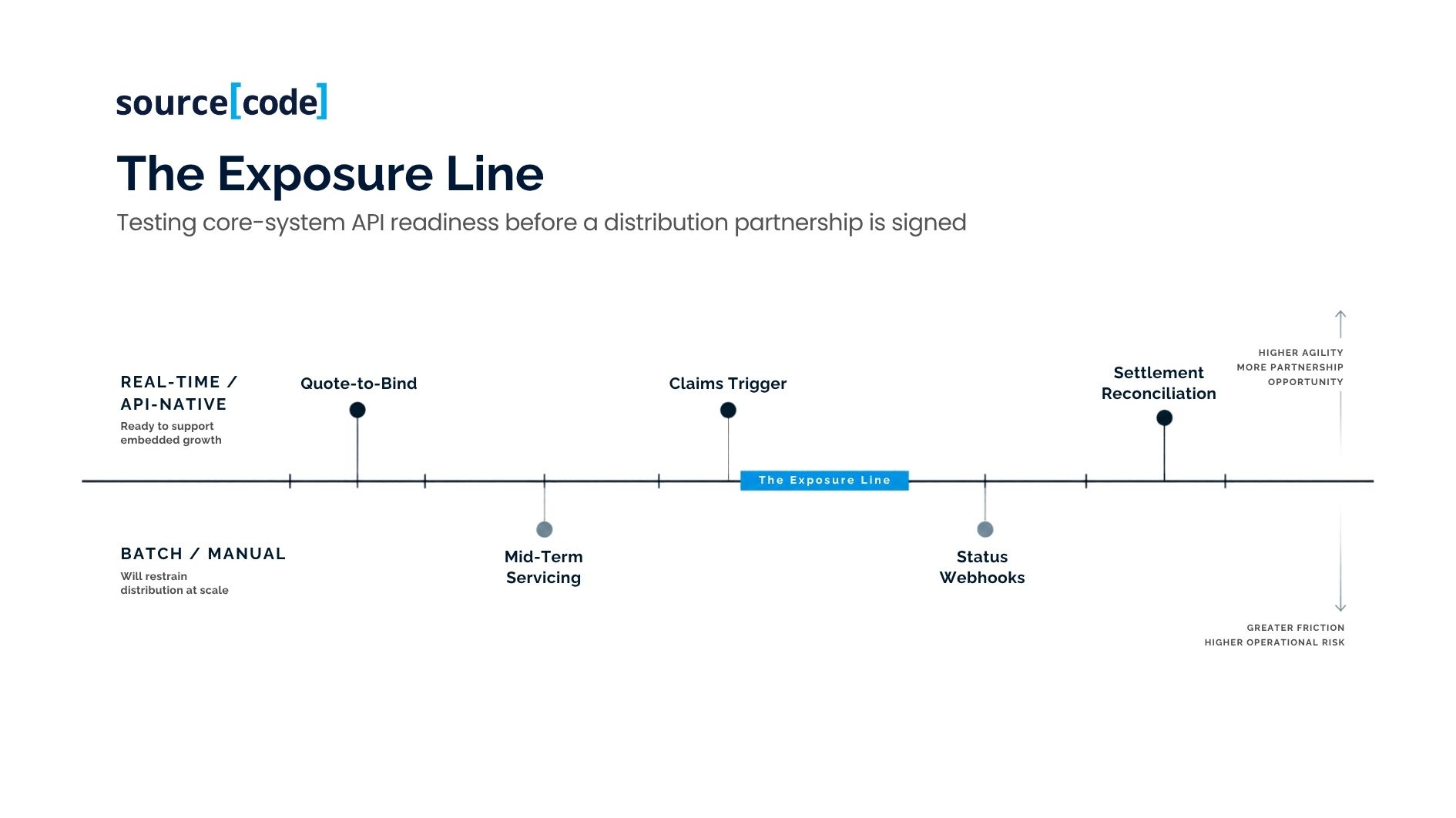
The Exposure Line is a five-dimension test source[code] uses with clients to answer that question before a distribution partnership is signed, not after the first service-level breach. For each dimension, the core system sits either above the line - real-time, API-native, tested under partner-representative load - or below the line - batch, manual, or manual-with-a-workaround.
1. Quote-to-bind latency. Can the system issue a bindable policy, with a policy number and documentation, in seconds via API - or does binding still require a batch cycle or underwriter touch?
2. Mid-term servicing exposure. Can endorsements, limit changes and cancellations be processed through the same API, or do they fall back to a service ticket the partner's customer never sees resolved?
3. Claims trigger and FNOL exposure. Can a claim be initiated and, where the product design calls for it, validated automatically against an external data event - rather than requiring a phone call to a call centre the embedded customer doesn't know exists?
4. Event and status webhooks. Does the core system push policy and claims status changes to the partner platform as they happen, or does the partner have to poll, or wait for a file?
5. Settlement and reconciliation exposure. Does premium, commission and claims data reconcile automatically between carrier, partner and any intermediary in the chain, or does it depend on a monthly manual bordereau that becomes the operational bottleneck once transaction volume scales?
A system that sits below the line on even one or two of these dimensions doesn't necessarily rule out an embedded partnership - but it does mean the gap needs to be named, costed and either remediated or explicitly fronted by middleware before the SLA is signed, not discovered by the partner's engineering team three months into integration testing.
What This Actually Changes: Build, Partner, or Front
Once the Exposure Line is applied honestly, the decision in front of most CDOs and Heads of Digital is not "should we do embedded insurance" - the demand case in APAC is strong enough that the answer to that is usually yes. The decision is which of three paths gets the core system's actual API-readiness to match the commitment being made:
- Modernise the core capability that sits below the line, where the gap is narrow enough (one or two dimensions) to be worth remediating with a defined, time-boxed programme rather than a multi-year full core replacement.
- Front the gap with a dedicated integration or insurance-as-a-service layer, deliberately, with clear ownership of where the middleware's responsibility ends and the core system's begins - rather than accumulating point-to-point integrations by accident, deal by deal.
- Sequence the distribution ambition to what the core can actually support today, launching a narrower embedded product where the core is genuinely above the line, while the remediation or modernisation work for the rest runs in parallel.
All three are legitimate. What isn't legitimate, from a governance standpoint, is signing a real-time SLA against a system that hasn't been tested against these five dimensions at all.
The Fair Counterargument: Middleware Has Worked, and Will Keep Working - Up To a Point
It would be dishonest to present core-system limitations as a hard blocker to embedded insurance, because the market evidence doesn't support that. Insurance-as-a-service platforms exist precisely because carriers can - and routinely do - run embedded programmes without touching their core system. As bolttech's own product commentary puts it, APIs let insurers "continue to use and access legacy systems, but in a way that provides the simplicity of working with a single system," giving carriers "the best of both worlds" (bolttech, 2019). A specialist API layer sitting in front of a legacy core, handling real-time quote-bind logic and event webhooks while writing back to the core asynchronously, is a proven and often sensible pattern - particularly for a first embedded product, or a lower-complexity line like device or travel protection.
The honest caveat is that this pattern manages the symptom, not the underlying constraint, and it doesn't remove risk so much as relocate it. Every capability the middleware fronts but the core can't natively support becomes a reconciliation problem, a latency risk under peak load, or a single point of failure the carrier doesn't fully control if the middleware vendor's roadmap diverges from the carrier's. It works well for claims lines where "real time" genuinely means "same day," and for lower-volume, lower-complexity products. It becomes materially riskier for high-volume, parametric, or claims-trigger-automated products, where the gap between what the middleware promises the partner and what the core can actually deliver under load is exactly where service-level breaches happen. The right conclusion isn't "avoid middleware" - it's "know precisely which of the five Exposure Line dimensions the middleware is genuinely solving, versus papering over."
What Leaders Should Do Before The Next Partnership Conversation
- Run the Exposure Line test on your core system before you're in a partner's due-diligence process, not during it. Findings owned internally are a remediation plan; findings surfaced by a partner's integration team are a credibility problem.
- Separate the commercial timeline from the technical one explicitly. If procurement or the partnerships team is working to a quarter, and the Exposure Line shows a below-the-line gap that needs a genuine remediation programme, say so in the room where the deal terms get set - not after signature.
- Decide deliberately, per dimension, whether to modernise, front with middleware, or sequence - rather than defaulting to whichever the last vendor conversation happened to cover.
- Put the Exposure Line result in the SLA negotiation, not just the engineering backlog. A partner asking for sub-second bind times and same-day claims triggers is asking a technology question; answer it as one, with evidence, not with a general assurance that "we have APIs."
The source[code] Perspective
We work with insurers and insurtechs across APAC and the Gulf on exactly this kind of core-and-integration work, and the pattern above is consistent: the partnership conversation moves faster than the systems conversation, because the partnership conversation is more fun to have. Nobody signs off a distribution deal because the claims-trigger webhook was tested under representative load; they sign it off because the commercial terms look good and the platform partner is credible.
The uncomfortable middle ground worth naming honestly: full core replacement is usually the wrong first answer for an embedded insurance ambition, not because the core doesn't need it eventually, but because a two-to-five-year, multi-million-dollar transformation programme is the wrong instrument for a distribution decision that needs to move in a quarter or two. The right first instrument is a precise, dimension-by-dimension answer to what the core can expose today - which is a smaller, faster, cheaper piece of work than either "replace the core" or "assume the APIs are fine because the vendor's brochure says API-first."
We'd rather have that conversation with a client before a term sheet is signed than help debug a claims-trigger latency problem with a distribution partner already live and unhappy. Talk to us!
Conclusion
The embedded insurance growth numbers, however inconsistent between research firms, point in the same direction: this is a real, compounding, APAC-led shift in how insurance gets distributed, and the underinsurance gap behind it is large enough that the strategic case for participating is not seriously in question. What is in question, and rarely tested with the same rigour as the commercial case, is whether the core policy administration system behind the deal can actually deliver what the partnership's service-level terms will assume it can - in real time, via API, under partner-representative volume.
That is a testable question with a specific, five-dimension answer, and it is far cheaper to test before the signature than after the first missed SLA.
Frequently Asked Questions
What is embedded insurance API infrastructure? It is the set of real-time, machine-to-machine interfaces - quote-and-bind, mid-term servicing, claims triggers, status webhooks, and settlement reconciliation - that a core policy administration system must expose so a distribution partner (a marketplace, lender, telco or OEM) can sell and service insurance inside its own digital experience without manual handoffs.
Why is embedded insurance growing faster in Asia-Pacific than other regions? Market research firms put APAC's embedded insurance CAGR at roughly 19-31% through the early 2030s, ahead of every other region in the same datasets (Mordor Intelligence, 2026; Straits Research, 2026). McKinsey attributes this largely to a structural underinsurance gap - life insurance penetration roughly 2.5 times below the US, non-life roughly seven times below - combined with very high digital engagement among consumers (McKinsey & Company, 2023).
Can embedded insurance work without replacing a legacy core policy administration system? Yes, in many cases. Insurance-as-a-service and API middleware platforms let carriers front real-time quote-bind and event capability in front of an older core system, which is a proven pattern, particularly for lower-complexity products. The trade-off is that unresolved core-level gaps - such as native real-time claims triggering - become reconciliation risk or latency risk under volume rather than being removed.
What specific APIs does a core system need to support an embedded insurance partnership? At minimum: real-time quote-and-bind, an API for mid-term policy servicing (endorsements, cancellations), a claims initiation and trigger capability, event webhooks that push policy and claims status changes to the partner, and an automated settlement/reconciliation feed for premium and commission data.
How long does it take to modernise a core insurance system for real-time API readiness? Roland Berger's analysis of core insurance system transformation programmes found typical costs of EUR 20 million to more than EUR 100 million over two to five years, with around half of programmes failing to meet original time or budget targets (Roland Berger, 2026). This is why full core replacement is rarely the right first response to a near-term embedded distribution opportunity - targeted remediation or a deliberate middleware layer is usually faster.
What should a CDO or Head of Digital check before signing an embedded distribution partnership? Test the core system against each specific real-time capability the partnership's service-level terms will assume - issuance latency, mid-term servicing, claims triggering, status webhooks and settlement reconciliation - rather than accepting a general "we have APIs" assurance, and decide deliberately whether to modernise, front the gap with middleware, or sequence the product to what the core can support today.
Reference List
Mordor Intelligence (2026) Embedded Insurance Market Size, Growth, Share Report 2026-2031. Available at: https://www.mordorintelligence.com/industry-reports/embedded-insurance-market (Accessed: 16 September 2026).
Straits Research (2026) Embedded Insurance Market Size, Share, Growth, 2034. Available at: https://straitsresearch.com/report/embedded-insurance-market (Accessed: 16 September 2026).
McKinsey & Company (2023) Why Asian insurers are ideally positioned for embedded market gains. Available at: https://www.mckinsey.com/industries/financial-services/our-insights/insurance/why-asian-insurers-are-ideally-positioned-for-embedded-market-gains (Accessed: 16 September 2026).
Deloitte Insights (2023) Embedded insurance is poised for exponential growth. Available at: https://www.deloitte.com/us/en/insights/industry/financial-services/embedded-insurance.html (Accessed: 16 September 2026).
Roland Berger (2026) How insurers can maximize value from core insurance system transformation. Available at: https://www.rolandberger.com/en/Insights/Publications/How-insurers-can-maximize-value-from-core-insurance-system-transformation.html (Accessed: 16 September 2026).
bolttech (2019) How Insurance APIs Help P&C Carriers Improve Customer Service and Workflows. Available at: https://bolttech.io/insights/insurance-apis/ (Accessed: 16 September 2026).