Two Licenses From Thirty-Six Applications: Why Permission Became APAC Fintech's Scarcest Input
Executive Summary
Hong Kong's Stablecoins Ordinance commenced on 1 August 2025. By the closing date of 30 September 2025 the Hong Kong Monetary Authority had received 36 formal applications, following 77 non-binding expressions of interest logged that August. On 10 April 2026 it granted two licenses - to The Hongkong and Shanghai Banking Corporation Limited, and to Anchorpoint Financial Limited, a joint venture of Standard Chartered Bank (Hong Kong), Animoca Brands and HKT. Chief Executive Eddie Yue's accompanying commentary made the intent unambiguous: the regime runs on "same activity, same risks, same regulation", and should further licenses follow, "the overall number will remain very limited" (Hong Kong Monetary Authority, 2026a; 2026b).
That is a 5.6 per cent conversion rate from application to authorization, in the APAC jurisdiction that moved first and moved hardest. It is the most important fintech number in the region this year, and it is not a funding number.
Set it beside the other two inputs. Capital contracted - we set out the regional funding picture in yesterday's analysis and will not restate the figures here. Engineering headcount has flattened and is being relocated rather than grown. India's technology sector added roughly 135,000 net jobs in FY2026 to reach about 5.95 million people, growth of 2.3 per cent (Nasscom, 2026), while global capability centers in India now employ 2.36 million people across 2,117 GCCs generating US$98.4 billion in FY2026 (Zinnov and Nasscom, 2026). The Philippine IT-BPM industry cut its 2028 roadmap from US$59 billion and 2.5 million full-time employees to a range of US$43.3-50.5 billion and 1.85-2.14 million, citing AI adoption and competition from other delivery geographies (IBPAP, reported in BusinessWorld, 2026). Australia's technology workforce fell by 31,000 to around 950,000 in the year to May 2025, a 3.7 per cent contraction while the wider labor market grew (Department of Industry, Science and Resources data, reported in ACS Information Age, 2025). Singapore is the exception that proves the point: information and communications supplied 74.2 per cent of newly created roles and the vacancy-to-unemployed ratio rose from 1.50 to 1.58 between September and December 2025 (Ministry of Manpower data, reported March 2026) - even as DBS, OCBC and UOB reduced combined headcount by about 2,806 roles, or 2.6 per cent, across 2025.
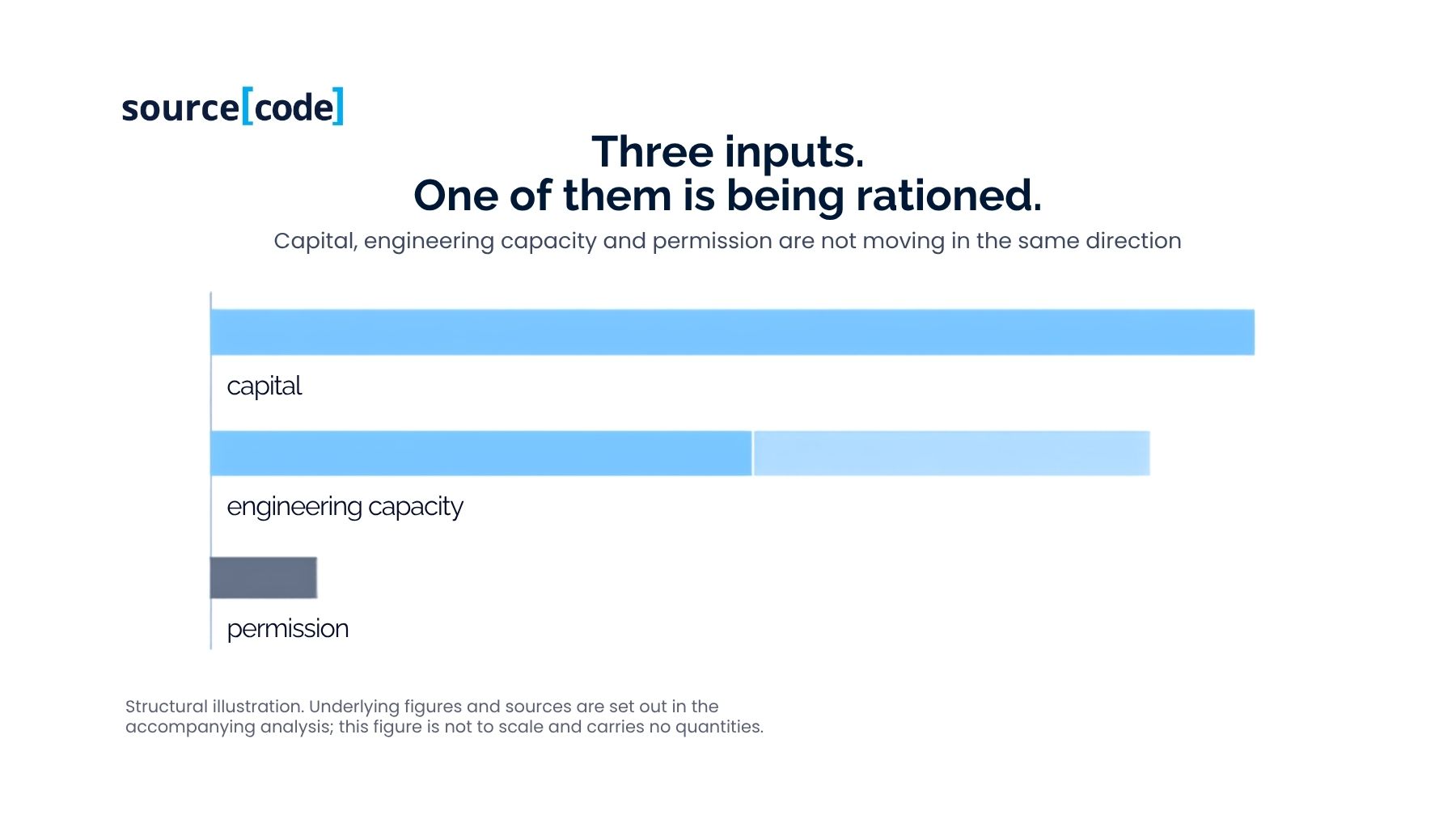
Three inputs, three different directions. Capital is cheaper to raise than it was but scarcer than it was in 2021. Engineers are available but concentrated in captive centers rather than in the market. Permission is now rationed on purpose - and, critically, holding permission is not the same as being able to use one. As at 11 August 2026, neither Hong Kong licensee has a regulated token in public circulation. Anchorpoint's HKDAP missed its Q2 2026 and end-of-July 2026 launch targets and is now targeting an August rollout through licensed exchanges under a B2B2C model; HSBC's HKD stablecoin remains on a second-half 2026 timeline (crypto.news, 2026; CoinDesk, 2026). The HKMA had already been obliged to warn the public about counterfeit tokens claiming association with the licensees (Hong Kong Monetary Authority, 2026c).
The measurable gap that follows is the subject of this piece: the authorization-to-revenue gap - the elapsed calendar time between a supervisor granting an authorization and the first live customer transaction conducted under it. It is the commercial mirror of the compliance clock we described yesterday, and for most APAC fintech boards it is currently unmeasured, unowned and considerably longer than the plan assumes.
Introduction: The Board Slide That Is Now Wrong Twice
Two years ago the constraint in APAC fintech was capital, and every board deck opened with a raise. Last year the constraint was talent, and every deck opened with a hiring plan. Both slides are now describing yesterday's bottleneck.
The Hong Kong numbers are worth sitting with because they are unusually clean. Thirty-six firms - well-capitalized, well-advised, self-selected, most of them able to fund a delivery team without difficulty - applied for the same permission. Thirty-four did not receive it. Of the two that did, neither had converted the permission into a live customer transaction more than two weeks after it was granted.
This is not a criticism of the licensees; a bank commissioning a token under a new statute in its first year should be slow. It is a description of where value now accumulates. In a market where capital is available to many and engineers are available to anyone willing to pay, the differentiating asset is a permission that few can obtain - and the differentiating capability is being able to operate it from the day it lands.
Industry Context: Three Regimes, Three Different Answers
The regional picture is not one regulatory direction but several, and executives routinely conflate them.
Hong Kong legislated. The Stablecoins Ordinance created a purpose-built license class with concrete engineering obligations: reserve assets whose market value must at all times at least equal the par value of stablecoins in circulation, held in high-quality liquid instruments under trust arrangements segregating them from the issuer's own assets; redemption of onboarded customers honored within one business day; a minimum paid-up capital requirement of HK$25 million (with an exemption for authorized institutions incorporated outside Hong Kong); a published whitepaper; regular public disclosure of reserve assets with independent attestation; and compliance with the HKMA's dedicated anti-money-laundering guideline for licensed stablecoin issuers, including chain analytics and holder identity verification (Hong Kong Monetary Authority, 2026a; Davis Polk, 2026; Charltons, 2026).
Singapore did not legislate separately - and this is the most misunderstood fact in the regional conversation. The Monetary Authority of Singapore finalized a detailed stablecoin regulatory framework on 15 August 2023, covering reserve composition, valuation, custody and audit, minimum base capital, disclosure, and redemption at par within five business days, with a defined "MAS-regulated stablecoin" label for issuers that meet every criterion (Monetary Authority of Singapore, 2023). What it did not do, on the evidence available at the time of writing, is enacting a dedicated stablecoin statute creating a distinct license class. Issuance today runs through Payment Services Act licensing for digital payment token services - the route StraitsX took with an in-principle approval in November 2023 (StraitsX, 2023).
Japan has bifurcated, with a registered non-bank issuer already operating and the three megabanks - MUFG, SMBC and Mizuho - working through a joint yen stablecoin council, targeting the fiscal year ending March 2027 and not yet cleared for live issuance. Korea has not resolved the question at all: the Financial Services Commission is consolidating roughly ten pending digital-asset bills into a single framework act, a plan its chairman put to the National Assembly's Political Affairs Committee on 29 July 2026, with the central bank arguing for a bank-led sequence.
Underneath all four sits a fact from the Bank for International Settlements that should reframe every APAC stablecoin business case: of a market capitalized at roughly US$320 billion at end-May 2026, with around US$28 trillion of transaction volume in 2025, approximately 99.4 per cent of fiat-backed stablecoins are pegged to the US dollar (Bank for International Settlements, 2026). The Financial Stability Board's October 2025 thematic review found significant gaps and inconsistencies in how jurisdictions have implemented its recommendations (Financial Stability Board, 2025). A regional strategy premised on local-currency tokens is, today, a strategy premised on a market segment that barely exists.
Current Challenges: Capacity Has Moved, Not Grown
The headcount data tells a consistent story once the aggregates are separated.
Supply has not collapsed; it has relocated into captive centers. India's 2.36 million GCC employees across 2,117 centers, generating US$98.4 billion in FY2026 (Zinnov and Nasscom, 2026), sit inside somebody's balance sheet - increasingly a bank's or an insurer's. That capacity is not in the open market. A Series C fintech in Singapore competing for a senior platform engineer in Bengaluru is not competing with other fintechs; it is competing with a global bank's captive center offering a fifteen-year career.
Third-party delivery capacity is being repriced downward, not upward. IBPAP's decision to cut its 2028 headcount ceiling from 2.5 million to a range topping out at 2.14 million is the clearest signal in the region that the labor-arbitrage model is being compressed by automation and by competing delivery geographies (IBPAP, reported in BusinessWorld, 2026). Buying capacity by the seat is getting less reliable as a growth plan, not more.
Domestic markets are contracting while specific skills tighten. Australia's 3.7 per cent workforce contraction sits against a 2030 policy target of 1.2 million technology jobs - a gap of roughly 250,000 from the current base - and ACS and Deloitte Access Economics estimate around 150,000 Australian enterprises report significant or severe digital skills gaps (ACS and Deloitte Access Economics, 2025). Simultaneously, Australian institutions announced substantial reductions: ANZ confirmed 3,500 roles globally by September 2026, and NAB 410 roles from its technology and enterprise operations division, both in September 2025 (ACS Information Age, 2025b). Fewer people, in more places, doing more regulated work.
And regulatory change is absorbing the capacity that remains. In a survey of more than 2,000 senior compliance, risk and legal leaders across eleven markets, 74 per cent of firms reported taking more than a year to implement a new regulatory change, and 60 per cent expected compliance costs to rise over the following twelve months (CUBE Global, 2025). That survey is published by a regulatory-technology vendor with a commercial interest in the finding and should be read as directional rather than authoritative - but it is the only disclosed-methodology figure of its kind we could locate for 2025 or 2026, and its direction is corroborated by everything else on this page.
Key Trends: What the 2026 Numbers Signal
Permission is becoming a durable moat in a way distribution never was. A license that 34 of 36 credible applicants did not obtain is a competitive position that cannot be replicated by spending. Boards accustomed to treating regulatory approval as a project milestone should start treating it as an asset class with an acquisition cost and a carrying cost.
Supervisors are decoupling "regulated" from "licensed", and the market has not caught up. Firms describe themselves as operating under a stablecoin framework when they hold a general payments license; others hold a bespoke license and have nothing in market. Both statements are true and neither is informative. The question a director should ask is narrower: what specifically are we permitted to do, under which instrument, and what is live?
Captive capacity is becoming the dominant employer of APAC engineering talent in financial services, which makes the build-versus-partner decision a talent-market decision rather than a cost decision.
Currency concentration is a strategic risk hiding inside a technology programme. At 99.4 per cent US-dollar pegging, an APAC institution building stablecoin capability is, by default, building distribution for another jurisdiction's currency - a point the BIS makes forcefully in the context of monetary sovereignty in emerging markets (Bank for International Settlements, 2026).
Strategic Analysis: The Authorization-to-Revenue Gap
The authorization-to-revenue gap is the elapsed calendar time from a supervisor granting an authorization to the first live customer transaction conducted under it. Yesterday's piece measured the clock that runs from a published requirement to a compliant production system. This one runs the other way - from permission granted to revenue earned - and it is the gap that determines whether a hard-won license is an asset or an expensive certificate.
It is worth measuring for three reasons.
It is the only number that prices a license honestly. A license obtained after eighteen months of preparation and used nine months later has consumed twenty-seven months of senior management attention before its first dollar. Most business cases model the application, not the interval after it.
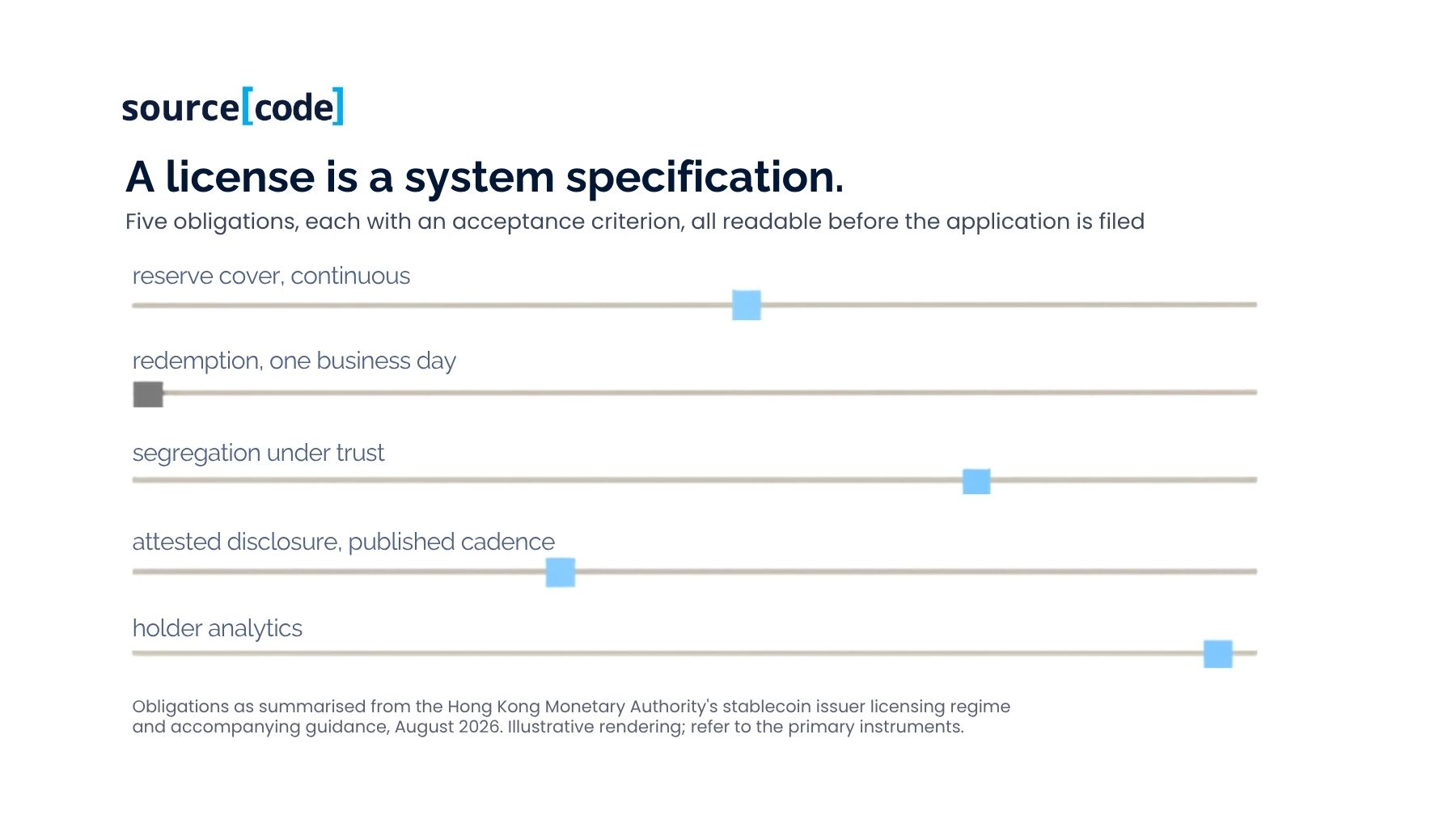
It exposes which obligations were designed for and which were discovered. The Hong Kong obligations are, in engineering terms, entirely specific: continuous par-value monitoring of a reserve pool, one-business-day redemption, segregation under trust, independent attestation on a published cadence, chain analytics on holders. A firm that treated those as a legal annexe rather than a system specification finds them at integration time. A firm that built to them concurrently with the application closes the gap to weeks.
It is comparable across jurisdictions, which a license count is not. Comparing Hong Kong's two licenses to Singapore's framework tells you very little. Comparing how long it takes each market's participants to reach live transaction is a genuine measure of regulatory efficiency, and - for an executive choosing where to place a 2027 programme - a far better one than counting statutes.
The counter-argument deserves stating, because for many firms it wins. If your business does not require a bespoke permission, pursuing one is an expensive distraction; the correct move is to distribute under someone else's license and spend the engineering budget on the product. The crossing point is narrow and identifiable: when the economics of your product depend on holding the customer relationship, the float, or the data - rather than on riding somebody else's rails - permission stops being optional. Below that line, partner. Above it, the license is the business, and the gap after it is the risk.
Real-World Examples
Hong Kong: the license as system specification. The two granted licenses went to a global bank and to a joint venture combining a global bank's local entity with digital-asset and telecommunications operators. Neither profile is accidental. The obligations - reserve segregation under trust, one-business-day redemption, attested public disclosure - map almost exactly onto capabilities a regulated bank already runs, or onto capabilities a purpose-built venture can construct from scratch without legacy compromise. The profile that struggles is the mid-sized firm retrofitting a treasury and reconciliation stack designed for a different product.
Singapore: framework without a statute, and the operational consequence. The MAS approach places a demanding standard on issuers - par redemption within five business days, defined reserve composition and audit - administered through general payments licensing. For an engineering organization the practical consequence is that the requirements are no less real, but the perimeter is defined by supervisory expectation and license conditions rather than by a single statutory instrument. That is harder to trace to code, and it is where we most often see firms carry an evidence gap they cannot close quickly under examination.
Australia and India: the same institution on both sides of the ledger. An Australian bank reducing domestic technology roles while a captive center in India expands is not reducing engineering capacity; it is relocating and, usually, insourcing it - which removes those engineers from the contestable market permanently. Field observation, offered directionally: in APAC engagements over the past eighteen months, the constraint we most often find is not the number of engineers available but the number who have ever shipped inside a supervised perimeter, where evidence, retention and attestation are product requirements rather than afterthoughts. That population is small, it is not growing at the rate of the general developer population, and captives are absorbing it.
Actionable Recommendations
Put your permission inventory on one page, with dates. Every authorization the group holds, the instrument it sits under, the entity that holds it, what it permits, what is live under it today, and what it costs annually to maintain. Most APAC fintech groups above Series B cannot produce this in under a week. It should take an hour.
Measure your last authorization-to-revenue gap, and set a target for the next. Grant date to first live customer transaction, plus the engineer-weeks consumed in between. If the number embarrasses the organisation, that is the finding.
Read the license conditions as a system specification during the application, not after it. Reserve monitoring, redemption service-level obligations, segregation, attestation cadence and holder analytics are engineering backlog items with acceptance criteria. Writing them as user stories in parallel with the legal submission is the single cheapest intervention available.
Assume your talent plan is competing with a captive center, and price accordingly. Where the scarce skill is regulated-product engineering rather than general software engineering, a partner with an existing supervised-delivery practice is often faster than a hiring plan - and where it is not, the comparison is still the one worth running.
Do not build a local currency thesis on a dollar-denominated market. If your 2027 plan assumes regional currency tokenization at scale, stress-test it against the 99.4 per cent figure and decide explicitly whether you are betting on a change in that ratio.
The sourceCode Perspective
We build and run engineering teams for banks, insurers and fintechs across Australia and Southeast Asia, so our bias is declared: we see the inside of the gap between permission and production more often than we see the outside of it.
What we observe is that the firms closing that gap quickly did something unremarkable early. They treated the supervisor's requirements as acceptance criteria owned by a permanent platform team, rather than as a legal workstream handed to engineering at the end. Reserve accounting, redemption service levels, evidence retention and attestation are not exotic engineering; they are ordinary engineering, specified late. Specified early, they cost a fraction, and they turn a license into a product on the day it is granted.
The honest caveat is the one above: for many firms the right answer is not to pursue a permission at all. Distribution under someone else's license is a legitimate, often superior, strategy - and the fastest way to waste a year is to chase an authorization the business model never needed.
Conclusion
Thirty-six applications produced two licenses, and two licenses have produced no tokens in public circulation as at publication date - Anchorpoint's HKDAP missed successive Q2 and end-of-July 2026 launch targets and is now targeting an August rollout, more than four months after the license was granted. Capital in the region is disciplined. Engineering headcount is flat and moving into captives. The Philippines has revised its own ceiling downward, Australia's technology workforce has contracted, and Singapore's vacancies are rising while its banks shrink.
Read together, these numbers describe a market where the things that used to be scarce - money, people - have become manageable, and the thing that was assumed to be procedural has become the binding constraint.
The firms that do well in the next eighteen months will not be the ones that predicted which regulator would move first. Everyone could see Hong Kong moving. They will be the ones that had already built to the conditions, so that the day permission arrived; the product was ready to transact.
Stay ahead of the next permission decision. The regulatory timetable in this piece is live - the authorization-to-revenue gap is being measured in real time across the region. Analysis like this - the licensing decisions, the headcount shifts and the engineering implications that follow - goes to subscribers of APAC BFSI Weekly every Monday morning.
Subscribe here: APAC BFSI Weekly
Frequently Asked Questions
What is a stablecoin? A stablecoin is a digital token issued against a reserve of assets and designed to hold a stable value against a reference - most commonly a single fiat currency - with the issuer undertaking to redeem it at par. As at end-May 2026 the global market was capitalized at roughly US$320 billion, with approximately 99.4 per cent of fiat-backed stablecoins pegged to the US dollar (Bank for International Settlements, 2026).
How many stablecoin issuer licenses has Hong Kong granted? The Hong Kong Monetary Authority granted its first two stablecoin issuer licenses on 10 April 2026, to The Hongkong and Shanghai Banking Corporation Limited and to Anchorpoint Financial Limited, from 36 formal applications received by the 30 September 2025 closing date. The HKMA has indicated that any future total will remain very limited.
Does Singapore license stablecoin issuers? The Monetary Authority of Singapore finalized a stablecoin regulatory framework on 15 August 2023, covering reserve composition, custody and audit, minimum base capital, disclosure and redemption at par within five business days, with a defined "MAS-regulated stablecoin" label. On the evidence available at the time of writing, issuance is authorized through Payment Services Act licensing for digital payment token services rather than through a dedicated stablecoin statute creating a separate license class.
What is the authorization-to-revenue gap? The authorization-to-revenue gap is the elapsed calendar time between a financial supervisor granting an authorization and the first live customer transaction conducted under it, together with the engineering effort consumed in that interval. It measures whether a license has been converted into an operating product, which a license count alone cannot show.
What are the core engineering obligations on a licensed Hong Kong stablecoin issuer? Reserve assets must at all times have a market value at least equal to the par value of stablecoins in circulation, be held in high-quality liquid assets, and be segregated from the issuer's own assets under trust arrangements; redemption requests from onboarded customers must be met within one business day; a whitepaper must be published; reserve holdings must be disclosed publicly on a regular basis with independent attestation; and the HKMA's anti-money-laundering guideline for licensed stablecoin issuers applies, including chain analytics and holder identity verification.
Is APAC technology headcount growing in 2026? Unevenly, and mostly through relocation rather than growth. India's technology sector added roughly 135,000 net jobs in FY2026 to about 5.95 million people (2.3 per cent growth), with global capability centers employing 2.36 million; the Philippine IT-BPM industry lowered its 2028 employment ceiling from 2.5 million to a range of 1.85-2.14 million; and Australia's technology workforce contracted 3.7 per cent, by around 31,000 roles, in the year to May 2025.
What is a global capability center? A global capability center is an offshore or nearshore delivery center owned and operated by the enterprise it serves, rather than by a third-party outsourcing provider, staffed with permanent employees performing engineering, operations or analytics for the parent. In India, 2,117 such centers employed 2.36 million people and generated US$98.4 billion in FY2026.
What is a reserve attestation? A reserve attestation is an independent examination confirming that the assets backing an issued token exist, are of the composition claimed, and are at least equal in value to the tokens in circulation at a stated date, published on a defined cadence as a condition of license.
References
ACS and Deloitte Access Economics, 2025. Australia's Digital Pulse 2025, 31 July. Available at: https://www.acs.org.au/campaign/digital-pulse.html [Accessed 3 August 2026].
ACS Information Age, 2025a. Australia 'not on track' to meet 2030 tech jobs target, 6 November. Available at: https://ia.acs.org.au/article/2025/australia--not-on-track--to-meet-2030-tech-jobs-target.html [Accessed 3 August 2026].
ACS Information Age, 2025b. Tech workers face job cuts at ANZ, NAB, Bendigo Bank, September. Available at: https://ia.acs.org.au/article/2025/tech-workers-face-job-cuts-at-anz--nab.html [Accessed 3 August 2026].
Bank for International Settlements, 2026. Annual Economic Report 2026, Chapter III: Anchoring trust in money - innovation beyond stablecoins, 23 June. Available at: https://www.bis.org/publ/arpdf/ar2026e3.htm [Accessed 3 August 2026].
Charltons, 2026. HKMA issues first stablecoin issuer licenses, Hong Kong Law Newsletter. Available at: https://www.charltonslaw.com/hkma-issues-first-stablecoin-issuer-licenses/ [Accessed 3 August 2026].
CoinDesk, 2026. Fake Hong Kong stablecoins start trading as real ones remain absent, 29 April. Available at: https://www.coindesk.com/policy/2026/04/29/fake-hong-kong-stablecoins-start-trading-as-real-ones-remain-absent [Accessed 3 August 2026].
crypto.news, 2026. Standard Chartered-backed Anchorpoint eyes August HKDAP stablecoin rollout, c. 4 August. Available at: https://crypto.news/standard-chartered-backed-anchorpoint-eyes-august-hkdap-stablecoin-rollout/ [Accessed 11 August 2026].
CUBE Global, 2025. The Cost of Compliance Report 2025, 4 November (survey of more than 2,000 senior compliance, risk and legal leaders across eleven markets; published by a regulatory-technology vendor). Available at: https://cube.global/resources/report/the-cost-of-compliance-report-2025 [Accessed 3 August 2026].
Davis Polk & Wardwell LLP, 2026. Hong Kong's licensing and regulatory framework for stablecoins is now in effect, client update. Available at: https://www.davispolk.com/insights/client-update/hong-kong-s-licensing-and-regulatory-framework-stablecoins-now-effect [Accessed 3 August 2026].
Financial Stability Board, 2025. Thematic Review on the FSB Global Regulatory Framework for Crypto-asset Activities, October. Available at: https://www.fsb.org/2025/10/thematic-review-on-fsb-global-regulatory-framework-for-crypto-asset-activities/ [Accessed 3 August 2026].
Hong Kong Monetary Authority, 2026a. Granting of stablecoin issuer licenses, press release, 10 April. Available at: https://www.hkma.gov.hk/eng/news-and-media/press-releases/2026/04/20260410-4/ [Accessed 3 August 2026].
Hong Kong Monetary Authority, 2026b. Eddie Yue: Robust development of the regulated stablecoin ecosystem in Hong Kong, Insight, 10 April. Available at: https://www.hkma.gov.hk/eng/news-and-media/insight/2026/04/20260410/ [Accessed 3 August 2026].
Hong Kong Monetary Authority, 2026c. Beware of tokens purported to be associated with licensed stablecoin issuers, press release, 28 April. Available at: https://www.hkma.gov.hk/eng/news-and-media/press-releases/2026/04/20260428-5/ [Accessed 3 August 2026].
IBPAP data, reported in BusinessWorld, 2026. AI, global competition force Philippines' IT-BPM industry to cut targets, 15 July. Available at: https://bworldonline.com/top-stories/2026/07/15/763409/ai-global-competition-force-philippines-it-bpm-industry-to-cut-targets/ [Accessed 3 August 2026].
International Monetary Fund, 2026. Making Stablecoins Stable, IMF Working Paper WP/26/74, 10 April. Available at: https://www.imf.org/en/publications/wp/issues/2026/04/10/making-stablecoins-stable-575348 [Accessed 3 August 2026].
Ministry of Manpower (Singapore) data, reported in Human Resources Online, 2026. Technological developments continued to drive demand for skilled workers in 2025: MOM, 20 March. Available at: https://www.humanresourcesonline.net/technological-developments-continued-to-drive-demand-for-skilled-workers-in-2025-mom [Accessed 3 August 2026].
Monetary Authority of Singapore, 2023. MAS finalizes stablecoin regulatory framework, media release, 15 August. Available at: https://www.mas.gov.sg/news/media-releases/2023/mas-finalises-stablecoin-regulatory-framework [Accessed 3 August 2026].
Nasscom, 2026. Technology Sector in India: Strategic Review 2026, 22 May. Available at: https://nasscom.in/knowledge-center/publications/technology-sector-india-strategic-review-2026 [Accessed 3 August 2026].
StraitsX, 2023. StraitsX receives in-principle approval from the Monetary Authority of Singapore to issue single-currency pegged stablecoins, 16 November. Available at: https://www.straitsx.com/blog-post/straitsx-receives-in-principle-approval-from-mas-to-issue-scs [Accessed 3 August 2026].
Zinnov and Nasscom, 2026. India GCC Landscape Report 2026. Available at: https://zinnov.com/centers-of-excellence/zinnov-nasscom-india-gcc-landscape-2026-report/ [Accessed 3 August 2026].