Every Number on That Slide Was Measured Somewhere Else
Executive Summary
On 5 August 2026, in a written reply to a parliamentary question from Ms. Mariam Jaafar, MP for Sembawang GRC, Deputy Prime Minister and MAS Chairman Gan Kim Yong confirmed that Singapore's forthcoming Guidelines on Artificial Intelligence Risk Management will apply across financial institutions' AI use cases, including systems operating with higher degrees of autonomy, and are expected to be finalized soon. They "set out expectations for board and senior management oversight, risk management frameworks and processes, and controls across the AI life cycle" (Monetary Authority of Singapore, reported in Fintech Singapore, 2026).
They are not final. The consultation paper was issued on 13 November 2025 and closed on 31 January 2026, and MAS proposed a 12-month transition period after issuance (Allen & Gledhill, 2025; Linklaters, 2025). No response to feedback had been published at the time of writing. Insurers are in scope because the Guidelines apply to all financial institutions.
Here is the uncomfortable part. The second of the four sections in the AI Risk Management Operationalization Handbook - published on 20 March 2026 by MAS with a consortium of 24 banks, insurers, capital-market firms and industry partners under Project MindForge - asks institutions to perform identification of AI usage, risk materiality assessment and AI incentivization (Allen & Gledhill, 2026a; The Asian Banker, 2026). That is a request for a number about your own business. Almost nothing in the current APAC insurance evidence base is a number about anyone's own business.
- The industry's most-quoted AI fraud figure - P&C insurers saving up to US$160 billion by 2032 - is the upper bound of a US$80-160 billion range, modelled for the United States only, from a roughly US$122 billion annual US fraud base. It is a forecast with no Asia-Pacific component whatsoever (Deloitte Insights, 2025a; 2025b). We are correcting our own carousel accordingly; see Current Challenges.
- The best P&C maturity instrument in the market - only 10% of P&C insurers have successfully scaled AI, from 344 executives across 18 markets including Australia, Hong Kong, India, Japan and Singapore - publishes no regional or APAC split at all (Capgemini Research Institute, 2026).
- The most cited P&C economics - AI investment rising from 0.6% to 1.9% of revenue across 2025-26, with 20-30% loss-adjustment-expense and 15-20% underwriting-expense-ratio reductions - rests on 56 P&C insurers, with the P&L figures modelled against a US FY2024 baseline and no Asia-Pacific cut disclosed (Boston Consulting Group, 2026).
- The strongest single Australian number - 74% of Australian insurers adopting AI for claims resolution in 2025, against a 68% global average - is published by a claims-services provider, from 250 leaders across three regions, with the Australian sub-sample undisclosed (Gallagher Bassett, 2026).
- Meanwhile the Bank of Japan surveyed 153 financial institutions at a 100% response rate and found roughly 50% already using generative AI - and did not include a single insurer (Bank of Japan, 2025).
This piece introduces one construct to make that pattern usable at board level: evidentiary distance, and its operational metric, the substitution count. It is not a criticism of the researchers. Every study above is honest about its own scope. The failure happens downstream, in the slide that strips the scope line.
Introduction: The Line Under the Number
Every research report carries a line under its headline figure. Sample size. Markets. Fieldwork window. Whether the figure was measured or modelled.
That line is the first thing removed when a number moves from a PDF into a board pack, and the only thing that determines whether the number means anything to the institution reading it. A slide saying "AI can cut claims expense by 30%" is not wrong. It is unattributed - and at board level, unattributed is functionally the same as unfounded, because nobody in the room can tell whether it describes a business like theirs.
This matters more in August 2026 than a year ago because a supervisor is about to ask for the other kind of number. MAS's proposed Guidelines, and the handbook built alongside them, ask institutions to identify their AI usage, inventorize it, and assess how material its risk is. Those are internal measurements. They cannot be sourced from a consultancy or benchmarked into existence.
Industry Context: Singapore Is Building the Scaffolding in Public
Three instruments now sit around the Guidelines, and executives routinely conflate their status.
The Guidelines are proposed, not issued. Consultation ran 13 November 2025 to 31 January 2026. Scope is all financial institutions, covering conventional AI, generative AI and AI agents. The structure is three-part: board and senior management oversight; identification, inventory and risk materiality assessment; and lifecycle controls spanning data management, fairness, transparency, human oversight, third-party risk, testing and monitoring. A 12-month post-issuance transition was proposed on the explicit basis that "the maturity of AI risk management practices vary among FIs" (Allen & Gledhill, 2025).
The MindForge toolkit is voluntary and already published. Launched 20 March 2026, it comprises the AI Risk Management Operationalization Handbook and a supplement of case studies, structured in four sections aligned to the proposed Guidelines: scope and oversight; AI risk management; AI lifecycle management; and enablers (Allen & Gledhill, 2026a). MAS's Chief FinTech Officer, Kenneth Gay, called it "a major step forward in our journey to ensure the responsible adoption of AI in finance" (The Asian Banker, 2026).
SAFR is industry-developed and expressly not supervisory expectation. The white paper Safeguards for Agentic Finance at Runtime, published 3 July 2026 under MAS's BuildFin.ai initiative, sets out runtime controls for autonomous agents across policy-bound execution, real-time validation, and auditability and interoperability. Its own text states that it does not constitute regulatory guidance or supervisory expectations (Baker McKenzie, 2026; Allen & Gledhill, 2026b).
The sequence is deliberate and, from a delivery standpoint, generous: the supervisor published the implementation manual before the rule. Nobody in this market can reasonably claim to have been surprised.
Current Challenges: A Correction, and What It Illustrates
We are issuing a correction to our own material, and it is instructive.
An earlier draft of this week's carousel carried the line that Deloitte projects P&C insurers could save up to US$160 billion by 2032 through AI-driven fraud analytics. That sentence appears verbatim in Deloitte's 2026 Global Insurance Outlook of 9 October 2025, with no geographic qualifier and an adjacent example about a European carrier (Deloitte Insights, 2025a). Traced to the study it footnotes, the position changes materially: the underlying April 2025 analysis predicts savings of "between US$80 billion and US$160 billion by 2032", built on an estimate that 10% of P&C claims are fraudulent, producing a US$122 billion annual loss, with assumed detection improvements of 20-40% for soft fraud and 40-80% for hard fraud (Deloitte Insights, 2025b). Every scope marker in that study is American.
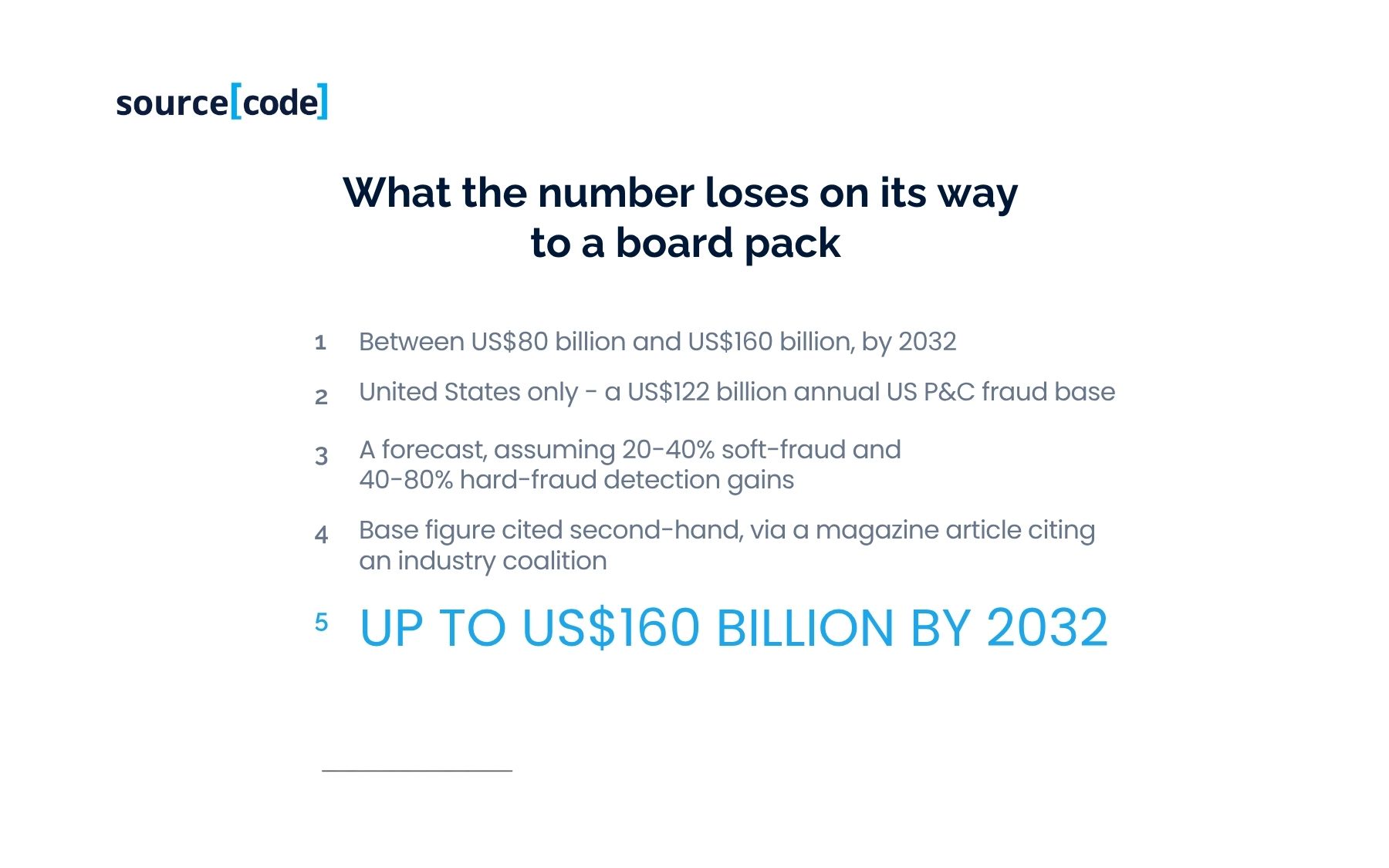
So the figure carries five substitutions before it reaches an APAC insurance board: a different geography, a different regulatory and litigation environment, a forecast in place of a measurement, an upper bound in place of a range, and - one step further back - a base reached via a magazine article citing an industry coalition rather than from the coalition's own published total.
Now try to replace it with an Asia-Pacific equivalent. There isn't one. The Insurance Council of Australia states on its own consumer page that an estimate of undetected insurance fraud in the Australian market is "not yet available". The nearest official APAC figure is Korea's: the Financial Supervisory Service recorded 1.16 trillion won (roughly US$757 million) in confirmed fraudulent claim payouts in 2025, a record, involving about 105,700 suspects (Financial Supervisory Service data, reported in The Korea Times, 2026). That is detected fraud - what was caught, not an estimate of what exists.
The lesson is not that the Deloitte research is bad. It is that a well-scoped US forecast and an official Korean detection statistic are different kinds of object, and putting them on one slide without saying so is how an APAC insurance investment case ends up resting on American litigation economics.
Key Trends: What the 2026 Evidence Base Actually Says
Adoption is high, capability is not, and the gap is stable across every instrument. Accenture's Pulse of Change, fielded November-December 2025 across 218 senior insurance executives within a 3,650-leader global study, found 90% intend to increase AI investment and 85% see greater benefit for growth than for cost - while only 24% have embedded continuous AI learning and 5% are redesigning job roles (Accenture, 2026). Capgemini's employee-side finding is the same shape from the other end: 47% of insurance employees with access to AI tools report their workday unchanged after 18 months (Capgemini Research Institute, 2026).
The barriers reported are infrastructural, not strategic. Among 344 P&C executives, 81% cite legacy systems and IT architecture constraints, 74% data quality and accessibility, 67% a shortage of AI skills and 55% the absence of a clear return on investment (Capgemini Research Institute, 2026). Three of the four are engineering problems. None is solved by a policy document.
Asia-Pacific is at or ahead of the world on deployment and behind it on capability - outside insurance. Aon's 2026 Human Capital Trends Study, with a disclosed APAC sub-sample of 504 of 2,361 leaders, found 74% of APAC organizations have deployed or are piloting AI against 73% globally, while only 21% believe they can recruit and retain sufficient AI talent, against 24% (Aon, 2026). It is cross-industry, not insurance - which is precisely the point.
Customers in Asia are the most comfortable constituency in the evidence base, and almost nobody quotes them. The Geneva Association surveyed 6,000 insurance customers, 1,000 each in China, Japan, France, Germany, the United Kingdom and the United States, and found 68% had used generative AI assistants in their insurance purchase process, with 37% favorable and 47% neutral toward insurers using generative AI and only 12% uncomfortable - customers in the Asian markets surveyed showing higher favorability and lower concern than those in Europe and the United States (Geneva Association, 2025). It is one of the few genuinely APAC, genuinely insurance, and genuinely primary datasets in circulation.
And the supervisory evidence gap is the sharpest signal of all. EIOPA published a survey of European insurers on generative AI adoption on 2 February 2026. No Asia-Pacific insurance supervisor has published an equivalent. What exists regionally is the Bank of Japan's survey of banks, the HKMA's technology stock-take of banks, and MAS Managing Director Chia Der Jiun's statement in November 2025 that over 30 financial institutions have established AI functions in Singapore, including insurers - a count, from a regulator that would know, without a denominator (Monetary Authority of Singapore, 2025).
Strategic Analysis: Evidentiary Distance
Evidentiary distance is the number of substitutions between a figure quoted in a decision and a measurement of the decision-maker's own business. A substitution is any one of five swaps: a different geography, a different industry, a different entity, a different time period, or a forecast used in place of a measurement. The substitution count is the metric - count the swaps, and read the figure accordingly.
Run it across this week's evidence and the ledger looks like this.
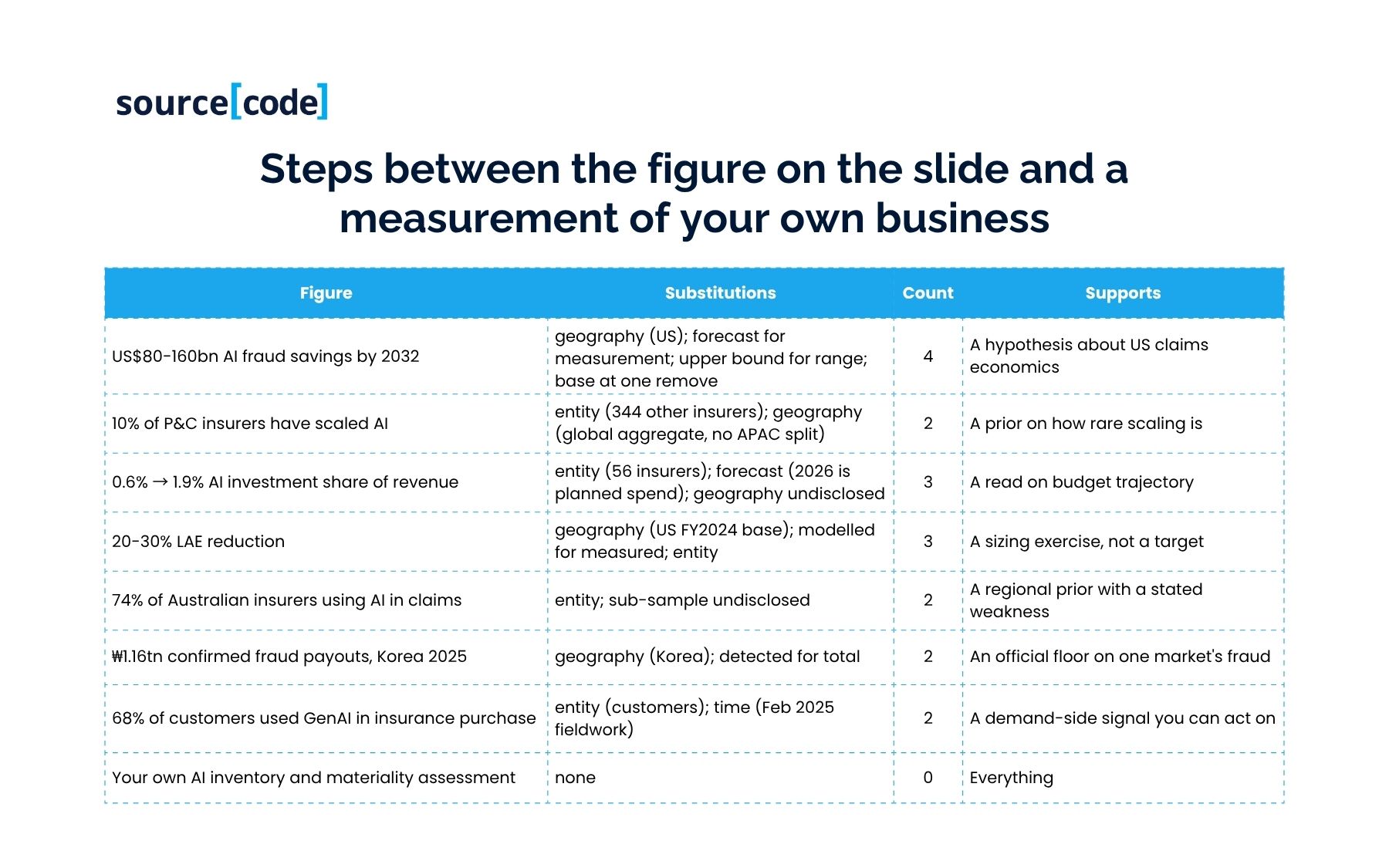
The distribution is the finding. Nothing available to an APAC insurance board today sits below a substitution count of two, and the figures most likely to appear on an investment slide sit at three or four. That is not a scandal; it is a young market with a thin regulatory dataset. But it explains why AI business cases in this sector are so hard to defend twelve months later, and why supervisors are converging on inventories rather than benchmarks.
The counter-argument has real force. Borrowed evidence is how every industry decides before its own data exists - and the institutions that moved on a US forecast in 2024 have production systems now while the careful ones have a literature review. The response is narrow: borrowed evidence is fine for direction and dangerous for magnitude. Use the US fraud forecast to decide that fraud analytics is worth investigating. Do not use it to set the savings target your programme is measured against.
Real-World Examples
The best Australian number in the market, and why it is the best one. Gallagher Bassett's Carrier Perspective: 2026 Claims Insights, published 6 May 2026, reports 74% of Australian insurers adopting AI for claims resolution against a 68% global average, with 62% saying technology-enabled fraud and AI manipulation are significantly increasing cost pressures, and regulatory risk ranking higher in Australia than in any other region surveyed. The sample is 250 senior insurance leaders across three regions (Gallagher Bassett, 2026). The Australian sub-sample is not disclosed, the fieldwork window is not published, and the publisher sells claims services. It is still the strongest Australia-specific insurance AI adoption figure available anywhere. That sentence is the state of the evidence base in one line.
A carrier number with almost no distance at all. ICICI Lombard's FY2026 annual report carries a disclosure from managing director and chief executive Sanjeev Mantri that tech-enabled query resolution improved "from earlier 30% to now ~70% of overall service requests", alongside the framing that technology must enhance human judgement rather than replace it (ICICI Lombard, 2026). It is one company, self-reported, and "tech-enabled" is broader than "AI" - but it is a named executive attaching a movement to a defined service population in a signed annual report. For an Indian general insurer's board it outweighs any global aggregate, because it carries one substitution instead of three.
Where the region has been rigorous, and about whom. The Bank of Japan's September 2025 survey broke generative AI use out by institution type - 66.7% of major banks, 43.1% of regional banks, 25.9% of shinkin banks - and found roughly half of respondents saw room for improvement on monitoring usage, third-party risk and cyberattack countermeasures (Bank of Japan, 2025). This is what a supervisory AI dataset looks like. No insurer appears in it.
Actionable Recommendations
Start the inventory now, not on issuance. The sequencing trap is obvious: institutions that wait for the rule will spend the transition's first months discovering how many models they have. Identification, incentivization and risk materiality assessment are the long-lead items in the framework, and nothing about starting them early is wasted if the final text shifts.
Define "an AI system" before you count, and write the definition down. Most disagreement about inventory size is a definitional argument in disguise - whether a claims rules engine counts, whether a vendor feature counts, whether a model inside a third-party platform counts. Supervisors will care about the definition as much as the count. Ours starts with: anything that influences a customer outcome and whose behavior changes without a code change.
Put a substitution count next to every figure in the AI business case. One column, added to a document that already exists. Any figure at three or more moves from justification to context. It takes a morning and changes the conversation permanently.
Instrument for the questions you will be asked, not the ones you ask yourself. Board oversight, lifecycle control and third-party AI risk all resolve to evidence: what ran, on what data, who approved it, what changed, and what a human did about it. Those are logging and retention requirements, far cheaper to build in than to retrofit.
Read SAFR now even though it binds nobody. Runtime authorization boundaries, real-time validation and decision-level auditability are the specification most agentic pilots in this region are missing. Voluntary, industry-written and published - the cheapest available preview of what supervisory expectation will look like.
The sourceCode Perspective
We build and run engineering teams for insurers, banks and fintechs across Australia and Southeast Asia, so the bias is declared: we make money when the answer is "instrument it properly", and that is this article's recommendation.
With that stated, the pattern we see is consistent enough to report as an observation rather than a study. When a carrier is asked how many AI or machine-learning systems it runs in production, the first number and the final number are rarely close - and the gap is almost never in the data-science function's models. It is in vendor platform features switched on during a routine upgrade, in scoring services embedded in a third-party claims or fraud tool, and in models a business unit procured as a product rather than as a model. None of that is negligence. It is what happens when capability arrives through the procurement path instead of the engineering path.
The practical consequence is that an AI inventory is mostly a third-party discovery exercise, and third-party discovery takes calendar time that budget does not compress. That is the honest reason to start before the rule lands, and it is the only recommendation here we would give even if the Guidelines were withdrawn tomorrow.
Conclusion
The AI figures circulating in APAC insurance are not fabricated. They are borrowed - from American fraud economics, from global aggregates that never published an Asian cut, from banking surveys that excluded insurers, from consulting models built on a 2024 US industry baseline.
Borrowed evidence is a reasonable way to decide whether to move. It is a poor way to decide how much, and an indefensible way to answer a supervisor.
Singapore is about to ask insurers a question no external dataset can answer: what AI do you run, how material is its risk, and who is accountable for it. The institutions that answer well will not be the ones with the best benchmarks. They will be the ones that spent the interval before the rule counting.
Tomorrow we publish our own number. On Wednesday 19 August, sourceCode releases State of AI in APAC Insurance 2026 - a benchmark built to the standard this article argues for, with its sample, method and scope stated on the page rather than in a footnote, and every borrowed figure labelled as borrowed.
Get the benchmark on release →
Frequently Asked Questions
What is evidentiary distance? Evidentiary distance is the number of substitutions between a figure quoted in a decision and a measurement of the decision-maker's own business. A substitution is any one of five swaps: a different geography, a different industry, a different entity, a different time period, or a forecast used in place of a measurement. A figure with zero substitutions was measured on the business making the decision.
What is a substitution count? A substitution count is the operational metric for evidentiary distance: the number of swaps between a figure on a slide and the decision-maker's own instrumented data. As a working rule, figures at zero or one substitution can carry a target; figures at two can carry a direction; figures at three or more belong in the context section of a business case rather than the justification.
Are the MAS Guidelines on AI Risk Management in force? No. As at 18 August 2026 they remain proposed. MAS issued the consultation paper on 13 November 2025 and consultation closed on 31 January 2026. In a written parliamentary reply on 5 August 2026, the Deputy Prime Minister and MAS Chairman indicated the Guidelines are expected to be finalized soon. MAS proposed a 12-month transition period after issuance. No finalization or effective date has been announced, and this article does not predict one.
Do the MAS Guidelines apply to insurers? As proposed, yes. The Guidelines are addressed to all financial institutions rather than to a single sector, which brings insurers, reinsurers and insurance intermediaries regulated in Singapore within scope alongside banks and capital-market firms.
What is an AI inventory? An AI inventory is a maintained register of the artificial intelligence and machine-learning systems an institution uses, including those embedded in third-party products, recording for each what it does, what data it uses, where it sits in a business process, who owns it and how material its risk is. Inventorization appears in the second section of the AI Risk Management Operationalization Handbook published under Project MindForge on 20 March 2026.
What is a risk materiality assessment? A risk materiality assessment is a structured judgement of how much harm a given AI system could cause - to customers, to the institution, or to the wider market - used to determine how much governance, testing, monitoring and human oversight that system requires. It is the mechanism by which a principles-based framework is applied proportionately rather than uniformly.
Is SAFR binding on financial institutions? No. Safeguards for Agentic Finance at Runtime, published 3 July 2026 under MAS's BuildFin.ai initiative, is an industry-developed white paper covering policy-bound execution, real-time validation, and auditability and interoperability for AI agents. Its own text states that it does not constitute regulatory guidance or supervisory expectations.
Is there a reliable Asia-Pacific estimate of insurance fraud losses? Not on the evidence available at the time of writing. The Insurance Council of Australia states that an estimate of undetected insurance fraud in the Australian market is not yet available. South Korea's Financial Supervisory Service publishes confirmed fraudulent claim payouts - 1.16 trillion won in 2025 - but that measures detected fraud rather than total losses. The widely quoted US$80-160 billion AI fraud savings forecast is United States only and contains no Asia-Pacific component.
Has any Asia-Pacific insurance supervisor surveyed insurers on AI use? None that has published results, on the evidence available at the time of writing. EIOPA published a generative AI survey of European insurers on 2 February 2026. In Asia-Pacific, the Bank of Japan has surveyed banks and deposit-taking institutions and the HKMA has conducted a technology stock-take of banks, but neither includes insurers.
References
Accenture, 2026. Pulse of Change 2026 - insurance findings, reported in Insurance Business Asia, 23 January (3,650 C-suite leaders across 20 industries and 20 countries, including 218 senior insurance executives; fieldwork November-December 2025; no Asia-Pacific breakdown published). Available at: https://www.insurancebusinessmag.com/asia/news/technology/insurers-push-ahead-with-ai-despite-skills-gap-562924.aspx [Accessed 8 August 2026].
Allen & Gledhill, 2025. MAS consults on proposed Guidelines for Artificial Intelligence Risk Management, client update. Available at: https://www.allenandgledhill.com/sg/publication/articles/31741/mas-consults-on-proposed-guidelines-for-artificial-intelligence-risk-management [Accessed 8 August 2026].
Allen & Gledhill, 2026a. MAS launches AI risk management toolkit for financial services sector, client update. Available at: https://www.allenandgledhill.com/sg/publication/articles/32846/mas-launches-ai-risk-management-toolkit-for-financial-services-sector [Accessed 8 August 2026].
Allen & Gledhill, 2026b. MAS publishes white paper on safeguards for AI agents in finance, client update. Available at: https://www.allenandgledhill.com/sg/publication/articles/33294/mas-publishes-white-paper-on-safeguards-for-ai-agents-in-finance [Accessed 8 August 2026].
Aon, 2026. 2026 Human Capital Trends Study - Asia Pacific, 3 June (2,361 business, HR and people leaders globally, including 504 in Asia Pacific across Australia, China, Hong Kong, India, Malaysia, the Philippines and Singapore; cross-industry, not insurance-specific). Available at: https://www.aon.com/apac/in-the-press/asia-newsroom/2026/apac-leads-in-ai-adoption-but-lags-in-workforce-readiness-aon-study-finds [Accessed 8 August 2026].
Baker McKenzie, 2026. Singapore: MAS publishes agentic AI safeguards for financial institutions, client alert, July. Available at: https://www.bakermckenzie.com/en/insight/publications/2026/07/singapore-mas-publishes-agentic-ai-safeguards-for-financial-institutions [Accessed 8 August 2026].
Bank of Japan, 2025. Use and Risk Management of Generative AI by Japanese Financial Institutions, Financial System Report annex, 30 September (153 financial institutions, 100% response rate; banks and deposit-taking institutions only - no insurers). Available at: https://www.boj.or.jp/en/research/brp/fsr/fsrb250930.htm [Accessed 8 August 2026].
Boston Consulting Group, 2026. AI-First Companies Win the Future: Property and Casualty Insurance, Executive Perspectives, March (n=56 P&C insurers within the Build for the Future 2025 Global Study, n=1,250 companies; P&L impact figures modelled against a US FY2024 industry baseline; no Asia-Pacific cut disclosed). Available at: https://www.bcg.com/assets/2026/executive-perspectives-ai-first-companies-win-the-future-property-casualty-insurance.pdf [Accessed 8 August 2026].
Capgemini Research Institute, 2026. World Property & Casualty Insurance Report 2026, 5 May (344 executives across 18 markets including Australia, Hong Kong, India, Japan and Singapore; 809 employees across 16 markets; 1,113 policyholders; no regional or Asia-Pacific split published). Available at: https://www.capgemini.com/insights/research-library/world-property-and-casualty-insurance-report/ [Accessed 8 August 2026].
Deloitte Insights, 2025a. 2026 Global Insurance Outlook, 9 October. Available at: https://www.deloitte.com/us/en/insights/industry/financial-services/financial-services-industry-outlooks/insurance-industry-outlook.html [Accessed 8 August 2026].
Deloitte Insights, 2025b. Sharma, N., Kamalapurkar, K. and Canaan, M., Property and casualty carriers can win the fight against insurance fraud, 24 April (United States only; forecast to 2032). Available at: https://www.deloitte.com/us/en/insights/industry/financial-services/financial-services-industry-predictions/2025/ai-to-fight-insurance-fraud.html [Accessed 8 August 2026].
European Insurance and Occupational Pensions Authority, 2026. EIOPA survey on generative AI shows swift, cautious adoption among Europe's insurers, 2 February. Available at: https://www.eiopa.europa.eu/eiopa-survey-generative-ai-shows-swift-cautious-adoption-among-europes-insurers-2026-02-02_en [Accessed 8 August 2026].
Financial Supervisory Service (Republic of Korea) data, reported in The Korea Times, 2026. Insurance fraud claims hit new high in 2025, 31 March. Available at: https://www.koreatimes.co.kr/southkorea/20260331/insurance-fraud-claims-hit-new-high-in-2025-data [Accessed 8 August 2026].
Gallagher Bassett, 2026. The Carrier Perspective: 2026 Claims Insights, 6 May (250 senior insurance leaders across Australia, North America and the United Kingdom; Australian sub-sample size not disclosed; published by a claims-services provider). Available at: https://www.gallagherbassett.com/au/news-and-insights/key-insights-from-2026-carrier-perspective/ [Accessed 8 August 2026].
Geneva Association, 2025. Gen AI in the Insurance Customer Journey, November (6,000 insurance customers, 1,000 each in China, Japan, France, Germany, the United Kingdom and the United States; fieldwork February 2025). Available at: https://www.genevaassociation.org/sites/default/files/2025-11/ai_journey_report_211125_final.pdf [Accessed 8 August 2026].
ICICI Lombard General Insurance, 2026. Annual Report FY2026, message from the managing director and chief executive officer. Available at: https://www.icicilombard.com/docs/default-source/financial-information/annual-report-fy2026.pdf [Accessed 8 August 2026].
Insurance Council of Australia, 2026. Insurance fraud, consumer information page. Available at: https://insurancecouncil.com.au/consumers/insurance-fraud/ [Accessed 8 August 2026].
Linklaters, 2025. Tay, J-Y., Webb, E. and Teo, C., Singapore: MAS proposes comprehensive AI Risk Management Guidelines for financial institutions, Financial Regulation Insights, November. Available at: https://financialregulation.linklaters.com/post/102lw8a/singapore-mas-proposes-comprehensive-ai-risk-management-guidelines-for-financial [Accessed 8 August 2026].
Monetary Authority of Singapore, 2025. Chia, D.J., Remarks at the 21st Singapore International Reinsurance Conference, 3 November, reproduced by the Bank for International Settlements. Available at: https://www.bis.org/review/r251112a.pdf [Accessed 8 August 2026].
Monetary Authority of Singapore, reported in Fintech Singapore, 2026. MAS to finalise AI risk guidelines covering agentic AI, 6 August (reporting the written parliamentary reply of 5 August 2026). Available at: https://fintechnews.sg/135480/ai/mas-ai-guidelines/ [Accessed 8 August 2026].
OpenGov Asia, 2026. Singapore sets principles-based approach for AI in financial services, 5 August. Available at: https://opengovasia.com/singapore-sets-principles-based-approach-for-ai-in-financial-services/ [Accessed 8 August 2026].
The Asian Banker, 2026. MAS partners with industry to develop AI risk management toolkit for the financial sector, 20 March (reproducing the MAS media release; consortium of 24 banks, insurance companies, capital market firms and other industry partners). Available at: https://www.theasianbanker.com/press-releases/mas-partners-with-industry-to-develop-ai-risk-management-toolkit-for-the-financial-sector [Accessed 8 August 2026].