A CFO's Guide to the Real Cost of an AI Pilot That Never Scales
Key Takeaways
-
No P&L line captures "initiative that should have scaled and didn't" - which is why stalled AI pilots survive budget cycle after cycle without ever being called what they are: a standing cost.
-
Independent research converges: Gartner expects at least 30% of generative AI projects abandoned after proof of concept, a widely cited MIT study found 95% of pilots showed no measurable P&L impact, and BCG found 74% of companies have yet to show tangible AI value at all.
-
The gap between institutions that commit and those that keep piloting is not linear - BCG's AI leaders posted 1.5x the revenue growth, 1.6x the shareholder returns and 1.4x the ROIC of the rest of the market over three years, and expect that gap to widen further by 2027.
-
The right financial comparison is not "pilot cost vs. zero" - it is twelve more months at the current run rate versus a committed decision made now. Treat the difference as a genuine, quantifiable line item.
-
Delay is sometimes the financially correct call - but only when bought deliberately with a specific, time-boxed reason (data readiness, regulatory clarity, model risk sign-off), not when it is simply what happens by default.

Introduction
Every finance function has a line for capital that failed to deliver - write-offs, impairments, restructuring charges. What it does not have is a line for money not spent on time. An AI pilot that quietly runs for eighteen months without a scale decision does not trigger an impairment review or a variance report. It shows up, if it shows up anywhere, as a modest line in the innovation budget, renewed each cycle with the same justification: "still learning, still promising."
That accounting silence is the problem this article is about. The cost of a stalled AI pilot is not the pilot budget, and it is not zero. It is the difference between where the institution's cost-to-serve, underwriting accuracy or claims cycle time would be today had the pilot become a committed, production capability twelve months ago - and where it actually is. That difference does not appear on anyone's P&L as a loss. It appears, twelve to twenty-four months later, as a competitor's structurally lower cost-to-serve, rarely traced back to the original decision to keep piloting rather than commit.
This is a finance problem before it is a technology problem. The evidence below is drawn from independent research across consultancies, analyst firms and one contested study - read with appropriate scepticism where the evidence is thin, and set against a fair counterargument, because staying in pilot longer is sometimes the right call. The purpose is to give CFOs in banking, insurance and fintech a way to put a number on the decision they are already making by not deciding.
The evidence on AI-pilot stall economics
Start with the scale of the stall. Gartner predicted in mid-2024 that at least 30% of generative AI projects would be abandoned after proof of concept by the end of 2025, citing poor data quality, inadequate risk controls, escalating costs and unclear business value (Gartner, 2024). By mid-2025, Gartner sharpened the warning for the next wave: over 40% of agentic AI projects will be cancelled by the end of 2027, for largely the same reasons. Analyst Anushree Verma's assessment was blunt - most agentic AI initiatives today are "early stage experiments or proof of concepts that are mostly driven by hype and are often misapplied," running on models that "don't have the maturity and agency to autonomously achieve complex business goals" (Gartner, 2025).
A widely circulated 2025 study from MIT's NANDA initiative pushed the picture further, reporting that 95% of the generative AI pilots it examined delivered no measurable profit-and-loss impact, based on interviews with 52 executives, a survey of 153 leaders and analysis of roughly 300 public AI deployments (MIT NANDA, 2025). It is worth being precise about what this study is and is not: it is not peer-reviewed, its sample is self-selected, and its 95% figure has been debated in the trade press for over-generalising a narrower finding. Only two of the nine sectors it examined - technology and media - showed material business transformation; over 80% of organisations had piloted tools like ChatGPT or Copilot, but the report's central claim is that most of that activity lifted individual productivity without reaching enterprise P&L. Treat the 95% figure as directional, not precise - but directionally, it agrees with everything else in this section.
BCG's October 2024 survey put a more conservative but still stark number on the same phenomenon: 74% of companies have yet to show tangible value from AI (BCG, 2024). Only 26% have moved beyond proof-of-concept, and within that group just 4% have cutting-edge capability across functions. The financial-services detail matters here: BCG found fintechs (49%) and banking (35%) among the sectors with the highest concentration of AI leaders - evidence that BFSI is not lagging overall, but that the gap within BFSI between leaders and laggards is likely to be unusually wide.
Forrester's 2026 predictions add a finance-specific twist: as boards push CFOs to approve AI spend against demonstrable ROI, enterprises are expected to defer 25% of planned AI spend into 2027, and fewer than a third of decision-makers today can tie AI value directly to financial growth (Forrester, 2025). That is not evidence AI spend is being cut. It is evidence that a large amount of it is being held in suspension - pilots neither killed nor committed, simply rolled forward.
The CFO's decision problem
Here is what makes this a genuinely hard finance problem rather than a simple "move faster" argument. A stalled AI pilot does not look like a failing investment on any standard reporting cadence. Its burn rate is usually small relative to the total technology budget, it does not breach a covenant, and it rarely shows a variance against a KPI - because a pilot typically was never given a KPI with a hard deadline. It was given a mandate to "prove value," a standard that can be satisfied indefinitely by small, real, individually-defensible wins that never aggregate into a business case.
Standard capital allocation logic - net present value, payback period, hurdle rate - was built to compare a known investment against a known alternative, usually "do nothing at the current cost structure." AI pilots break that comparison in both directions. The cost of committing is visible and front-loaded: integration, data remediation, model risk sign-off. The cost of not committing is invisible and back-loaded - a widening gap in unit cost, cycle time or conversion that only becomes obvious once a competitor has already captured it. Finance teams are well-equipped to model the first cost and poorly equipped to model the second, because it requires an assumption about a competitor's trajectory in the absence of a decision - exactly the kind of comparative modelling a real options approach to capital investment was designed for. Real options theory treats an investment as a sequence of choices under uncertainty rather than a single go/no-go gate, and its central insight is that delay has value only when it buys genuinely new information that changes the decision (The Decision Lab, n.d.). The theory is frequently invoked to justify caution; it is far less often used to put a number on what delay costs when no new information is actually being generated.
This is the CFO's real decision problem: not "should we approve the business case for scaling," but "what does it cost us to keep not deciding, and is that cost currently being modelled at all." For most institutions in BFSI today, the honest answer is no.
What most institutions get wrong
Three recurring errors show up across the institutions we work with and the research reviewed for this piece.
First, they price the pilot but not the plateau. Finance governance is generally strong at tracking a pilot's direct cost - licences, data science hours, vendor fees. It is far weaker at recognising when a pilot has stopped generating new information and simply become a recurring cost with no decision attached. A pilot that has run for six quarters without a scale decision is not "still early stage." It is a standing commitment that has quietly escaped the capital governance process that would apply to any other commitment of similar size.
Second, they treat "no measurable harm" as "no cost." Because a stalled pilot rarely shows a negative return - it usually shows a small, real, positive one that just doesn't scale - it is easy to conclude it is doing no damage. This is the sunk-cost fallacy in reverse: instead of over-committing to a failing project because of past spend, institutions under-commit to a promising one because staying small looks safer than scaling, even when the invisible cost of staying small is larger.
Third, they do not distinguish genuine uncertainty from organisational drift. Some pilots are genuinely waiting on something specific - a regulatory position, a data remediation programme, a model risk framework that does not yet exist. Most, based on Gartner's stated reasons for abandonment and Deloitte's 2026 finding that governance gaps persist even as AI/ML use has reached 67% of banks and 57% of insurers (Deloitte, 2026), are not waiting on anything specific at all. They are waiting on someone to make a decision, and no one owns that decision with a deadline.
The Deferral Tax Model: a cost-of-delay decision tool
To make the invisible cost visible, we use a simple model with finance-native language: the Deferral Tax. Not to be confused with a deferred tax asset or liability on the balance sheet - the naming is deliberate, because the discipline should be the same. A deferred tax difference gets tracked and reconciled because accounting requires it. A deferral tax on a stalled AI initiative currently does not, only because no one has required it.
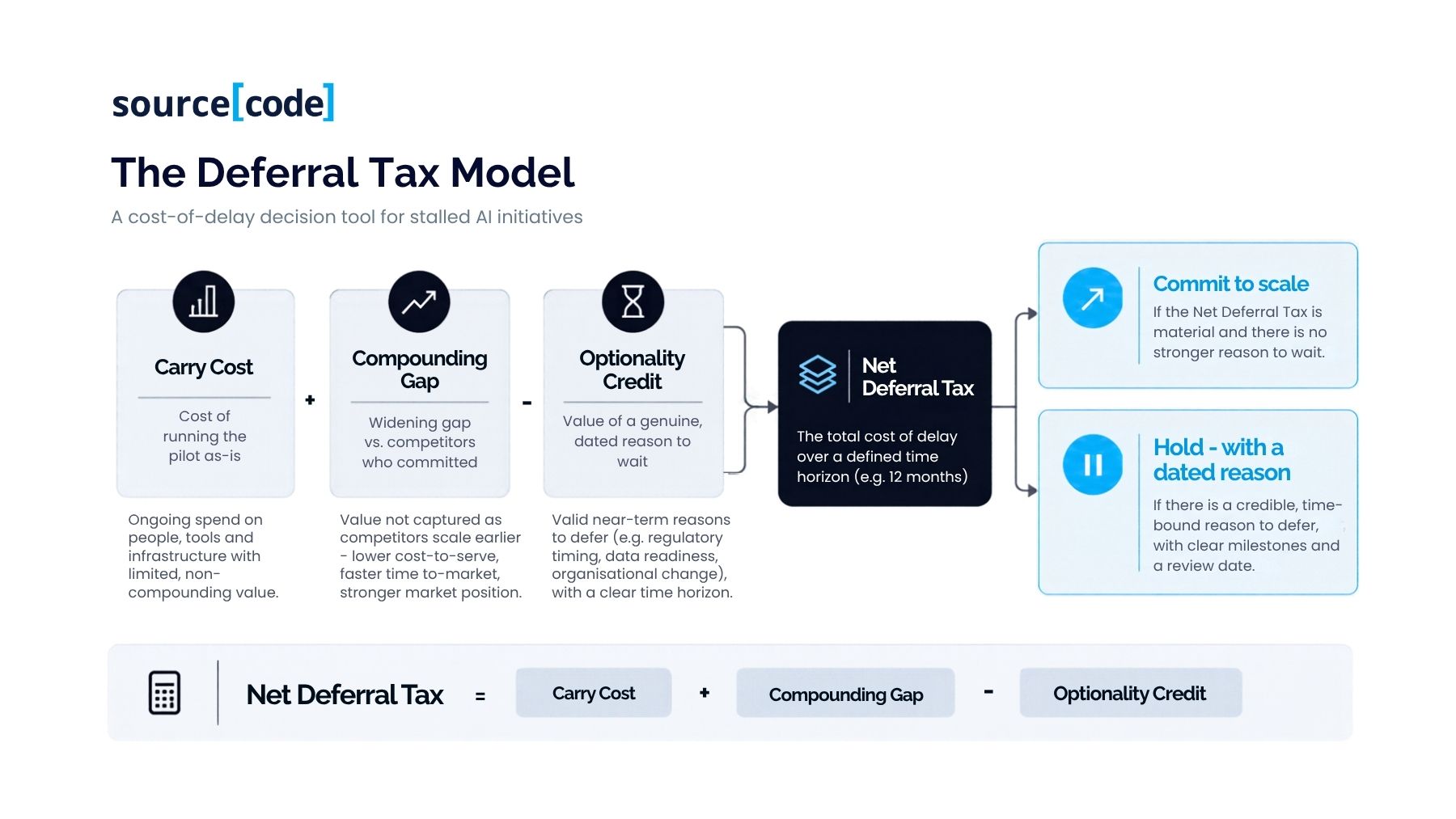
The model has three components, each estimated at the rigour a CFO would expect of any other twelve-month forecast:
1. Carry Cost. The direct cost of continuing the initiative at its current scope for the next twelve months - team time, vendor fees, infrastructure, and the opportunity cost of the specialist capacity (data science, risk, product) tied up maintaining a pilot rather than building toward production. Most finance teams already track a version of this; the gap is that it is compared to zero rather than to the alternative below.
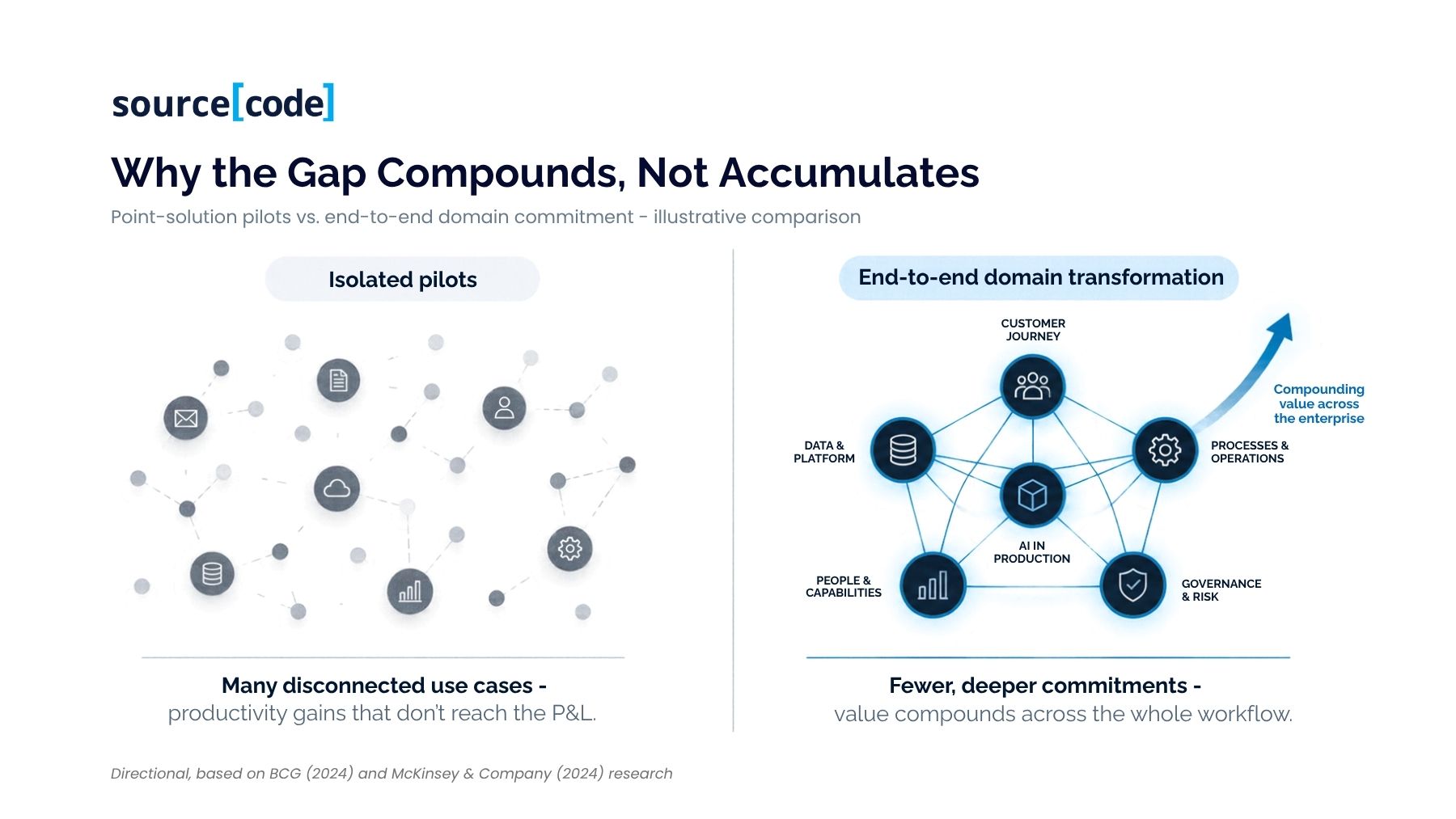
2. Compounding Gap. The widening cost-to-serve, cycle-time or conversion disadvantage relative to competitors who have already committed, projected forward twelve months at the trajectory implied by the leader-vs-laggard evidence above. This is not linear. BCG's data shows AI leaders compounding their advantage - 1.5x revenue growth and 1.6x shareholder returns over three years already achieved, expecting a further 60% AI-driven revenue growth advantage and roughly 50% greater cost reduction by 2027 relative to the rest of the market (BCG, 2024). McKinsey's insurance-specific frontrunner research shows why the gap compounds rather than accumulates steadily: a full end-to-end transformation of a domain like claims processing can generate up to 14 times the impact of the same technology applied as isolated point solutions (McKinsey & Company, 2024) - a competitor who commits to domain-level transformation is not twelve months ahead on a linear curve, they are on a different curve entirely.
3. Optionality Credit. The legitimate, quantifiable value of waiting where waiting actually buys new information - a pending regulatory clarification, a data remediation programme with a defined end date, a model risk sign-off in progress. This is the honest counterweight to the first two components, and what stops the model becoming a blunt "always scale immediately" instrument. If it is real, specific and time-boxed, net it against the other two.
The decision rule: Net Deferral Tax = Carry Cost + Compounding Gap − Optionality Credit. Model this over twelve months, compare it to the cost of a committed scale decision made now, and bring the comparison to the same capital allocation forum that reviews any other investment of that size. If the Optionality Credit is generic or undated ("still assessing," "waiting to see how the market develops"), it is not optionality - it is drift, and the Net Deferral Tax should be treated as a real, current cost. This is illustrative logic, not a fitted formula: every institution's inputs will differ by initiative, and the point is the discipline of estimating all three terms, not a universal multiplier.
Business and technology implications
Running this model changes more than the finance conversation. Technically, it forces an earlier, more honest conversation about what "production-ready" actually requires - data lineage, model monitoring, integration with core claims or banking systems, and the operating discipline to run AI as a production capability rather than a supervised experiment. Institutions that only ever price the pilot rarely budget for this transition properly, because the pilot's economics never had to include it.
Organisationally, naming the Deferral Tax creates accountability that does not currently exist: a pilot with a calculated cost of delay attached needs an owner and a decision date, converting an open-ended exploration into a time-boxed one.
Competitively, the implication is worth stating plainly for banking and insurance: cost-to-serve advantages in underwriting, claims and servicing are largely structural once built, because they depend on integrated data and workflow, not a single model. The BCG and McKinsey findings above both point the same way - leaders are not winning by running more pilots, they are winning by committing to fewer, deeper, domain-level transformations. A twelve-month deferral is not twelve months of standing still; it is twelve months of a rival moving to a different cost structure that becomes progressively harder to close.
A fair counterargument: when delay is the right call
None of this is an argument for scaling every pilot immediately, and a piece that only said "move faster" would be dishonest about the evidence. Real options theory exists precisely because delay sometimes has genuine positive value - when uncertainty is high, additional information will materially change the decision, and the cost of waiting is lower than the risk of premature commitment (The Decision Lab, n.d.). In regulated financial services this is not hypothetical: a model risk framework that does not yet exist, a regulator yet to issue guidance on AI in underwriting or claims decisioning, or a core data quality issue that would make scaled deployment actively dangerous are all legitimate reasons to hold a pilot at its current scope. Deloitte's 2026 research is a useful reality check - even among the 67% of banks and 57% of insurers already using AI/ML in some form, governance gaps persist, with over half citing transparency and explainability as a genuine hurdle and more than a third citing fairness concerns (Deloitte, 2026). Committing to scale a claims or underwriting model without resolving those gaps is not boldness - it is a different, arguably larger, version of the same risk this article is about.
The distinction that matters is not speed, it is specificity. "We are waiting for the model risk committee's sign-off on the revised validation framework, expected next quarter" is an Optionality Credit. "We want more confidence before we commit" is not - it is the absence of a decision wearing the language of prudence. The Deferral Tax Model does not argue against caution; it argues against caution with no expiry date.
What leaders should do next
For CFOs and finance leaders reviewing AI initiatives currently sitting in extended pilot:
1. Inventory every AI initiative that has run longer than two budget cycles without a scale or kill decision. If no one can name the date the decision will be made, that is itself the finding.
2. Estimate the Carry Cost and Compounding Gap for the two or three highest-potential initiatives, using the institution's own cost-to-serve data rather than industry averages, and compare the twelve-month total to the cost of committing now.
3. Require every extended pilot to state its Optionality Credit explicitly, with a date. No deadline means treat it as drift, and route it back through governance as a scale-or-stop decision.
Bring the Net Deferral Tax into the same forum that reviews other capital allocation decisions of comparable size - not a separate "innovation" track with lighter scrutiny.
The sourceCode’s perspective
We work with banks, insurers and fintechs across APAC and the Gulf on the part of this problem that is usually mispriced: the production engineering, data integration and operating discipline that separates a pilot proving a model works from a system an institution can run at scale, under regulatory scrutiny, at production volumes. What we consistently see is that the Deferral Tax is rarely a technology problem in disguise - the underlying model or vendor capability is usually adequate well before the institution commits to scale.
The gap is almost always production-readiness and governance: data pipelines never built for volume, monitoring that stops at the pilot's original scope, no defined path from "supervised experiment" to "accountable production system."
Closing that gap does not require moving faster recklessly; it requires being precise about what production-readiness actually costs, so the Optionality Credit in a CFO's calculation reflects a real, dated engineering plan rather than an open-ended hope the gap closes itself. Talk to us!
Conclusion
The sunk cost of an AI pilot is rarely what sinks an institution. The cost that matters is the one that never gets a line item: the compounding gap between where the institution would be with a committed, production-grade capability and where it actually is twelve months into an extended pilot. That gap does not appear on a P&L as a loss attributable to a decision. It appears, later, as a competitor's structural cost-to-serve advantage - by the time it is visible, it is usually too late to trace it back to the quarter in which the scale decision was deferred rather than made.
The Deferral Tax Model does not resolve the genuine uncertainty that sometimes justifies caution. It simply insists the cost of delay be estimated with the same rigour as the cost of commitment, brought to the same table, and given the same deadline.
Frequently Asked Questions
What is "cost of delay" in the context of an AI pilot? Cost of delay is the value an institution forgoes by not committing a promising AI initiative to production, measured over a defined period (typically the next twelve months) relative to the cost and outcome of committing now. It includes the direct cost of continuing to run the pilot (Carry Cost) and the widening competitive gap versus institutions that have already scaled (Compounding Gap), offset by any genuine value of waiting for new information (Optionality Credit).
Why doesn't cost of delay show up in standard financial reporting? Because standard reporting compares actual spend against budget or plan, not actual position against a counterfactual where a different decision was made earlier. A stalled pilot's direct cost is usually small and on-budget, so it does not trigger variance analysis. The larger cost - the competitive gap that opens up - is a comparison against a hypothetical, which most reporting cadences are not built to produce.
How reliable are the published statistics on AI pilot failure rates? They vary in rigour and should be read accordingly. Gartner's predictions (30% of generative AI projects abandoned after proof of concept by end of 2025; over 40% of agentic AI projects cancelled by end of 2027) come from an established analyst methodology. BCG's 74%-no-tangible-value finding comes from a large executive survey. The widely cited MIT NANDA "95% of pilots show no P&L impact" figure is directional - the underlying study has a smaller, self-selected sample and has drawn methodological criticism - and should be treated as indicative of a real pattern rather than a precise industry-wide rate.
Is staying in pilot mode ever the financially correct decision? Yes. When an institution is waiting on something specific - a regulatory position, a completed data remediation programme, a model risk sign-off - with a defined timeframe, the value of that additional information can genuinely exceed the cost of delay. The test is specificity and a date, not the general discomfort of committing capital under uncertainty.
How is this different from measuring ROI on an AI initiative that is already live? Measuring realised ROI on a live initiative - attributing outcomes to the AI capability specifically, isolated from other contributing factors - is a related but distinct problem, covered in sourceCode's Isolation Ledger framework. The Deferral Tax Model addresses the decision before that point: whether to commit an initiative to production at all, and what it costs to keep not deciding.
What should a CFO ask for from a technology or digital team currently running an extended AI pilot? Three things: a specific, dated reason the initiative has not yet been proposed for scale (the Optionality Credit); an estimate of the Carry Cost of continuing at the current scope for another twelve months; and a production-readiness assessment (data, integration, monitoring, governance) that shows what committing to scale would actually require, so the comparison is between two real numbers rather than a real number and an assumption.
Reference List
BCG (2024) AI Adoption in 2024: 74% of Companies Struggle to Achieve and Scale Value. Boston Consulting Group. Available at: https://www.bcg.com/press/24october2024-ai-adoption-in-2024-74-of-companies-struggle-to-achieve-and-scale-value (Accessed: 25 September 2026).
Deloitte (2026) AI Adoption in Financial Institutions: Balancing Growth and Governance. Deloitte Insights. Available at: https://www.deloitte.com/dk/en/services/consulting/perspectives/ai-adoption-in-financial-institutions-balancing-growth-and-governance.html (Accessed: 25 September 2026).
Forrester (2025) Forrester's 2026 Technology & Security Predictions: As AI's Hype Fades, Enterprises Will Defer 25% of Planned AI Spend to 2027. Forrester Research. Available at: https://investor.forrester.com/news-releases/news-release-details/forresters-2026-technology-security-predictions-ais-hype-fades-0 (Accessed: 25 September 2026).
Gartner (2024) Gartner Predicts 30% of Generative AI Projects Will Be Abandoned After Proof of Concept By End of 2025. Gartner Newsroom. Available at: https://www.gartner.com/en/newsroom/press-releases/2024-07-29-gartner-predicts-30-percent-of-generative-ai-projects-will-be-abandoned-after-proof-of-concept-by-end-of-2025 (Accessed: 25 September 2026).
Gartner (2025) Gartner Predicts Over 40% of Agentic AI Projects Will Be Canceled by End of 2027. Gartner Newsroom. Available at: https://www.gartner.com/en/newsroom/press-releases/2025-06-25-gartner-predicts-over-40-percent-of-agentic-ai-projects-will-be-canceled-by-end-of-2027 (Accessed: 25 September 2026).
McKinsey & Company (2024) The Potential of Gen AI in Insurance: Six Traits of Frontrunners. Giovine, C., Rifai, K., Hudelson, P., Joseph, P. and Kamath, S. Available at: https://www.mckinsey.com/industries/financial-services/our-insights/insurance-blog/the-potential-of-gen-ai-in-insurance-six-traits-of-frontrunners (Accessed: 25 September 2026).
MIT NANDA (2025) The GenAI Divide: State of AI in Business 2025. MIT Media Lab / NANDA initiative. Referenced via secondary reporting, including: Field, H. (2025) 'MIT Report Finds 95% of AI Pilots Fail to Deliver ROI, Exposing "GenAI Divide"', Legal.io. Available at: https://www.legal.io/blog/5719519/MIT-Report-Finds-95-of-AI-Pilots-Fail-to-Deliver-ROI-Exposing-GenAI-Divide (Accessed: 25 September 2026). Note: treated as directional evidence given methodological limitations of the underlying study (self-selected sample, non-peer-reviewed); figures should not be read as a precise industry-wide rate.
The Decision Lab (n.d.) Real Options Analysis. Available at: https://thedecisionlab.com/reference-guide/economics/real-options-analysis (Accessed: 25 September 2026).