Embedded Finance Is Now the Product. In APAC, Its Margin Has a Publication Date
Executive Summary
The distribution argument for embedded finance in Asia-Pacific is settled. In the largest recent regional survey, 77 per cent of consumers in ASEAN reported using embedded finance through wallets, buy-now-pay-later applications or in-app credit (HSBC, Google Cloud and PCMI, 2025). No board in Singapore, Sydney or Jakarta needs another slide making that case.
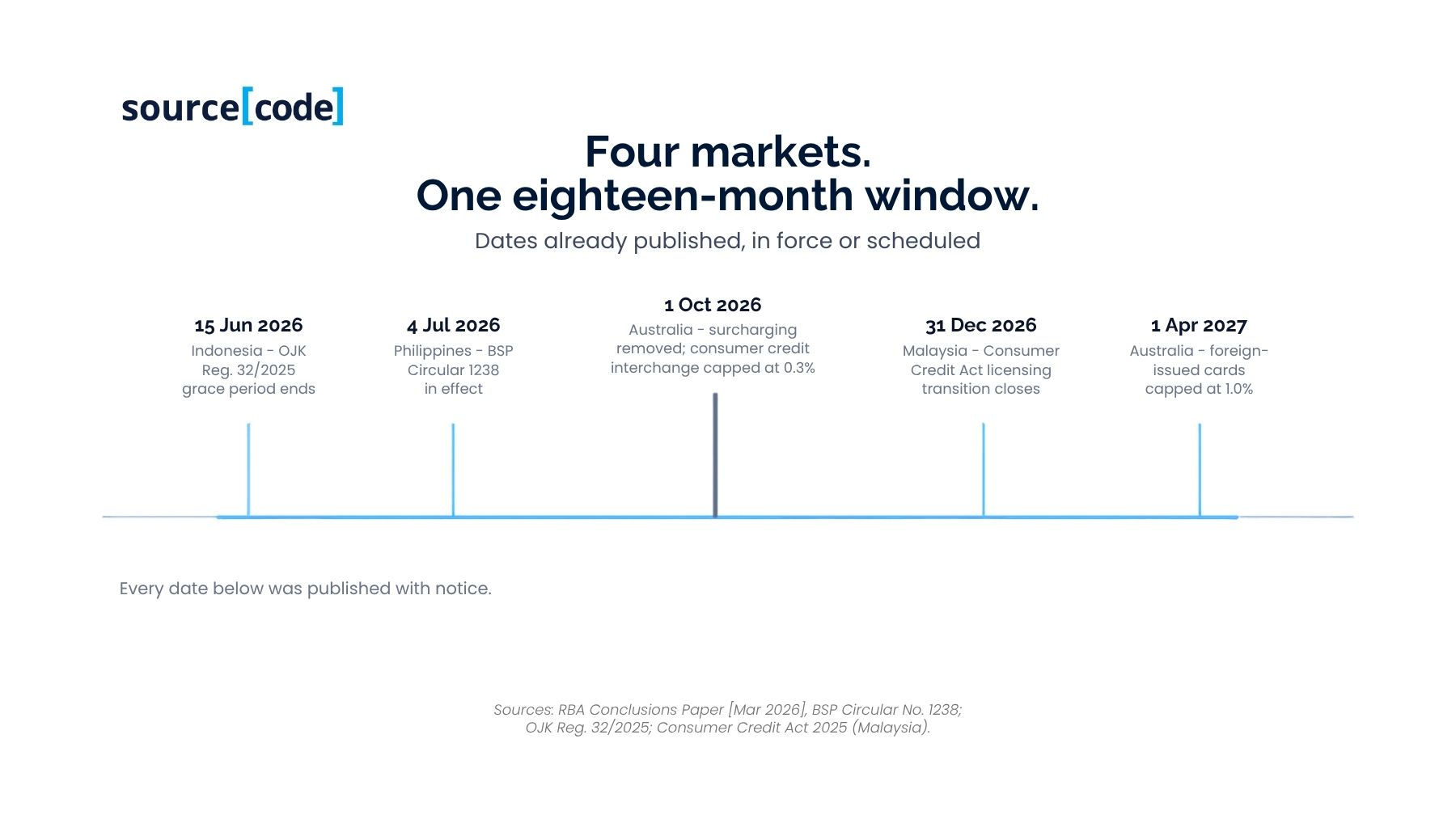
What is not settled is the margin. Over the next eighteen months, the economics under embedded finance in this region are being rewritten by regulators working to published dates. From 1 October 2026, Australia removes surcharging on debit, prepaid and credit cards on the designated eftpos, Mastercard and Visa networks and cuts the cap on domestic consumer credit interchange to 0.3 per cent of transaction value, with a 1.0 per cent cap on foreign-issued cards following on 1 April 2027 - an estimated A$660 million a year of interchange revenue removed from domestic issuers (Reserve Bank of Australia, 2026a). In Indonesia, the grace period under OJK Regulation 32/2025 expired on 15 June 2026, leaving embedded credit provision to commercial banks and licensed financing companies. In Malaysia, the Consumer Credit Act 2025 commenced on 1 March 2026, with a licensing transition window closing 31 December 2026. In the Philippines, BSP Circular No. 1238 took effect on 4 July 2026, directing fair, market-based pricing for retail digital fund transfers.
Together these describe a single condition: in APAC, embedded finance has stopped being a distribution business and become a regulated-margin business - and the capital cushion that used to absorb a repricing has gone. APAC fintech investment fell to a decade low of US$9.3 billion across 763 deals in 2025, from US$11.7 billion across 1,028 deals in 2024 (KPMG International, 2026).
The operating question that follows is narrow and measurable. Not "how fast do we ship features", but how long it takes a published regulatory requirement to reach production in your product - what we will call policy-to-production latency - and how many such changes the organisation can absorb in a quarter without stopping everything else.
Introduction: The Wrong Slide
Most APAC fintech board decks still lead with a distribution slide: partners signed, merchants live, monthly active users, take rate. It is the slide that raised the last round, and in 2021 it was the right one.
It has quietly become the wrong one, for reasons that have nothing to do with product quality. Take rate is now a variable set outside the company. A payments business in Australia whose model assumes pre-2026 interchange has a P&L with an expiry date of 30 September. An embedded credit proposition in Indonesia built on a non-bank balance sheet was structurally reclassified in June. A BNPL provider in Malaysia sits inside a licensing window closing at the end of December.
None of this arrived as a shock. Every one of those changes was published with notice by an institution with a website. The exposure is not informational - it is operational. The question a chief executive should put to the engineering organization is not whether the team knows about 1 October. It is: when the pricing rule changes, what do we actually have to touch, and how long does it take?
For a surprising number of otherwise-competent organizations, the honest answer is a quarter, a cross-functional programme and a feature freeze.
Industry Context: Demand Settled, Rails Compounding, Margin Moving
Three things are true at once in APAC, and they pull in different directions.
Demand is settled - and the honest version of the statistic is more useful than the viral one. The 77 per cent figure comes from a survey of 2,436 respondents across six ASEAN markets, and it counts e-wallet use as embedded finance (HSBC, Google Cloud and PCMI, 2025). Read precisely, it says embedded financial experiences are the default among digitally active ASEAN consumers; it does not say 77 per cent of Southeast Asians borrow inside apps. The distinction matters commercially: the ubiquitous part of embedded finance is the thinnest-margin part, and the profitable part is smaller and more heavily regulated than the headline implies.
The rails are compounding faster than most strategy documents assume. Malaysia's national payments infrastructure processed 8.44 billion digital payment transactions in 2025, with cross-border QR transactions growing 2.5 times to 29.7 million (Payments Network Malaysia, 2026). Indonesia's QRIS volume grew 116.43 per cent year on year in the first quarter of 2026 (Bank Indonesia, 2026). In the Philippines, InstaPay and PESONet together moved ₱16.09 trillion in the first half of 2026, up 44.61 per cent year on year (Bangko Sentral ng Pilipinas data, reported in BusinessWorld, 2026). Domestic instant payments are no longer an emerging channel here; they are the substrate.
Cross-border, however, is a 2027 event - and the market keeps saying otherwise. Nexus Global Payments, the Singapore-incorporated scheme organization established in 2025 by the central banks of India, Malaysia, the Philippines, Singapore and Thailand, with Indonesia joining as the sixth participant in 2026, appointed a PayNet-NETS joint venture as technical operator on 9 February 2026, with go-live targeted for 2027 (Nexus Global Payments, 2026; Endava, 2026). The useful reading is the inverse of the hype: the twelve to eighteen months before go-live is the integration window, and it is open now.
And the margin is moving on dates. The Australian package is the most consequential single change in the region because it compresses two revenue lines simultaneously and from the same date. The Reserve Bank's conclusions confirm domestic caps effective 1 October 2026 of 0.3 per cent for consumer credit (with the weighted-average benchmark removed), 8 cents per transaction or 0.16 per cent for debit and prepaid, and 0.8 per cent retained for commercial credit; foreign-issued cards are capped at 1.0 per cent from 1 April 2027. The Bank estimates A$660 million per year of interchange revenue removed from domestic issuers, against consumers currently paying an estimated A$1.6 billion of the A$1.8 billion in annual card surcharges on designated networks (Reserve Bank of Australia, 2026a). Separately, anyone engaging in credit activities involving buy-now-pay-later contracts in Australia has required a credit licence since 10 June 2025 (Australian Securities and Investments Commission, 2025).
Current Challenges: Where the Cost Actually Lands
Ask an engineering leader what a pricing change costs and you will usually get an estimate for the pricing engine. That is rarely where the cost is.
Pricing logic is almost never in one place. In most embedded finance stacks, the effective price a customer sees is assembled from a schedule in a core service, an override in a partner configuration, a promotional rule in a growth service, a fee display in three client applications, and a reconciliation assumption in the finance data model. A regulator changes one number; the organization changes five systems and discovers a sixth in production.
Eligibility logic has the same problem, with worse consequences. Indonesia's reclassification of who may provide BNPL, and Malaysia's affordability-assessment requirement for non-bank credit providers, are not pricing changes - they change who qualifies, and on what evidence. Where credit policy is code scattered through a decision service rather than versioned, auditable configuration, every policy change is a deployment risk and every audit is an archaeology exercise.
Consent and data-sharing obligations are arriving asymmetrically, and the asymmetry is the design problem. Australia's Consumer Data Right expanded to non-bank lenders on 13 July 2026, with more than 1.3 million Australians using the CDR - roughly 135 per cent more than a year earlier - ahead of phased consumer data sharing from 9 November 2026 (Australian Competition and Consumer Commission, 2026). That growth is real, and also small: BIS research puts Australia at roughly 13 API calls per capita as at December 2025, against Korea at around 20 calls per person per month and Brazil at 55 (Bank for International Settlements, 2026). Hong Kong's Interbank Account Data Sharing initiative now has 28 participating banks sharing account and transaction data for individuals, corporates and small businesses (Hong Kong Monetary Authority, 2026) - ahead of Australia on the business dimension, and almost absent from regional strategy conversations. Malaysia's proposed open finance framework, still unissued in final form, would go further by requiring reciprocity: mandated institutions act as both data providers and consumers, which changes the calculus for any distributor that assumed read-only access.
And the cushion is gone. Southeast Asian technology funding in the first half of 2026 looks superficially strong at US$7.4 billion - until a single US$4.5 billion data-center financing is removed, leaving roughly US$2.9 billion across 127 rounds, below the same period in 2025 on both value and count, with late-stage capital taking the overwhelming majority (Tracxn, 2026). Australian fintech investment fell to US$609 million in 2025 from US$1.9 billion in 2024 (KPMG International, 2026). There is no cheap round waiting to absorb a margin compression.
Key Trends: What This Implies for 2027
Compression is becoming policy, not cycle, and license perimeters are widening with it. The Philippine central bank's Circular No. 1238, effective 4 July 2026, directs institutions to adopt reasonable, fair and market-based pricing for retail digital fund transfers, supporting a target that 60 to 70 per cent of retail payment volume is digital by 2028. Read alongside the Australian interchange decision, supervisors across the region are plainly treating the price of a payment as a policy instrument - and consumer credit in Malaysia, BNPL in Indonesia and Australia, and payment services under Australia's forthcoming licensing regime each bring a category of embedded proposition inside a boundary it previously sat outside. The engineering consequence is unglamorous and expensive: audit trails, evidence retention, and the ability to demonstrate a control rather than assert it.
AI is not the lever most boards are budgeting for. Google's DORA research found around 90 per cent of developers use AI at work and more than 80 per cent believe it increases their productivity, while also finding AI adoption negatively related to delivery stability, and concluding that "AI doesn't fix a team; it amplifies what's already there" (Google Cloud DORA, 2025). A randomized controlled trial of 16 experienced open-source developers across 246 real tasks measured them 19 per cent slower with AI tooling, despite forecasting a 24 per cent speed-up (METR, 2025) - a result its authors caution against over-generalizing. The defensible conclusion is not that AI does not work, but that it multiplies whatever engineering system already exists, which makes the state of that system the variable worth investing in first.
Strategic Analysis: Policy-to-Production Latency
Policy-to-production latency is the elapsed calendar time from a supervisor publishing a dated, in-scope requirement to that requirement being live, verified and auditable in your production product - and the engineering effort consumed getting there. It is not a compliance metric but an operating one, and it can be measured retrospectively today, from changes your organization has already absorbed.
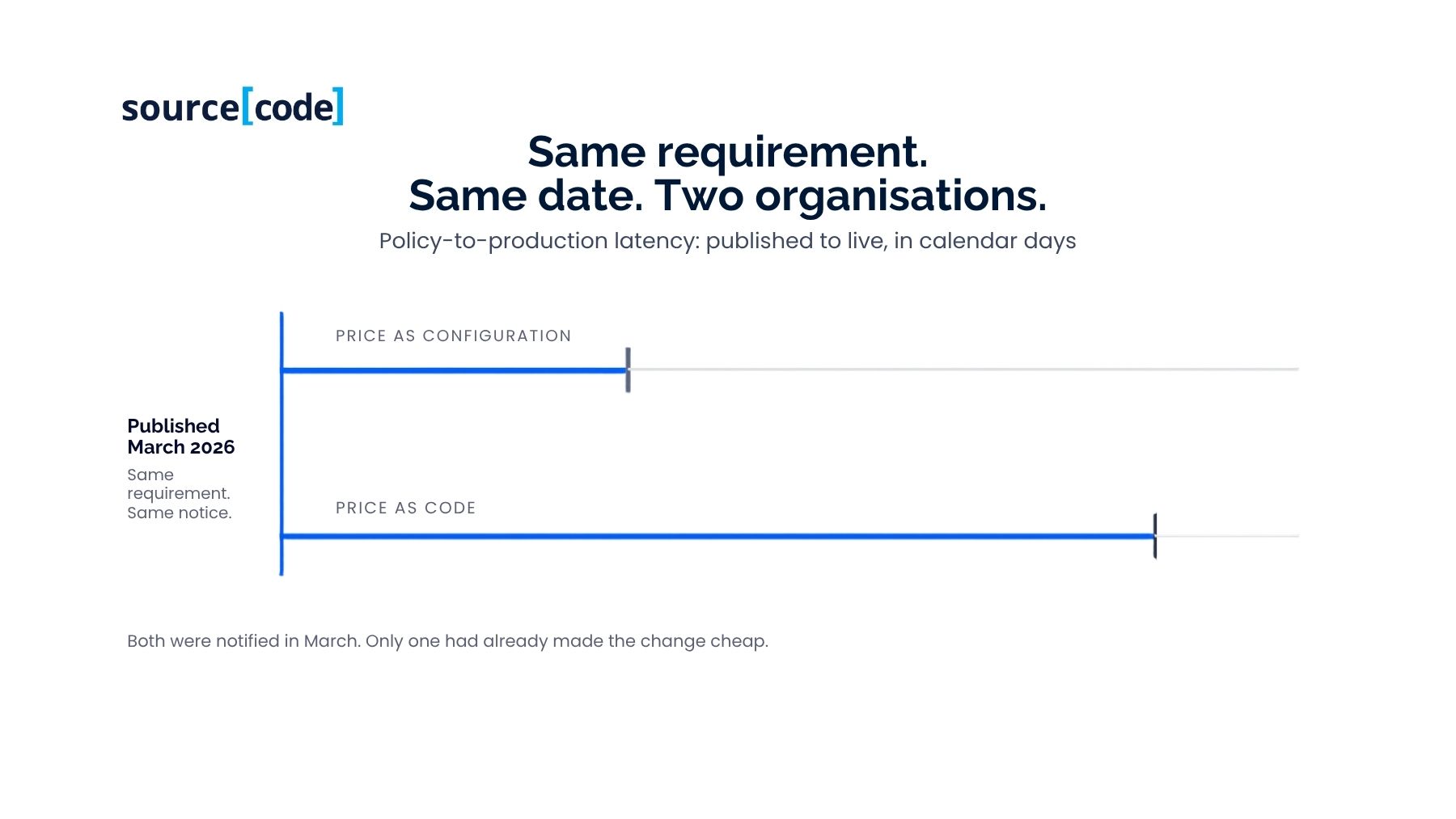
Its value is that it exposes design debt no other metric surfaces. A team with excellent feature velocity and poor policy-to-production latency looks healthy right up to the quarter when three jurisdictions move at once. The organizations that handle repricing without drama are rarely those with the most engineers. They are the ones where the following hold.
Price is data, not code. Fee schedules, interchange assumptions, surcharge behavior and merchant pricing live in versioned configuration with an effective-date field, an audit trail, and the ability to run two schedules in parallel across a cutover. A regulator's date becomes a scheduled activation, not a release train.
Eligibility is a policy artefact. Credit policy, affordability rules and customer-category logic are expressed declaratively, versioned, testable against historical portfolios, and reviewable by someone who does not read code. When a supervisor asks why a customer was approved in March, the answer is a query against a policy version, not a reconstruction.
Consent is first-class. Consent state - granted, refreshed, revoked, expired - is a modelled entity with its own lifecycle and observability, not a flag on a customer record. This is what makes CDR, IADS and any reciprocity regime an integration rather than a programme.
Rails are pluggable and instrumented. Adding a rail - a domestic instant scheme, a cross-border link, a new QR interoperation - is an adapter behind a stable internal contract, with reconciliation and exception handling built once rather than per integration.
The counter-argument deserves stating plainly, because it is often right. Building this discipline before you need it is over-engineering. A single-market fintech with one rail, one product and one regulator should hard-code its pricing and spend the budget on distribution. The threshold is roughly two or more regulated markets, or one market plus a licensed-credit or payments-license obligation on the roadmap. Below that line, judgement beats infrastructure. Above it the arithmetic reverses quickly - and most Series B and C fintechs in this region crossed the line in the last eighteen months without re-examining the assumption that got them there.
Real-World Examples
Profitability in this region is now demonstrably an operating achievement, not a funding one. Grab reported its first full-year net profit in FY2025 - US$200 million on revenue of US$3.37 billion, up 20 per cent - with its financial services segment growing revenue 37 per cent to US$347 million and its net loan portfolio more than doubling year on year to US$1,180 million (Grab Holdings, 2026). The instructive detail is the shape: financial services scaled as a component of an existing operating platform, not as a separately capitalized bet.
Australia's largest institutions have already answered the engineering-capacity question. Reporting in June 2026 put ANZ at approximately 9,000 employees in Bengaluru and 2,000 in Manila - around 28 per cent of its workforce - with NAB operating roughly 2,000 roles in Vietnam and Commonwealth Bank more than 6,500 in Bengaluru (SBS News, 2026); in July 2026, Commonwealth Bank cut 176 technology and engineering roles in Australia (ACS Information Age, 2026). A mid-size fintech now competes for APAC engineering talent against institutions that have industrialized the model, which raises the cost of assembling a platform team late.
The pattern in our own engagements. Two observations, offered directionally rather than as case studies. In embedded finance stacks we have reviewed across Australia and Southeast Asia, the most common source of repricing effort is not the pricing engine but the client applications - fee display copy, in-app disclosures and checkout logic never designed to be changed on a date. And the teams that absorbed a licensing change in weeks rather than quarters had usually done one thing years earlier: separated the decision from the decision's data, so policy could be versioned independently of the service executing it. Neither is exotic; both are cheap before a deadline and expensive during one.
Actionable Recommendations
Measure your last three. Take the three most recent externally mandated changes your product absorbed. For each, record the date the requirement was published, the date it went live in production, and the engineer-weeks consumed. That is your policy-to-production latency, and it is the most honest number in your operating review.
Put an effective-date field on every price. If a fee, rate, surcharge behavior or interchange assumption cannot be changed by configuration with a future activation date and a parallel-run capability, it is a scheduled outage waiting for a regulator's calendar.
Run the 1 October scenario now if you touch Australia. Model the P&L at a 0.3 per cent consumer credit cap with zero surcharge recovery, and separately at a 1.0 per cent foreign-card cap from April 2027. If the model requires repricing your own merchant or partner terms, those are contractual conversations with notice periods - which makes this a September problem, not an October one.
Inventory your license perimeter on one page and put the rail roadmap beside it. Which entity holds which license, which product sits inside which perimeter, and which transition window closes when - Malaysia's closes on 31 December 2026. If cross-border matters to your 2028 plan, the Nexus integration work belongs in the next four quarters, not the quarter after go-live.
Staff the platform before the growth. Where late-stage capital is concentrated and seed is scarce, the marginal engineer is better spent making change cheap than making features fast - a defensible allocation to a board precisely because it is measurable.
The sourceCode Perspective
We build and run engineering teams for banks, insurers and fintechs across Australia and Southeast Asia, so the bias is declared: we think most of what gets described as a compliance cost in this market is actually a design cost, incurred years earlier and paid on a regulator's schedule.
What we observe consistently is that the organizations absorbing change cheaply are not those with the largest engineering functions or the newest tooling. They are the ones where a small, permanent platform team owns the contracts between systems - pricing, policy, consent, rails - and where product teams build on top of those contracts rather than around them. That structure is unremarkable to describe and genuinely hard to retrofit, which is why the moment to build it is the quarter before you need it.
The honest caveat: for an early-stage single-market team, the right answer is still speed and hard-coding. The argument is about the crossing point - and about the fact that in APAC, in 2026, that crossing point arrives with a date attached.
Conclusion
The embedded finance debate in Asia-Pacific has moved past whether consumers want financial services inside the products they already use. They demonstrably do. It has moved to a harder question: who keeps making money doing it while the price of doing it is reset by supervisors working to published timetables.
Australia reprices on 1 October. Malaysia's licensing window closes on 31 December. Indonesia has already redrawn who may lend inside an app. Cross-border goes live in 2027, which makes the integration work a 2026 problem. None of these dates is a surprise, and none is negotiable.
The organizations that come through this period well will not be the ones that saw the changes coming - everyone saw them coming. They will be the ones that had already made change cheap.
Stay ahead of the next date. The regulatory timetable in this piece is not the last one. Analysis like this: the pricing changes, the licensing perimeters and the engineering decisions that follow - goes to subscribers of APAC BFSI Weekly every Monday, alongside the banking and fintech developments that shape the region's operating environment.
Subscribe here: APAC BFSI Weekly
Frequently Asked Questions
What is embedded finance? Embedded finance is the delivery of financial services - payments, credit, insurance or savings - inside a non-financial product or platform at the point of need, so the customer never leaves the host experience. In Southeast Asia it most commonly appears as wallet payments, buy-now-pay-later at checkout, and in-app credit.
What is policy-to-production latency? Policy-to-production latency is the elapsed calendar time between a regulator publishing a dated, in-scope requirement and that requirement being live, verified and auditable in a company's production product, together with the engineering effort consumed. It is an operating metric rather than a compliance metric, and it can be measured retrospectively from changes an organization has already absorbed.
What changes in Australian card payments on 1 October 2026? From 1 October 2026, surcharging is removed on debit, prepaid and credit cards on the designated eftpos, Mastercard and Visa networks, and domestic interchange caps fall to 0.3 per cent of transaction value for consumer credit (with the weighted-average benchmark removed) and 8 cents per transaction or 0.16 per cent for debit and prepaid; commercial credit remains capped at 0.8 per cent. A 1.0 per cent cap on foreign-issued cards takes effect on 1 April 2027. The Reserve Bank of Australia estimates the changes remove around A$660 million a year of interchange revenue from domestic issuers.
Who may provide buy-now-pay-later in Indonesia in 2026? Under OJK Regulation 32/2025, which took effect on 15 December 2025 with a grace period for existing providers that expired on 15 June 2026, BNPL provision is restricted to commercial banks and financing companies, with financing companies requiring prior approval from the regulator, alongside minimum age and minimum income requirements for borrowers.
When do Malaysia's consumer credit licensing obligations bite? Malaysia's Consumer Credit Act 2025 came into force on 1 March 2026, establishing the Consumer Credit Commission. Licensing and registration requirements took effect on 1 June 2026, with a transition period running to 31 December 2026, and non-bank credit providers must conduct affordability assessments before extending credit to individuals.
When does Nexus cross-border instant payments go live? Nexus Global Payments, the Singapore-incorporated scheme organization established in 2025 by the central banks of India, Malaysia, the Philippines, Singapore and Thailand - with Indonesia joining as the sixth participant in 2026 - appointed a PayNet-NETS joint venture as technical operator on 9 February 2026, with technical development beginning in early 2026 and go-live targeted for 2027. Claims that Nexus goes live in 2026 are incorrect.
What is open finance reciprocity? Open finance reciprocity is a framework design in which any institution that consumes customer data under the regime must also make equivalent data available as a provider. It is a feature of the open finance framework proposed by Bank Negara Malaysia, on which consultation closed on 1 March 2026, and it materially changes the economics for firms that assumed read-only access to customer data.
Does AI make fintech engineering teams faster? The evidence is mixed and should be read carefully. Google's DORA research finds around 90 per cent of developers using AI and more than 80 per cent believing it improves their productivity, while also finding AI adoption negatively related to delivery stability. A randomized controlled trial by METR measured 16 experienced developers as 19 per cent slower on real tasks with AI tooling, despite expecting to be faster - a result its authors caution against over-generalizing. The consistent finding across studies is that AI amplifies the quality of the underlying engineering system rather than substituting for it.
References
ACS Information Age, 2026. Commonwealth Bank cuts more tech jobs, 10 July. Available at: https://ia.acs.org.au/article/2026/commonwealth-bank-cuts-more-tech-jobs.html [Accessed 2 August 2026].
Australian Competition and Consumer Commission (ACCC), 2026. Non-bank lenders join Consumer Data Right as next stage commences, media release, 13 July. Available at: https://www.accc.gov.au/media-release/non-bank-lenders-join-consumer-data-right-as-next-stage-commences [Accessed 2 August 2026].
Australian Securities and Investments Commission (ASIC), 2025. Buy now pay later credit contracts: Credit licensing. Available at: https://www.asic.gov.au/regulatory-resources/credit/buy-now-pay-later-credit-contracts-credit-licensing/ [Accessed 2 August 2026].
Bangko Sentral ng Pilipinas data, reported in BusinessWorld, 2026. InstaPay, PESONet transfers surpass P16T, 17 July. Available at: https://bworldonline.com/top-stories/2026/07/17/764150/instapay-pesonet-transfers-surpass-p16t/ [Accessed 2 August 2026].
Bank for International Settlements, 2026. Opening doors to open finance: evidence from the international experience, BIS Papers No. 168, 30 March. Available at: https://www.bis.org/publ/bppdf/bispap168.pdf [Accessed 2 August 2026].
Bank Indonesia, 2026. Bank Indonesia Board of Governors Meeting - payment system developments, Q1 2026, 22 April. Available at: https://www.bi.go.id/id/publikasi/ruang-media/news-release/Pages/sp_288426.aspx [Accessed 2 August 2026].
Endava plc, 2026. Nexus Global Payments appoints technical operator, 9 February. Available at: https://investors.endava.com/news-events/press-releases/detail/115/nexus-global-payments-appoints-technical-operator [Accessed 2 August 2026].
Google Cloud DORA, 2025. State of AI-assisted Software Development 2025, 23 September. Available at: https://cloud.google.com/blog/products/ai-machine-learning/announcing-the-2025-dora-report [Accessed 2 August 2026].
Grab Holdings Limited, 2026. Grab reports fourth quarter and 2025 results with first full-year net profit, 12 February. Available at: https://www.grab.com/sg/press/others/grab-reports-fourth-quarter-and-2025-results-with-first-full-year-net-profit/ [Accessed 2 August 2026].
Hong Kong Monetary Authority (HKMA), 2026. Interbank Account Data Sharing (IADS). Available at: https://www.hkma.gov.hk/eng/key-functions/international-financial-centre/fintech/interbank-account-data-sharing/ [Accessed 2 August 2026].
HSBC, Google Cloud and Payments and Commerce Market Intelligence (PCMI), 2025. Digital Frontiers 2030: Unlocking opportunities from Southeast Asia's digital acceleration, 13 November (survey of 2,436 respondents across Singapore, Malaysia, Thailand, Indonesia, Vietnam and the Philippines). Available at: https://www.about.hsbc.com.sg/news-and-media/hsbc-and-google-cloud-report [Accessed 2 August 2026].
KPMG International, 2026. Pulse of Fintech H2 2025 - Asia-Pacific, February. Available at: https://kpmg.com/xx/en/what-we-do/industries/financial-services/pulse-of-fintech/aspac.html [Accessed 2 August 2026].
METR, 2025. Measuring the Impact of Early-2025 AI on Experienced Open-Source Developer Productivity, 10 July. Available at: https://metr.org/blog/2025-07-10-early-2025-ai-experienced-os-dev-study/ [Accessed 2 August 2026].
Nexus Global Payments, 2026. About Nexus. Available at: https://www.nexusglobalpayments.org/about-nexus/ [Accessed 2 August 2026].
Payments Network Malaysia (PayNet), 2026. 8.44 billion transactions processed in 2025 as digital payments become Malaysians' preferred way to pay, 22 April. Available at: https://www.paynet.my/about-us/media-centre/press-release/8-44-billion-transactions-processed-in-2025-as-digital-payments-become-malaysians-preferred-way-to-pay.html [Accessed 2 August 2026].
Reserve Bank of Australia, 2026a. Review of Merchant Card Payment Costs and Surcharging - Conclusions Paper: Impact and Implementation, 31 March. Available at: https://www.rba.gov.au/payments-and-infrastructure/review-of-retail-payments-regulation/2026-03/conclusions-paper/impact-and-implementation.html [Accessed 2 August 2026].
SBS News, 2026. Australian companies offshore jobs explained, 12 June. Available at: https://www.sbs.com.au/news/article/australian-companies-offshore-jobs-explained/bryis54ty [Accessed 2 August 2026].
Tracxn, 2026. Southeast Asia Tech H1 2026, 3 July, reported in Tech Wire Asia. Available at: https://techwireasia.com/2026/07/southeast-asia-tech-funding-h1-2026/ [Accessed 2 August 2026].