The Data-Rich Payment: Turning ISO 20022 From Compliance Deadline Into APAC BFSI Growth Engine
Executive Summary
The SWIFT MT-to-MX coexistence window closed in November 2025. Nine months on, the majority of APAC banks have technically achieved compliance, yet only a small minority are extracting commercial, risk or operational value from the structured data ISO 20022 now delivers. The migration has been treated primarily as a payments-operations project rather than an enterprise data event. This article argues that ISO 20022 is the largest untapped data asset on the balance sheet of most APAC banks, and sets out a five-lever framework - payment intelligence, cash management, AML precision, treasury automation and merchant analytics - that CIOs, CDOs and Heads of Payments can activate in the next twelve months. Banks that industrialize ISO 20022 data will structurally outperform on cross-border wallet share, correspondent revenue and financial-crime cost per transaction. Those that stop at compliance will discover that the standard's benefits accrue disproportionately to their competitors.
Introduction
Standards migrations rarely feel like strategic inflection points while they are happening. They are budgeted as regulatory programmes, staffed by payments operations and message-format specialists, and measured against a go-live date. ISO 20022 has followed exactly this pattern across most of Asia-Pacific banking. The dominant conversation in 2024 and 2025 was truncation risk, MT-MX translation, and CBPR+ readiness for high-value cross-border flows via SWIFT, alongside domestic real-time rails such as Australia's New Payments Platform, Singapore's FAST, Hong Kong's FPS, India's UPI messages, and Malaysia's RENTAS.
That conversation is now largely closed. The Bank for International Settlements' Committee on Payments and Market Infrastructures reports that more than 70 payment market infrastructures globally have migrated, with the ECB's TARGET2, the Federal Reserve's FedNow, Australia's HVPS+ pilots and most APAC RTGS systems either live or in final phases (BIS-CPMI, 2024). SWIFT reports that by end-2025 the vast majority of cross-border FIN traffic had transitioned to MX equivalents (SWIFT, 2025).
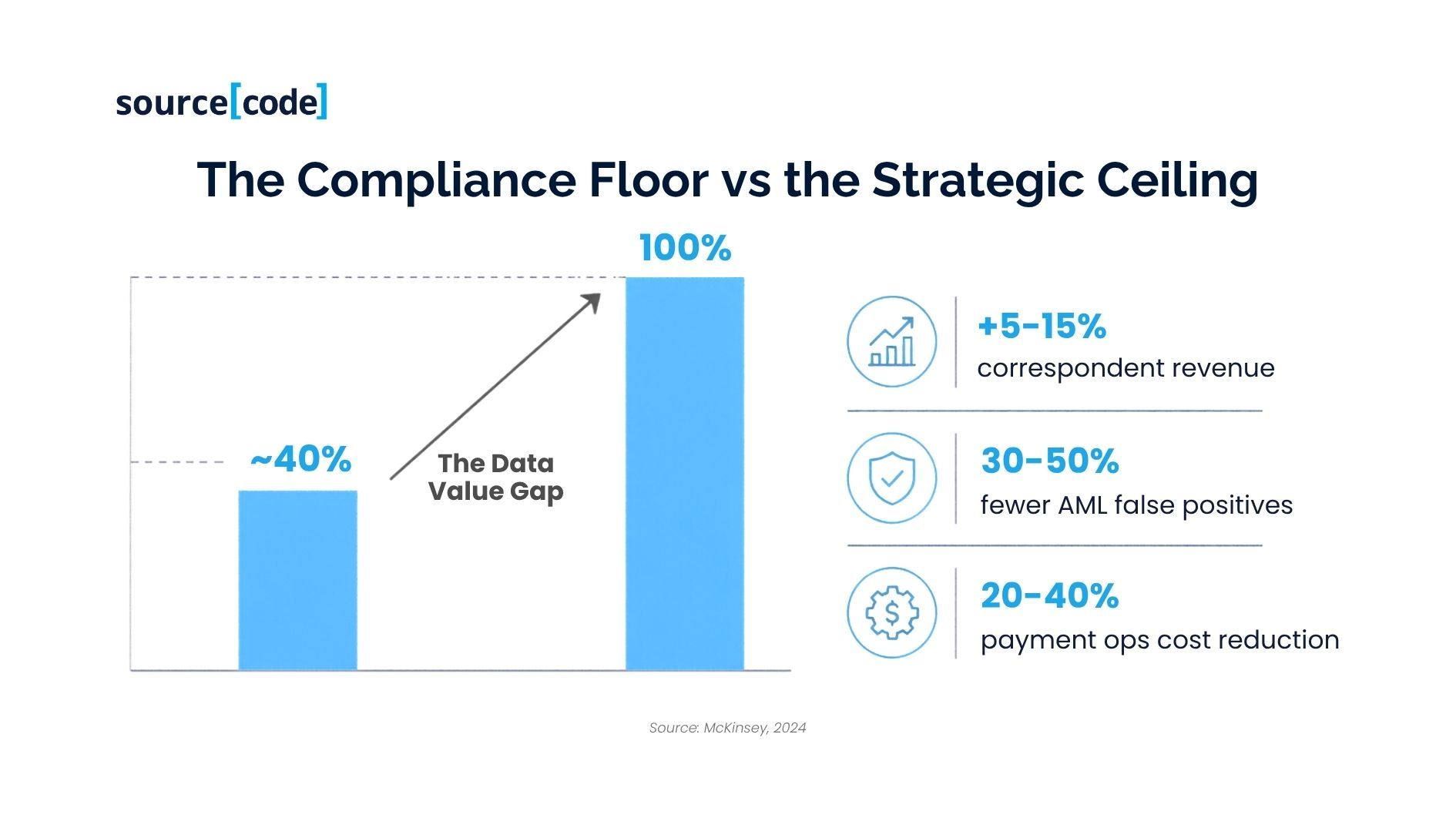
Compliance is the floor. The question APAC banking leaders should be asking in the second half of 2026 is far more consequential: what do we now do with a payment record that carries structured remittance, enriched party data, purpose codes, ultimate debtor and creditor fields, and machine-readable references? McKinsey estimates that structured payment data - if operationalised - can lift correspondent banking revenue by 5 to 15 per cent, reduce false-positive AML alerts by 30 to 50 per cent, and cut payment operations cost per transaction by 20 to 40 per cent (McKinsey, 2024).
The gap between the standard's potential and current APAC realization is where competitive advantage will be built or lost.
What ISO 20022 Actually Changes
ISO 20022 is often described as "a richer message format". That framing understates what has occurred. Three shifts matter for strategy.
First, payments become data objects, not text strings. A pacs.008 or pain.001 message carries typed fields for structured remittance, purpose, regulatory reporting, legal entity identifiers, and up to nine layers of party information. A well-populated cross-border payment now contains an order of magnitude more usable information than its MT103 predecessor.
Second, the data becomes interoperable end-to-end. When corporates originate a pain.001 with structured remittance, that context travels through the correspondent chain and can be delivered to the beneficiary's ERP without manual re-keying. Accenture estimates that the working-capital release from straight-through reconciliation across APAC corporate treasuries is worth USD 20 to 40 billion in released trapped cash (Accenture, 2024).
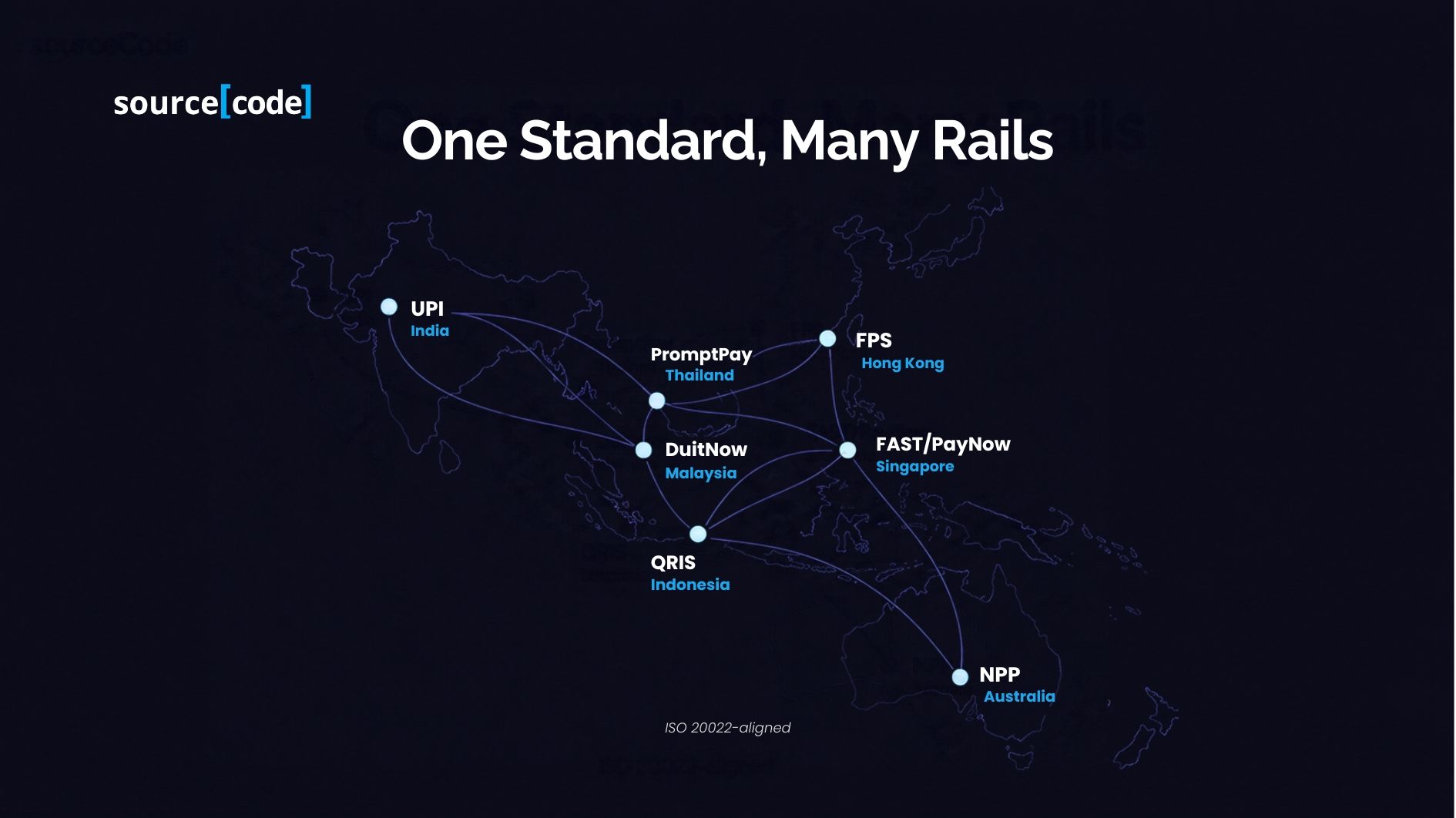
Third, ISO 20022 aligns with domestic real-time rails. Australia's NPP has always been ISO 20022-native. Singapore's FAST, Hong Kong's FPS, Thailand's PromptPay, and Malaysia's DuitNow use ISO 20022 or ISO 20022-derived schemas. This means a bank that industrialises the standard once can apply the same data models across cross-border, high-value and instant rails - a unification that legacy MT never allowed.
Why the Value Has Not Landed
Six recurring failure modes explain the slow value realization observable across APAC banks.
Compliance-only project scope. Migration was governed by a Head of Payments Operations with a fixed budget and a regulatory deadline. Data, risk, treasury and commercial owners were not co-invested. Once go-live cleared, the programme wound down.
Data truncation and translation debt. Many banks are still emitting "MT-shaped" MX messages - structurally valid but semantically empty. Wolters Kluwer's 2025 payments survey found that 61 per cent of APAC banks admit their outbound MX messages are populated below 40 per cent of available fields (Wolters Kluwer, 2025). This is compliance without data.
Legacy core and channels. Corporate portals, mobile banking channels and treasury cores were not upgraded in lockstep. Rich data arrives on the wire and is discarded before it reaches decisioning systems.
Correspondent chain weakest link. A payment's data richness is only as good as the least-modernised bank in the chain. Coalition Greenwich data indicates that around a third of intra-APAC corridors still contain at least one participant that flattens or truncates structured fields (Coalition Greenwich, 2025).
Fragmented data governance. ISO 20022 data lives in payments, but its value accrues to AML, treasury, cash management and CX. In most banks, no single accountable owner exists across that surface.
No product monetisation model. Very few APAC banks have priced or productised structured remittance, virtual account reconciliation, or purpose-code analytics as a differentiated service.
Key Trends Shaping 2026 and 2027
Five forces will decide which banks convert data into economics.
The G20 cross-border roadmap targets bind in 2027. The Financial Stability Board's roadmap sets targets of 75 per cent of cross-border payments credited within one hour and cost transparency for retail and wholesale segments (FSB, 2024). ISO 20022 is the enabling infrastructure. Banks not delivering these SLAs will lose corporate wallet share to non-bank PSPs and stablecoin rails.
Regulator-mandated data quality. APRA, MAS, HKMA and the RBI have begun signaling supervisory expectations that structured party and purpose data must be populated correctly, particularly for sanctions and financial-crime purposes. MAS's 2025 Payments Consultation makes structured remittance a supervisory quality metric (MAS, 2025).
Real-time payments as the default corporate rail. ACI Worldwide projects real-time transaction volumes in APAC will exceed 250 billion by 2028, driven by India, Thailand and Indonesia (ACI Worldwide, 2025). ISO 20022 is the lingua franca of that volume.
AI-native reconciliation and exception handling. Structured payment data becomes machine-actionable. Agentic workflows can now auto-resolve investigations that previously required human research; Capco estimates 50 to 70 per cent reduction in unit cost of exception handling for banks combining ISO 20022 with agentic operations (Capco, 2025).
Stablecoin and tokenized deposit interoperability. Emerging tokenized money rails, including Project Agora and the mBridge extensions coordinated by BIS Innovation Hub, are being designed on ISO 20022 semantics (BIS, 2025). A bank fluent in ISO 20022 is structurally ready for the next payment fabric.
Five Levers That Convert Compliance Into P&L
The banks pulling ahead in Australia, Singapore and select Southeast Asian markets are treating ISO 20022 as an enterprise data asset, not a message format. They are activating five levers concurrently.
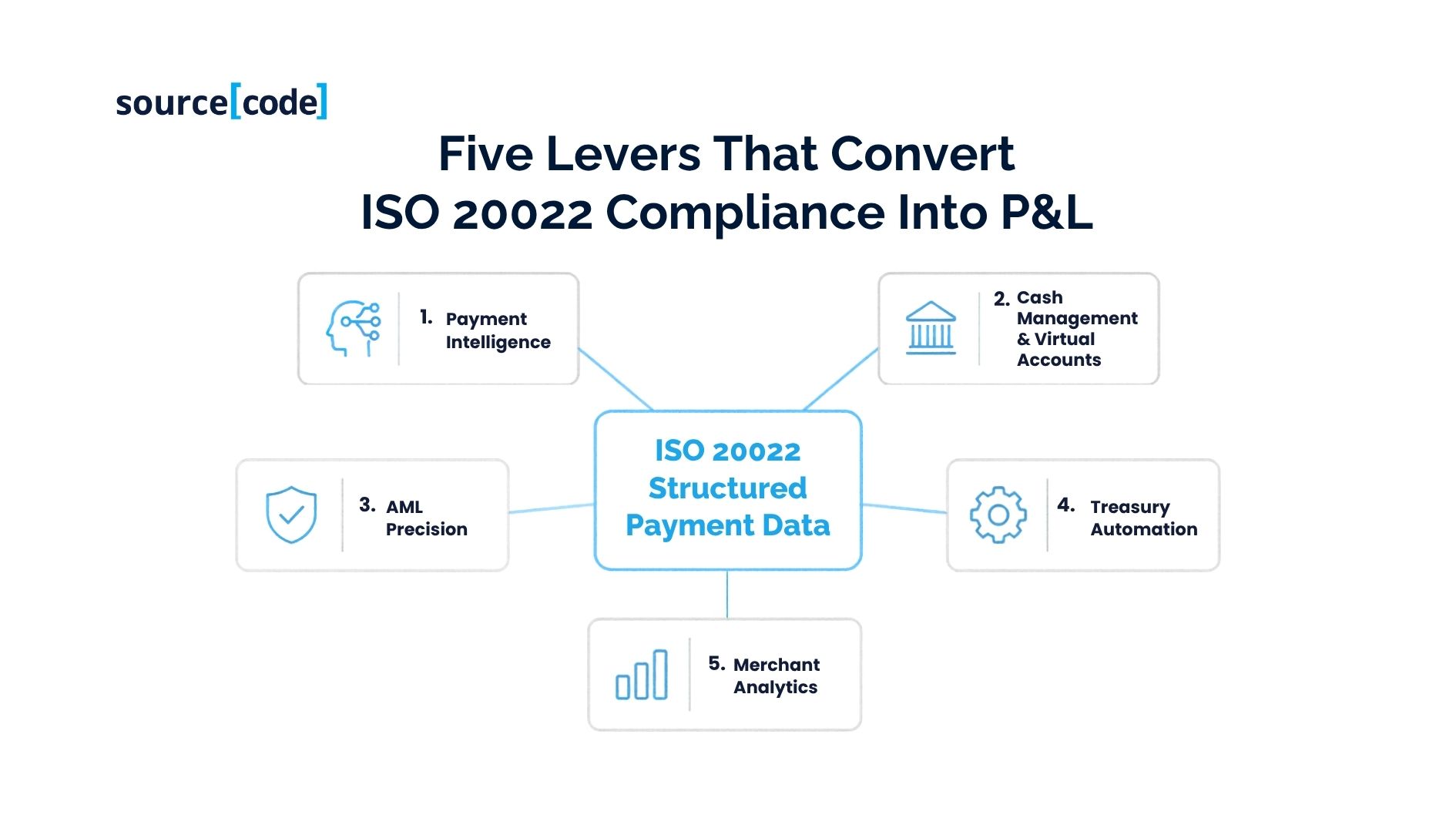
Lever 1 - Payment Intelligence
Structured payment data, combined with counterparty, geography and purpose codes, becomes a real-time telemetry stream describing corporate client behavior. Applied to relationship management, it surfaces working-capital stress, new supplier corridors, and cross-sell triggers before the RM has visibility. BCG has documented uplifts of 8 to 12 per cent in transaction-banking product cross-sell where payment intelligence is systematically fed into RM workbenches (BCG, 2024).
Lever 2 - Cash Management and Virtual Accounts
ISO 20022 structured remittance enables automated invoice-level reconciliation via virtual account architectures. For APAC corporates with fragmented ASEAN receivables, this collapses weeks of manual matching into minutes. Deloitte estimates that virtual account propositions built on ISO 20022 can generate 15 to 25 basis points of incremental deposit margin through liquidity concentration (Deloitte, 2024).
Lever 3 - AML and Financial Crime Precision
Structured beneficiary, ultimate party and purpose fields materially improve sanctions screening and transaction monitoring precision. IBM Institute for Business Value data suggests that ISO 20022-enriched screening can reduce false positives by 30 to 45 per cent in trade and correspondent flows (IBM IBV, 2024). Given that mid-size APAC banks typically run financial-crime operations of 400 to 1,200 FTE, the operating leverage is material.
Lever 4 - Treasury and Liquidity Automation
Purpose codes, value dates and structured cash flow forecasts embedded in ISO 20022 messages enable predictive intraday liquidity management. This is particularly acute in APAC where fragmented currencies, cut-off times and market holidays create friction. Oliver Wyman puts intraday liquidity buffer reductions of 5 to 10 per cent within reach for banks that fully exploit ISO 20022 (Oliver Wyman, 2024).
Lever 5 - Merchant and Acquirer Analytics
For banks with merchant acquiring, ISO 20022 real-time payment messages give richer merchant category, geolocation and consumer-context data than card rails. This becomes the raw material for merchant lending, dynamic MDR, and loyalty propositions.
Real-World Signals from APAC
Australia's major banks have moved fastest on HVPS+ RITS migration and are beginning to expose structured remittance APIs to corporate customers. NPP's PayTo - natively ISO 20022 - is being adopted by superannuation, insurance and utility billers as a direct-debit replacement, with the RBA reporting steadily rising PayTo agreement volumes across 2025 and 2026 (RBA, 2026).
Singapore's DBS has publicly discussed treating payments as a data platform, integrating ISO 20022 flows into corporate CFO dashboards. Regionally, ASEAN's cross-border QR linkages between PromptPay, DuitNow, QRIS and PayNow have adopted ISO 20022-aligned messaging, providing a real-time cross-border rail parallel to SWIFT (BIS, 2025).
Hong Kong's FPS is now integrated with the HKMA-coordinated eTradeConnect and the Commercial Data Interchange, allowing structured payment context to feed SME credit decisions. India's account aggregator framework interlocks with UPI-derived structured payment data to power alternate-data lending at scale, with the DPI stack reporting more than a billion consented data flows to date (Ministry of Finance India, 2025).
The pattern across these signals is consistent: the banks capturing value are the ones that treat ISO 20022 as a data supply chain feeding multiple business lines, not as a payments-team artefact.
Actionable Recommendations
CIOs, CDOs and Heads of Payments should structure a twelve to eighteen-month "ISO 20022 Value Realization" programme along five tracks.
Establish a single enterprise owner for structured payment data quality, jointly accountable to the CDO and Head of Payments. Publish a monthly data-quality scorecard measuring outbound field population rates across pacs, pain and camt families against internal benchmarks and correspondent peer averages.
Rebuild the corporate and channels stack to preserve structured data end-to-end. Any downstream system that flattens remittance, party or purpose fields becomes the choke point that destroys enterprise value.
Industrialise payment intelligence services for relationship managers and product owners. Feed structured data into an event-driven data platform, expose it through governed APIs, and instrument decisioning models on top.
Redesign financial-crime models and screening engines to consume structured fields natively. The historical MT-era assumption of unstructured free-text screening no longer holds; models must be retrained on richer semantic inputs, with governance under model risk management (MRM) frameworks.
Productize corporate-facing services - virtual accounts, real-time reconciliation, purpose-code analytics, sanctions transparency - as tiered fee propositions. This shifts ISO 20022 from a cost line to a revenue line.
The sourceCode Perspective
At sourceCode, we work with APAC BFSI institutions on the engineering backbone that turns standards migration into competitive infrastructure. Our teams have delivered structured payment data platforms, event-driven ISO 20022 middleware, API productization for corporate banking, and AI-assisted exception handling for banks across Australia and Southeast Asia. We approach ISO 20022 not as a message format engagement but as an enterprise data programme: joining payments engineering to data platforms, financial-crime models, treasury systems and corporate channels. That perspective - engineering excellence anchored in BFSI domain depth - is what enables banks to close the gap between the compliance floor and the strategic ceiling this standard was designed to lift.
Conclusion
ISO 20022 will be remembered either as the most expensive compliance exercise APAC banking undertook in the 2020s, or as the moment payments became data. Which of those retrospectives applies to any individual bank is being determined now, in the choices being made between wave-two investment cases and cost-cut rebasing. The standard is unusual because its benefits are strongly non-linear: half-implementation generates a fraction of the value. The banks that industrialize the data layer, unify governance across payments, risk, treasury and channels, and productize the resulting services will pull sharply ahead of peers on cross-border wallet share, financial-crime cost, and corporate deposit stickiness. The window to capture first-mover positioning across APAC is roughly the next eighteen months.
Considering how to convert your ISO 20022 investment into a durable data and revenue advantage? Talk with sourceCode about building the engineering and data backbone that turns payment messages into enterprise intelligence.
FAQ
What is ISO 20022 in banking? ISO 20022 is a global messaging standard that structures financial messages - payments, securities, cash management - as data objects with typed fields. It replaces free-text formats such as SWIFT MT and enables richer, machine-readable information to flow end-to-end across the payments chain.
When did SWIFT complete the ISO 20022 migration? SWIFT's MT-to-MX coexistence period for cross-border payments and reporting (CBPR+) closed in November 2025, after which MX messages became the operating standard for cross-border FIN traffic.
Why is ISO 20022 strategic and not just a compliance task? Structured fields for remittance, party information and purpose codes make payments into a data asset. Banks can use this data to improve AML precision, cross-sell to corporates, automate reconciliation, and productize cash management services.
Which APAC payment systems use ISO 20022? Australia's NPP and HVPS+, Singapore's FAST and PayNow, Hong Kong's FPS, Thailand's PromptPay, Malaysia's RENTAS and DuitNow, India's UPI-derived messaging and most regional RTGS systems now use ISO 20022 or ISO 20022-aligned schemas.
What is the biggest execution risk after ISO 20022 go-live? Emitting technically valid but semantically empty MX messages - "MT-shaped MX" - where structured fields are under-populated. This delivers compliance but destroys downstream data value and blocks AML, treasury and CX use cases.
References
Accenture, 2024. Cross-border payments in Asia: unlocking working capital through data. Accenture Research.
ACI Worldwide, 2025. Prime Time for Real-Time 2025. ACI Worldwide.
Bank for International Settlements (BIS), 2025. Project Agora and cross-border tokenization update. BIS Innovation Hub.
Bank for International Settlements - CPMI, 2024. Harmonized ISO 20022 data requirements for cross-border payments. Committee on Payments and Market Infrastructures.
BCG, 2024. Global Payments Report 2024: Fortune Favours the Bold. Boston Consulting Group.
Capco, 2025. Payments operations in the agentic era. Capco Intelligence.
Coalition Greenwich, 2025. APAC Corporate Banking: Payments Modernization Benchmark.
Deloitte, 2024. Transaction banking: winning with data in ASEAN. Deloitte Insights.
Financial Stability Board (FSB), 2024. G20 Roadmap for Enhancing Cross-Border Payments: Consolidated Progress Report.
IBM Institute for Business Value (IBV), 2024. ISO 20022: from compliance to competitive advantage.
McKinsey, 2024. Global Payments Report 2024. McKinsey & Company.
Ministry of Finance India, 2025. India Digital Public Infrastructure Annual Update.
Monetary Authority of Singapore (MAS), 2025. Payments Services Consultation Paper.
Oliver Wyman, 2024. Intraday liquidity: the next efficiency frontier.
Reserve Bank of Australia (RBA), 2026. Payments System Board Annual Report.
SWIFT, 2025. ISO 20022 Migration Progress Update, Q4 2025.
Wolters Kluwer, 2025. APAC Payments Compliance Benchmark 2025.