The SME Credit Reset: Closing APAC's Financing Divide with AI-Native Underwriting
Executive Summary
Across APAC, the small-and-medium-enterprise (SME) financing gap has calcified into a strategic problem for banks, not just a social one. The Asian Development Bank's 2025 Global Trade Finance Gap Survey pegs the worldwide trade finance shortfall at USD 2.5 trillion, unchanged from 2023, with SMEs still absorbing a disproportionate share of rejections at 41 percent (ADB, 2025). The International Finance Corporation's most recent global estimate places the total formal MSME credit gap at USD 5.2 trillion, plus a further USD 2.9 trillion for informal enterprises - a combined shortfall larger than the GDP of Japan (IFC, 2024).

Yet the same period has produced the technical ingredients for a genuine reset. Alternative credit-scoring markets in Asia-Pacific are compounding at 25.8 percent through 2031, and AI-powered, cash-flow-based SME lending is expanding at roughly 26 percent CAGR into the next decade (Mordor Intelligence, 2026; MarketIntelo, 2026). One large European bank cited by McKinsey compressed "time-to-yes" on SME credit from 20 days to under 10 minutes, lifting win rates by a third and margins by more than 50 percent (McKinsey, 2024). The lesson is unambiguous: SME credit is no longer a bureau problem - it is a data-engineering problem.
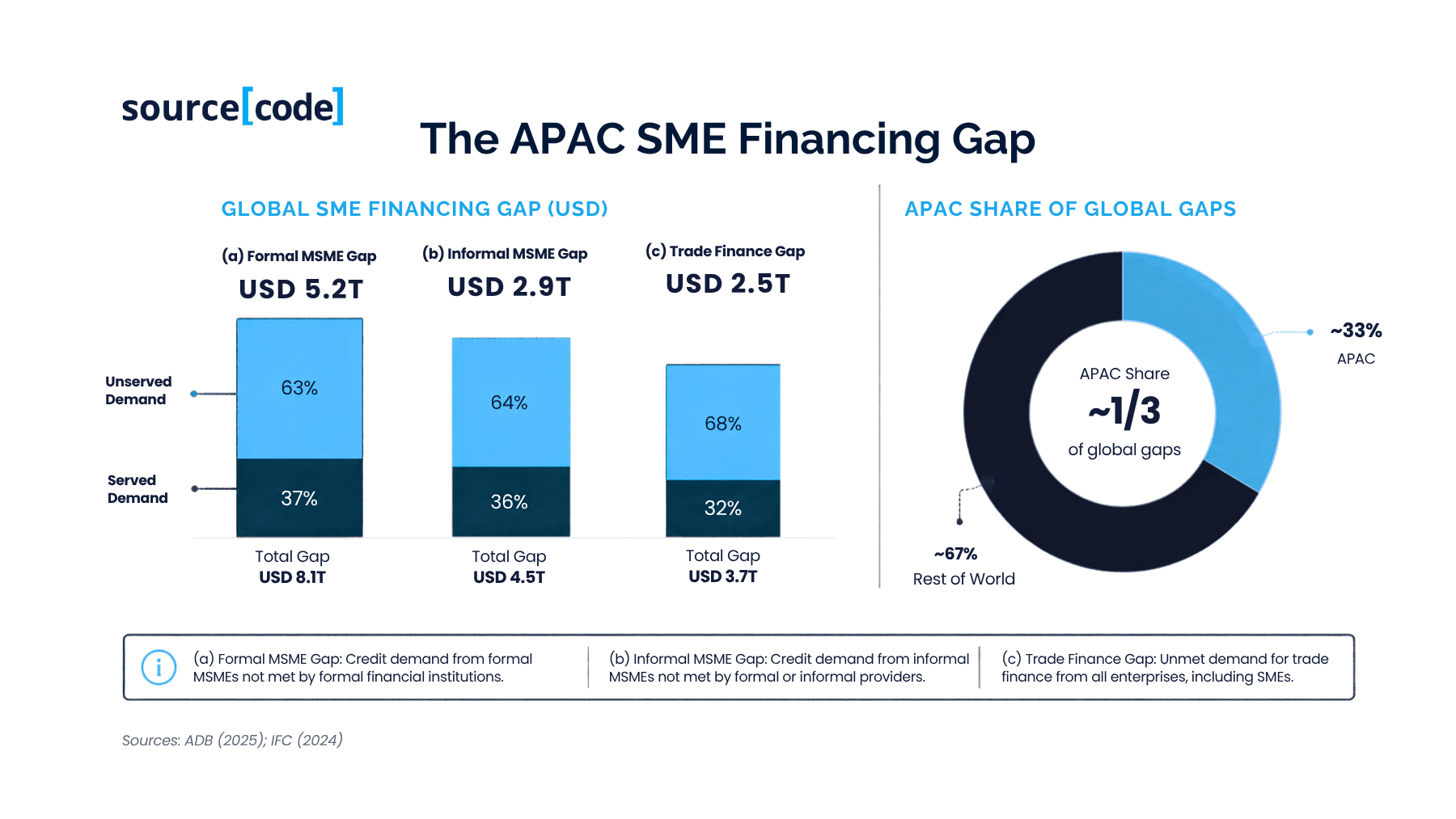
This article sets out why APAC banks that treat SME lending as a platform, not a product, will capture the region's next USD-scale profit pool - and what CIOs, CDOs, and heads of business banking must build in the next 12-18 months to be part of it.
Introduction
For a decade, incumbent banks in APAC have described SME banking as "difficult to serve at scale." The dossier of reasons is familiar: thin credit files, fragmented informal-sector activity, high manual-underwriting cost, and lifetime revenue that rarely justifies a relationship manager. Digital natives have used exactly the same conditions to build category leadership. GXS Bank (Grab), ANEXT Bank (Ant), Green Link, Tyme, and non-bank platforms such as Funding Societies, Validus, and Aspire have moved from niche to mainstream by treating SME data - payments, invoicing, payroll, logistics, marketplace - as the underwriting file itself.
The competitive question is now inverted. Incumbents are not asking whether SMEs are bankable; they are asking whether their own credit stacks can decide fast enough and accurately enough to defend share. Regulators are accelerating the shift: Australia's Consumer Data Right (CDR) is being extended to non-bank lenders in phases from 9 November 2026 (ACCC, 2026); Singapore's SGFinDex and PayNow rails already expose consented cash-flow data; India's Account Aggregator framework has crossed one billion consented data pulls; and ASEAN policymakers, backed by the World Economic Forum, are building interoperable digital-finance corridors to reduce SME onboarding friction (WEF, 2025).
The winners of the next cycle will not be defined by balance-sheet capacity. They will be defined by how quickly they industrialize AI-native credit decisioning across their small-business franchises.
Industry Context
Three structural forces have converged to make 2026 the pivotal year for SME credit in APAC.
First, demand. SMEs generate more than 97 percent of registered businesses and account for around half of employment across ASEAN and Australia (OECD, 2026). Post-tariff supply-chain realignment, the ASEAN electric-vehicle build-out, and the region's construction backlog all require working-capital velocity that traditional annual reviews cannot supply.
Second, data availability. More than 70 percent of adults in Indonesia, Vietnam, and the Philippines now transact on digital payment platforms (WEF, 2025). Grab, Sea, GoTo, Naver, and regional QR schemes have produced a decade of high-frequency merchant data. Grab's financial services arm reported a 56 percent year-on-year jump in loan disbursements to USD 566 million by March 2025 alongside a 44 percent revenue increase - evidence that underwriting on platform data works at scale (GrowthHQ, 2025).
Third, regulation. APRA's CPS 230, MAS Notice 655 on customer due diligence, HKMA's supervisory guidance on model risk, and Australia's CDR expansion each raise the bar on the quality of credit decisioning while simultaneously opening the sources of data that decisioning can consume. Together they create the conditions for banks to redesign the underwriting operating model - provided they invest in the plumbing.
Current Challenges
Despite the tailwinds, most APAC incumbents are still constrained by four architectural drags:
- Bureau dependency. Credit scores in most ASEAN jurisdictions still lean on limited bureau data with poor coverage of SMEs that trade primarily through digital wallets, marketplaces, or informal channels.
- Fragmented data estates. Customer-transaction data lives in the core, cash management in a treasury system, KYC in a compliance vault, and invoicing in a partner platform. Feature stores that unify these signals are the exception.
- Slow model lifecycle. Credit models take 6-12 months to move from development to production. Champion-challenger discipline, drift monitoring, and MRM sign-off remain manual.
- Product economics. Origination cost per SME ticket often exceeds AUD 3,000-5,000 in Australia and USD 1,500-3,000 in Southeast Asia - high enough to make sub-SGD 250,000 tickets structurally unprofitable under the current model.
Digital natives have used these frictions as a moat. Traditional banks that continue to price for risk they cannot see will keep losing the profitable slice of the SME book to platforms that can.
Key Trends Shaping 2026-2028
Five trends are reshaping the SME credit stack across APAC.
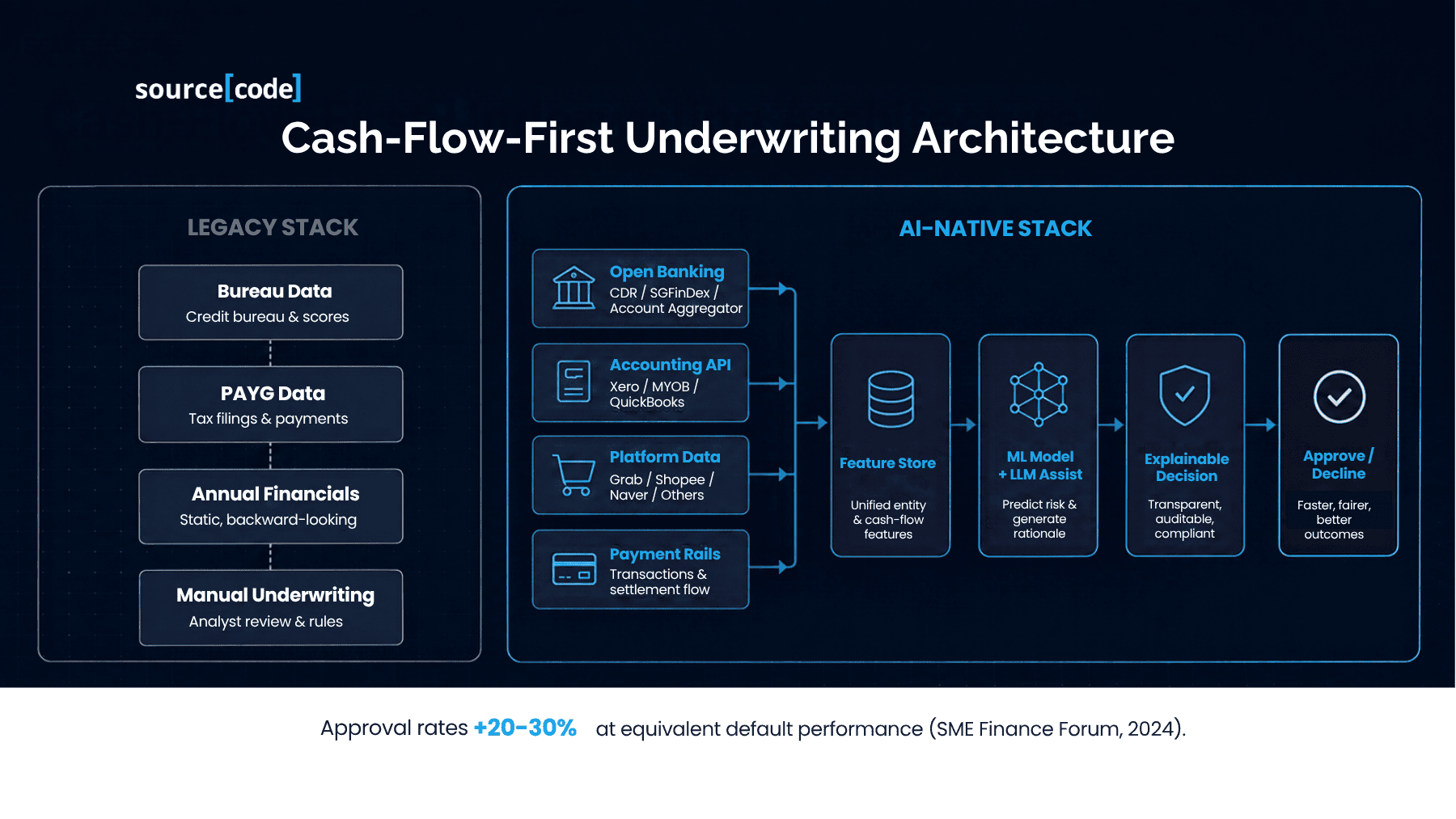
1. Cash-flow-first underwriting. Consented open-banking feeds, accounting-platform APIs (Xero, MYOB, QuickBooks), and payment-rail data are replacing static PAYG statements as the primary signal. Well-tuned cash-flow models are approving 20-30 percent more applicants without increasing default rates (SME Finance Forum, 2024).
2. Embedded credit at point of context. Working-capital, invoice financing, and buy-now-pay-later B2B products are increasingly originated inside the SME's e-invoicing, procurement, or logistics workflow - not on the bank's website.
3. Generative and agentic AI in operations. LLMs are cutting document extraction, KYB, and fraud review from days to minutes. Agentic workflows chain retrieval, calculation, and case narration to compress "time to human review" while preserving auditability.
4. Alternative data at scale. Platform data - merchant sales through Grab, Naver SmartStore, Shopee, Lazada, or a payment terminal - is displacing bureau signals as the primary predictor of SME repayment behavior (SME Finance Forum, 2024).
5. Regulator-driven explainability. Australia's CDR, MAS's FEAT principles, and Hong Kong's revised model-risk expectations require banks to explain decisions to customers and regulators. Explainable AI is no longer a research nicety - it is a licensing precondition.
Strategic Analysis
The economics of SME lending change materially when three cost lines are simultaneously attacked: origination cost, cost of risk, and cost of servicing.
Origination cost falls when KYB, KYC, and document capture are automated with computer vision and LLM-based extraction, and when open-banking APIs remove the need for manual bank-statement uploads.
Cost of risk falls when underwriting is trained on high-frequency cash-flow signals rather than lagging annual financials, and when drift is monitored continuously rather than annually. Where cash-flow underwriting has been deployed at scale in ASEAN - for example inside super-app ecosystems - approval rates have expanded without a corresponding rise in first-payment defaults.
Cost of servicing falls when relationship-manager time is redirected from application chasing to portfolio management, and when SME cross-sell (payments, FX, payroll, insurance) is orchestrated by data rather than by cold outreach.
McKinsey's benchmark is instructive: top-performing banks in developed markets generate more than 30 percent higher revenue per SME customer than average banks and can shrink SME time-to-yes below 10 minutes on prime tickets (McKinsey, 2024). Extrapolated to APAC, where digital adoption is higher and the credit gap is wider, the profit pool available to banks that industrialize the stack is significantly larger.
Real-world Examples
GXS Bank (Singapore). Acquired the Singapore arm of Validus Capital to accelerate SME lending on top of its digital-first stack, using Grab platform data as a proprietary signal source. Loan disbursements across Grab's financial-services franchise grew 56 percent year-on-year to USD 566 million by March 2025 (GrowthHQ, 2025).
ANEXT Bank (Singapore). Focused on SME cross-border trade finance, leveraging the parent group's regional payment network and consented cash-flow data to compress onboarding.
Vietnamese fintech lenders. Vietnam's fintech SME lending market is forecast to reach USD 3.05 billion by 2031 at 18.5 percent CAGR (Ken Research, 2026), with lenders such as Validus Vietnam, Kilde, and Interloan using invoice, payroll, and platform data to price short-tenor working capital.
Australia CDR expansion. From 9 November 2026, large non-bank lenders and BNPL providers join the CDR framework, opening a new pool of consented, standardized transaction data for SME risk models (ACCC, 2026).
India Account Aggregator ecosystem. Consented pulls of GSTN, bank statement, and tax data have enabled Indian NBFCs to originate SME loans in under 10 minutes with substantially lower operating costs - a reference architecture that ASEAN policymakers are now studying.
Actionable Recommendations
Boards and executive teams in APAC BFSI should treat SME credit modernization as a 12-18 month program with five concrete workstreams.
Consolidate the SME data estate into a single feature store that unifies core banking, payments, KYB, accounting-API pulls, and platform data. Without this substrate, no downstream AI investment compounds.
Rebuild the origination journey around consented open-banking and accounting-platform data. Design for CDR (Australia), SGFinDex (Singapore), Account Aggregator (India), and equivalent frameworks in emerging ASEAN markets. Aim for sub-15-minute time-to-decision on tickets below the risk-based automation threshold.
Industrialize the model lifecycle. Move credit-model development onto an MLOps platform with lineage, drift monitoring, champion-challenger deployment, and integrated model-risk governance. Cut model deployment cycles from months to weeks.
Redesign the operating model around exceptions, not applications. Redeploy relationship managers from data chasing to portfolio management and cross-sell. Use agentic AI to draft credit memos, prepare exception cases, and surface early-warning indicators.
Treat embedded and platform partnerships as first-class channels. Package APIs - for lending, KYB, payments, FX - that let e-invoicing, ERP, and marketplace partners originate credit inside their own workflows, with the bank retaining risk and pricing decisions.
sourceCode Perspective
At sourceCode, we work with BFSI clients across APAC on the engineering substrate that this reset requires: data platforms and feature stores that unify core, payments and third-party signals; MLOps and MRM tooling that shortens model lifecycle from months to weeks; API and event-driven architectures that let embedded partners originate credit safely; and secure, auditable AI workflows that meet APRA, MAS, HKMA, and CDR expectations.
Our experience is that most SME credit programs fail not because the models are wrong but because the plumbing underneath them is not built for continuous decisioning. Sequencing the modernization - data first, then decisioning, then experience - is what turns a transformation slide into a P&L outcome.
Conclusion
The APAC SME financing gap is not a symptom of insufficient capital. It is a symptom of an underwriting stack designed for a different era. The banks that will win the next cycle are those that treat SME credit as a data and engineering discipline: cash-flow-first, model-driven, embedded, and explainable by design.
The regulatory scaffolding is arriving. The data is already in the system. The economics - as evidenced by digital-native lenders and top-quartile incumbents - clearly favor speed. The remaining variable is executive will.
Looking to explore how AI-native underwriting can unlock profitable SME growth across your banking ecosystem? Talk with sourceCode about the engineering, data, and governance foundations that turn small-business credit into a defensible franchise.
Visit https://www.sourcecode.com.au to start the conversation.
Frequently Asked Questions (FAQ)
What is the size of the SME financing gap in APAC? The Asian Development Bank estimates the global trade finance gap at USD 2.5 trillion in 2025, with APAC historically absorbing roughly a third. The IFC estimates the total global formal MSME credit gap at USD 5.2 trillion (ADB, 2025; IFC, 2024).
What is AI-native SME underwriting? It is a credit-decisioning approach built around continuously ingested cash-flow, transaction, and alternative data - consented via open banking or platform APIs - analyzed by ML and generative-AI models with automated governance, model-risk monitoring, and explainability by design.
Which APAC regulators are enabling this shift? APRA (Australia), MAS (Singapore), HKMA (Hong Kong), and the RBI (India) have each moved to open consented data flows and to raise expectations on model risk, explainability, and outsourcing - creating both the data supply and the governance envelope for AI-native SME lending.
How much faster can SME credit decisions become? Well-designed digital SME lending has moved time-to-yes from 15-20 days to under 10 minutes on prime tickets, with approval rates 20-30 percent higher at equivalent default performance (McKinsey, 2024; SME Finance Forum, 2024).
What is sourceCode's role in this transformation? sourceCode designs and builds the data platforms, MLOps and MRM tooling, API architectures, and secure AI workflows that let APAC banks deliver AI-native SME credit at the speed the market now demands.
References
Asian Development Bank (2025) ADB Global Trade Finance Gap Survey 2025. Manila: ADB. Available at: https://www.adb.org/publications/adb-global-trade-finance-gap-survey (Accessed: 6 August 2026).
Australian Competition and Consumer Commission (ACCC) (2026) Non-bank lenders join Consumer Data Right as next stage commences. Available at: https://www.accc.gov.au/media-release/non-bank-lenders-join-consumer-data-right-as-next-stage-commences (Accessed: 6 August 2026).
GrowthHQ (2025) Southeast Asia Fintech Wars: How Grab, Sea Limited, and GoTo Are Shaping a USD 180 Billion Market by 2030. Available at: https://www.growthhq.io/our-thinking/southeast-asia-fintech-wars-how-grab-sea-limited-and-goto-are-shaping-a-180-billion-market-by-2030 (Accessed: 6 August 2026).
International Finance Corporation (IFC) (2024) MSME Finance Gap. Washington, DC: IFC. Available at: https://www.ifc.org/en/what-we-do/sector-expertise/financial-institutions/msme-finance (Accessed: 6 August 2026).
Ken Research (2026) Vietnam Fintech SME Lending Platforms Market 2019-2030. Available at: https://www.kenresearch.com/industry-reports/vietnam-fintech-sme-lending-platforms-market (Accessed: 6 August 2026).
MarketIntelo (2026) AI-Powered Cash-Flow-Based SME Lending Market Research Report 2034. Available at: https://marketintelo.com/report/ai-powered-cash-flow-based-sme-lending-market (Accessed: 6 August 2026).
McKinsey & Company (2024) Ten lessons for building a winning retail and small-business digital lending franchise. Available at: https://www.mckinsey.com/industries/financial-services/our-insights/banking-matters/ten-lessons-for-building-a-winning-retail-and-small-business-digital-lending-franchise (Accessed: 6 August 2026).
Mordor Intelligence (2026) Alternative Credit Scoring Market Size, Share and 2031 Growth Trends Report. Available at: https://www.mordorintelligence.com/industry-reports/alternative-credit-scoring-market (Accessed: 6 August 2026).
OECD (2026) Financing SMEs and Entrepreneurs 2026 - Australia Country Chapter. Paris: OECD Publishing. Available at: https://www.oecd.org/en/publications/financing-smes-and-entrepreneurs-2026_075d8058-en/full-report/australia_bdcad0cc.html (Accessed: 6 August 2026).
SME Finance Forum (2024) Cracking the Credit Code: Alternative Data and AI for Financial Inclusion. Available at: https://www.smefinanceforum.org/post/cracking-credit-code-alternative-data-and-ai-financial-inclusion (Accessed: 6 August 2026).
World Economic Forum (WEF) (2025) Tackling the digital financing gap to support SMEs in ASEAN. Available at: https://www.weforum.org/stories/2025/10/digital-finance-gap-support-smes-asean/ (Accessed: 6 August 2026).