Why Most Agentic AI Banking Pilots Never Reach the Call Centre Floor
Banks keep funding contact-centre AI pilots that demo brilliantly and then stall. The reason isn't model quality - it's that most roadmaps sequence use cases by how impressive the demo is, not by where human oversight stays economically viable once volume arrives.
Key Takeaways
-
Independent 2025-2026 research puts a hard number on the stall: Gartner expects more than 40% of agentic AI projects to be cancelled by 2027, and MIT's NANDA initiative found roughly 95% of generative AI pilots show no measurable profit-and-loss impact (CDO Magazine, 2025; OODA Loop, 2025, summarising MIT NANDA).
-
The "proven use case" listicle genre dominating banking AI content in 2026 is less uniform than it looks on the surface - some vendor content is genuinely generic, but at least one example commonly cited as a listicle (Backbase) now publishes a readiness-gated methodology rather than a ranked list. We verified each named example independently before citing the pattern.
-
Contact-centre interactions sit at an unusual intersection: high frequency (thousands of interactions a day) and medium-to-high stakes (financial harm, hardship, complaints, regulatory conduct exposure), which is precisely the combination where continuous human oversight is hardest to afford at scale.
-
Bank of America's Erica is the clearest live counter-example - and on close inspection it confirms the sequencing logic rather than breaking it: it reached 24.6 million+ users by staying in a lower-stakes band and deliberately keeping its newer GenAI/agentic capability human-in-the-loop before letting it near customers (The Financial Brand, 2026).
-
A banking AI roadmap should sequence agentic use cases by where human oversight remains economically viable at the volumes the contact centre actually runs - not by which demo gets the best reaction in a steering committee meeting.
Introduction
Every banking CTO's inbox in 2026 has received some version of the same listicle: "12 Agentic AI Use Cases Transforming Banking Customer Service," "25 Proven AI Agent Deployments for 2026," "The Top 8 AI Agent Use Cases for Banks." The genre is now dense enough that distinguishing a genuinely operational deployment from product-marketing fiction has become its own skill. Almost none of it answers the question a CTO or Head of Digital actually needs answered before the next budget cycle: why do so few of these pilots make it past a controlled trial and onto the live, regulated call centre floor?
The honest answer has little to do with model capability. Large language models are, by late 2026, more than capable of holding a coherent multi-turn conversation about a disputed transaction. The constraint is organisational and economic: every agentic action a bank lets run without a human in the loop has to be monitored, audited, and capable of being suspended - and that oversight infrastructure doesn't get cheaper just because the use case is popular in a vendor deck. The contact centre is where this bites hardest, because it is simultaneously the highest-volume channel in the bank and one where errors carry real conduct, hardship and reputational consequences. That combination - frequency and stakes together - is the actual sequencing variable banking AI roadmaps need to plan against. Most don't.
The Listicle Economy Has Outrun the Production Economy
Banking AI content in 2026 has a genre problem. A large share of what circulates under the "agentic AI in banking" label is structured as an enumerated set of use cases - KYC, fraud triage, dispute handling, loan servicing, proactive coaching - presented with little differentiation between a pilot run on sanitised test data and a deployment carrying live customer volume.
We set out to verify three names commonly cited as representative of this genre - Kore.ai, Neontri and Backbase - rather than take the saturation claim on faith, and the results were more mixed than the genre's reputation suggests:
- Kore.ai's banking customer-experience content (Kore.ai, 2026) reads closer to vendor long-form marketing than a ranked listicle: it groups use cases thematically, cites four customer deployments, and claims "over 270" retail banking use cases without enumerating them. It gestures at governance but doesn't build a sequencing argument.
- Backbase's current agentic banking content (Backbase, 2026) does not fit the listicle description at all. It's a readiness-gated methodology: a value-versus-readiness scoring rubric, six pass/fail governance gates, and a production checklist referencing FSB, NIST and EBA guidance - closer to the argument this article makes than to the genre it was cited to represent.
- Neontri's published blog has no article matching "agentic AI banking use case listicle." Its 2026 content covers AI agent architecture and cost modelling generically, not banking customer service specifically.
So the saturation observation is real, but the three named examples don't hold up uniformly as evidence of it. The clearer examples of the genre we found independently are StackAI's "Top 8 AI Agent Use Cases for Banks in 2026" (Muchacho, 2026), a numbered, template-promotional list with limited sequencing or regulatory depth, and Fast.io's "12 Real-World Applications" piece (Langridge, 2026), which is cross-industry and only loosely banking-specific. By contrast, Open Banking Tracker's "10 Agentic Banking Use Cases" (De Wilde, 2026) names real deployments, flags where public evidence is thin, and sequences by risk - a useful counter-example of the genre done well.
The point isn't to single out vendors. It's that a CTO building a 2026-27 roadmap from this content without independent verification is working from an unreliable base rate of what "proven" actually means.
What the Numbers Actually Say About Pilot-to-Production
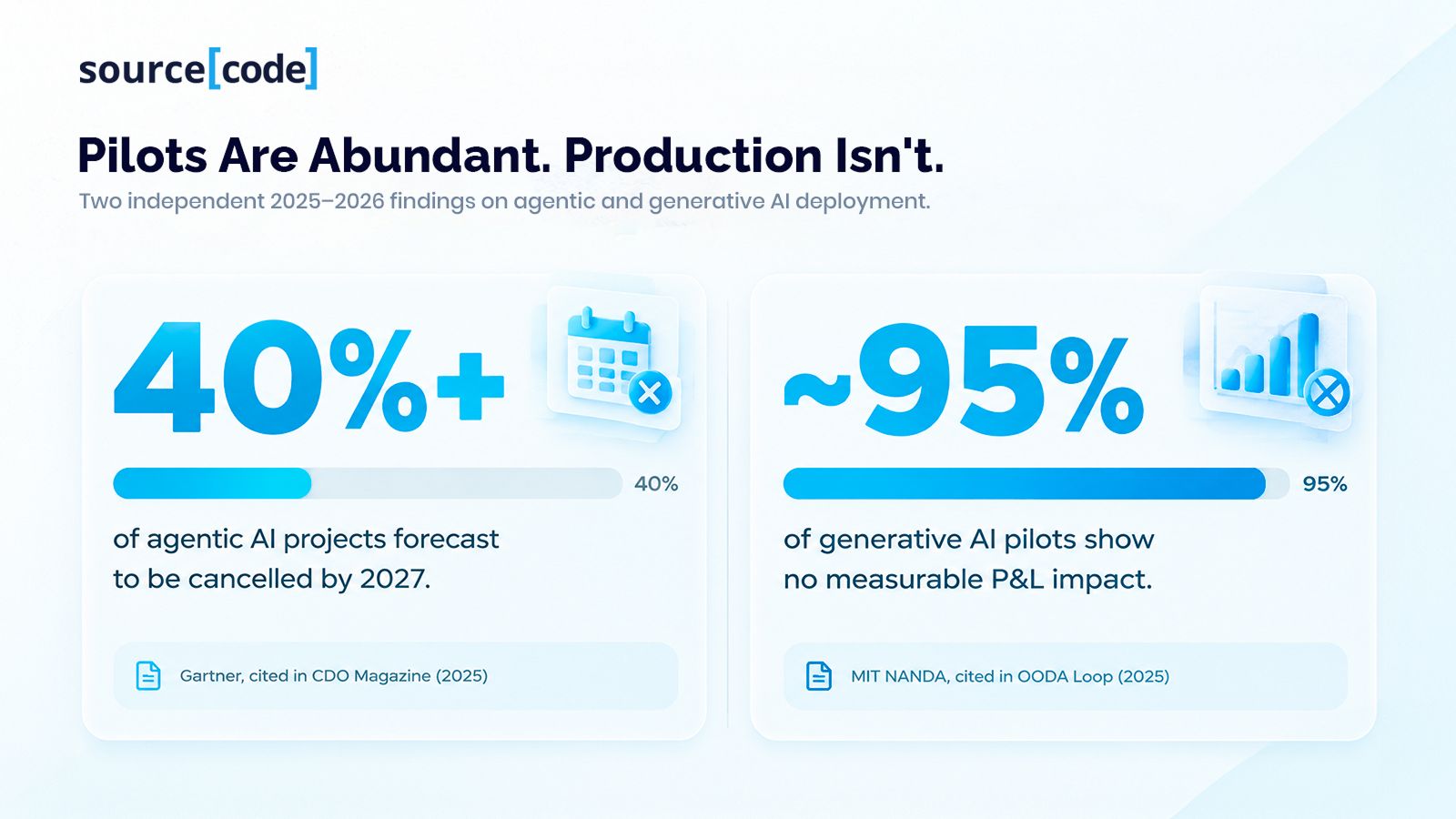
Strip away the use-case enumeration and the hard data on conversion from pilot to production is unambiguous:
-
Gartner forecasts that more than 40% of agentic AI projects will be cancelled by the end of 2027, citing rising costs, unclear return on investment and poor risk management; analyst Anushree Verma is quoted characterising most current agentic AI work as "hype-driven experiments or proof of concepts" rather than scaled deployments (CDO Magazine, 2025).
-
MIT's NANDA initiative, in its GenAI Divide: State of AI in Business 2025 study - roughly 150 leadership interviews, a 350-person employee survey, and analysis of around 300 public AI deployments - found only about 5% of generative AI pilots achieved measurable, rapid business impact; for the other 95%, implementation showed no clear profit-and-loss result (OODA Loop, 2025, summarising MIT NANDA).
-
Even optimistic industry forecasts concede the gap between intent and deployment: Accenture's Top Banking Trends for 2026 reports 57% of banking executives expect agentic AI fully embedded in risk, compliance, audit, fraud and transaction monitoring within three years, and 56% expect broad adoption in credit and KYC - forward-looking expectations, not production evidence, and notably with no comparable figures for contact-centre deployment specifically (Banking Dive, 2026).
None of these figures are banking-contact-centre-specific by design - that granular a breakdown isn't yet published by a major analyst firm, and we flag that gap rather than invent a number to fill it. But the direction is consistent: pilot activity is abundant, production conversion is not, and the shortfall concentrates in exactly the high-visibility, high-stakes use cases vendor demonstrations favour.
Why Contact Centre Use Cases Are a Harder Starting Point Than Vendor Demos Suggest
The vendor-demo instinct is to lead with the most dramatic use case: an agent resolving a complex dispute end-to-end, live, on stage. That instinct is backwards for a production roadmap, for one structural reason - human oversight has a cost curve, and that curve is driven by volume, not use-case novelty.
A contact centre combines very high interaction frequency (a mid-sized bank's contact centre fields thousands of interactions per day) with a stakes profile that's rarely trivial - balance disputes, hardship indicators, fraud reports, complaints touching regulatory obligations. Every agentic action in that channel that isn't fully deterministic needs some form of monitoring: sampled review, escalation triggers, an audit trail, a human who can intervene before an error compounds. That oversight cost scales roughly with volume. The more interactions an agent handles, the more oversight capacity a bank needs - and that capacity, unlike compute, doesn't get cheaper with scale the way a vendor pricing slide implies.
This is precisely the gap regulators are now naming, if not yet quantifying. ASIC's September 2026 supervisory letter to bank boards confirms it will commence a dedicated banking-sector AI review focused on "new and proposed use cases of AI by banks and the impact on customers," citing its 2024 finding (REP 798) that AI governance and consumer-risk assessment have lagged adoption (ASIC, 2026). APRA's April 2026 letter to regulated entities goes further on mechanics, stating that point-in-time, sample-based testing is no longer adequate assurance for AI systems and that continuous validation and monitoring is expected instead - effectively, oversight as a standing operational cost, not a one-off control (APRA, 2026, summarised in Charltons Quantum, 2026). Neither regulator has published a volume threshold or a contact-centre-specific rule yet. But both describe, in supervisory language, the same economics: oversight scales with the system, and in a contact centre that means large numbers, fast.
Vendor demos, by construction, never show this cost. A demonstration runs one scripted conversation; a production deployment runs the same logic across ten thousand conversations a day, each a candidate for an error a human didn't catch in time. That's the gap between "proven" in a listicle and "proven" on the call centre floor.
The Call-Floor Sequencing Matrix
If frequency and stakes are the two variables that actually determine where human oversight stays economically viable, a banking AI roadmap should be built as a map against those two axes - not as a ranked list of the most impressive demos. We call this the Call-Floor Sequencing Matrix, and it extends the frequency/stakes sequencing logic our own prior work applied to insurance use-case prioritisation (the Beachhead Matrix) into the specific economics of a regulated banking contact centre.
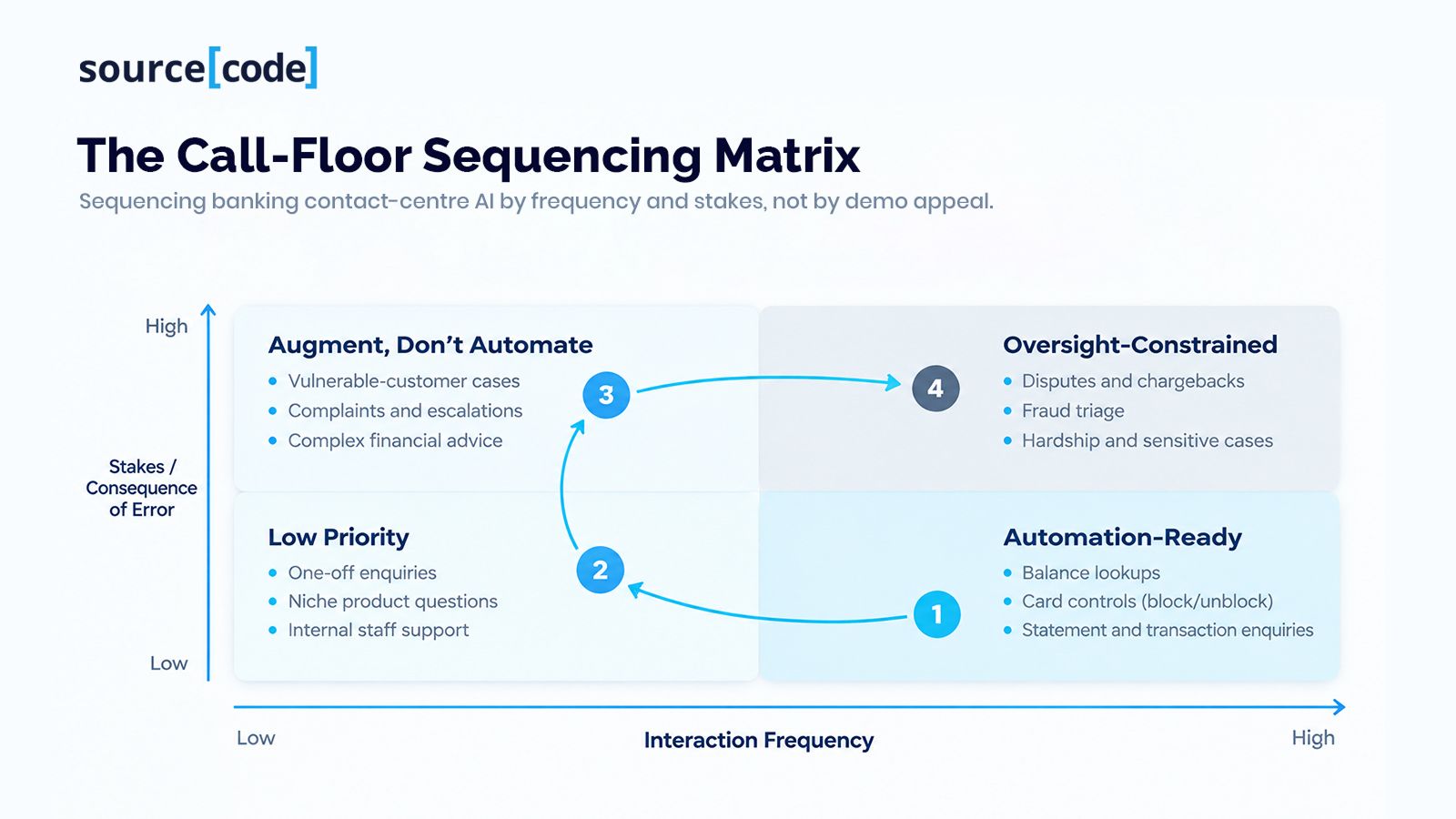
The matrix plots candidate contact-centre use cases on two axes - interaction frequency (how often this scenario occurs) and stakes (the financial, compliance and customer-harm consequence of an uncaught error) - producing four zones:
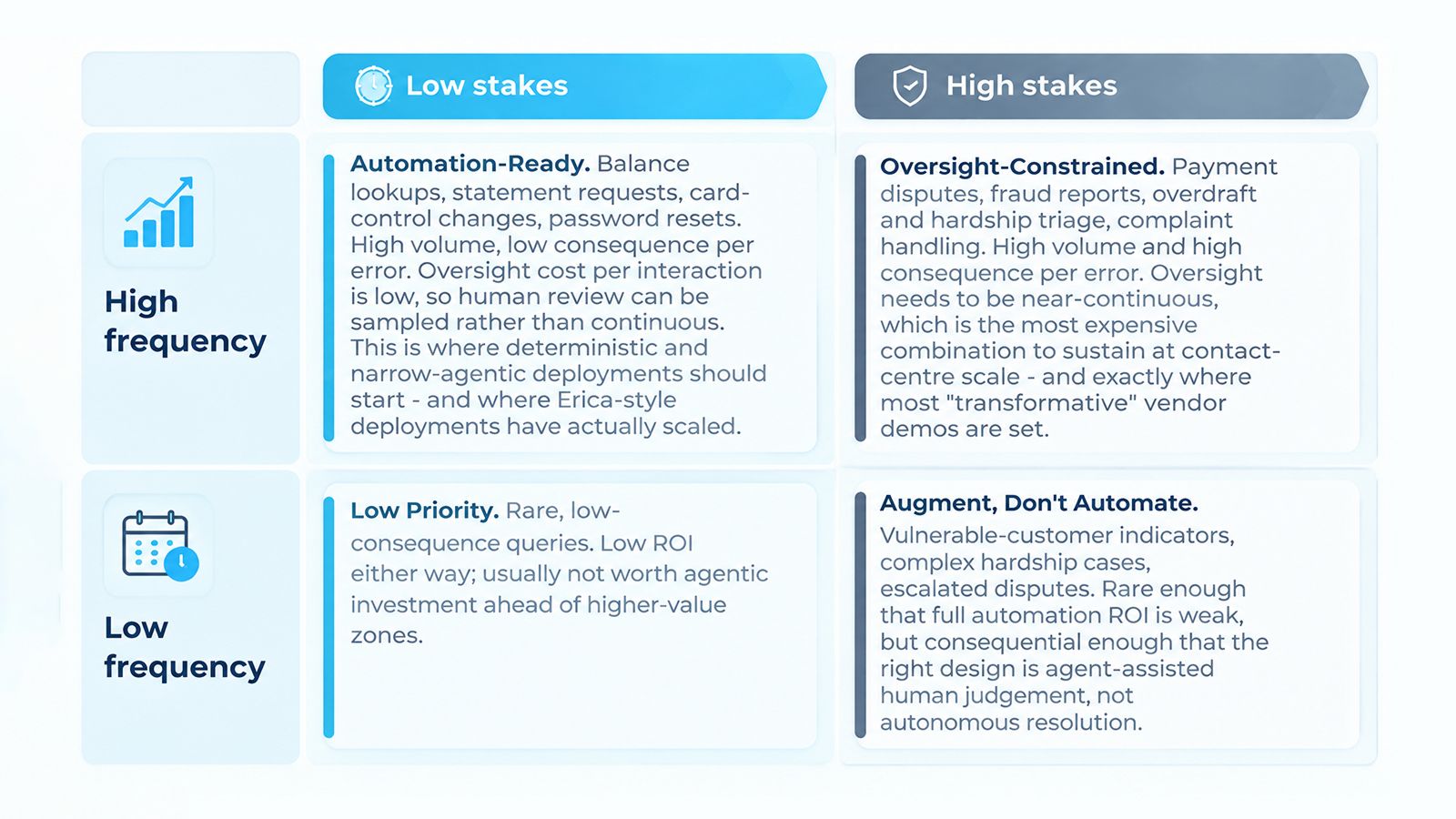
The sequencing implication: a defensible roadmap starts in Automation-Ready, uses that deployment to build the monitoring, escalation and audit-trail infrastructure a regulator will expect, and only then moves toward Oversight-Constrained work, with autonomy introduced incrementally and the escalation path tested under real volume before it's relied upon. Oversight-Constrained is also, not coincidentally, where the vendor-demo instinct leads first, because that's where the "wow" is highest - and the hardest zone to sustain at scale, which is exactly why it should be sequenced last.
The Counterargument: When High-Frequency Did Reach Production
A fair challenge: hasn't a high-frequency, customer-facing banking AI assistant already reached massive production scale? Yes - and how it did so matters more than the headline.
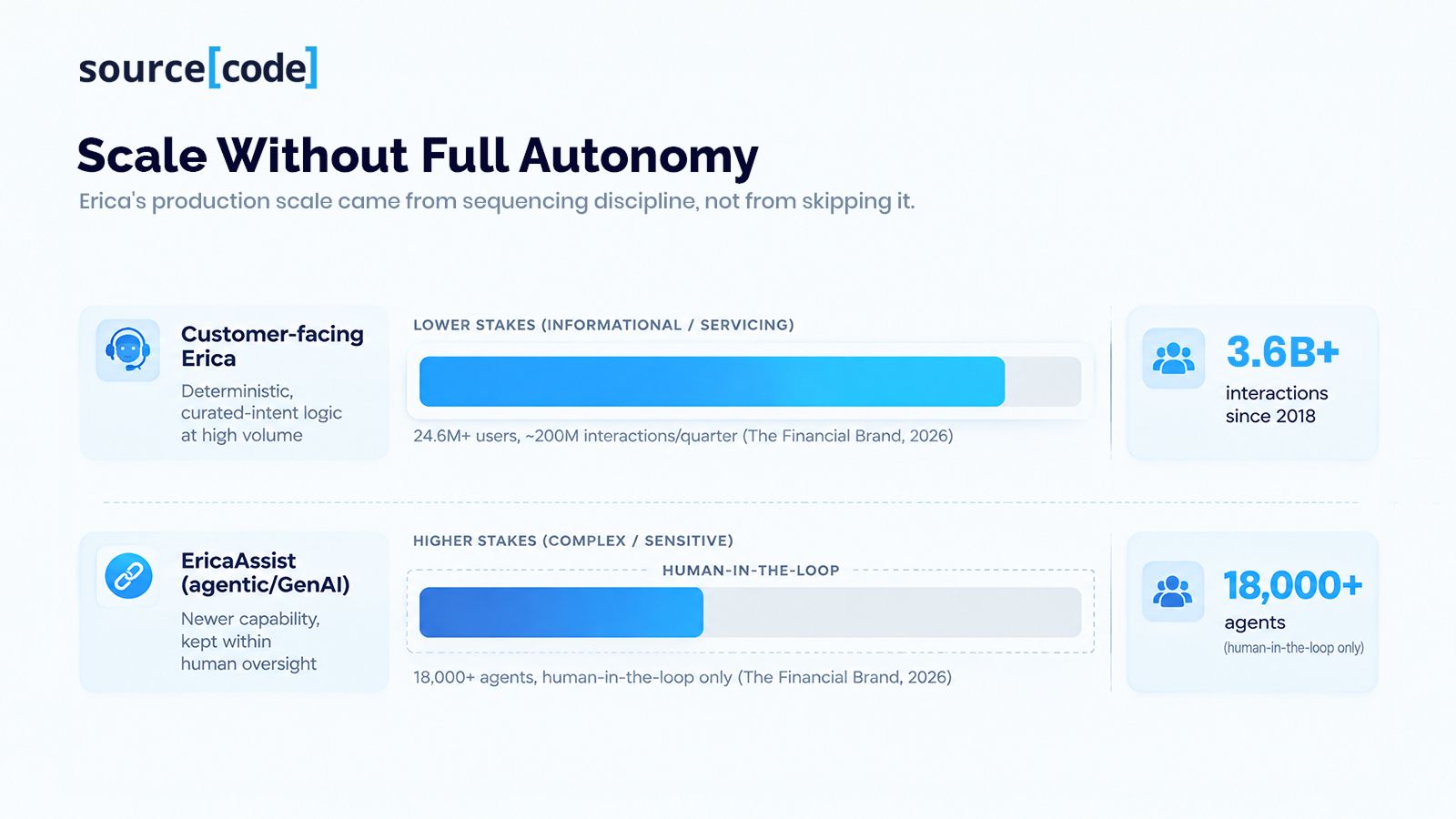
Bank of America's Erica has handled more than 3.6 billion interactions since its 2018 launch, reaching 24.6 million active users in a recent quarter with roughly 200 million interactions in that period alone (The Financial Brand, 2026). On the surface this looks like a direct refutation of the "contact centre is a hard starting point" argument. On closer inspection it's better read as confirmation of the sequencing logic, for two reasons documented in the reporting itself.
First, customer-facing Erica runs on traditional natural-language understanding and curated intents rather than a fully autonomous generative model, specifically because that architecture gives the explainable, repeatable answers a regulated high-volume channel needs; its core workload sits in the Automation-Ready quadrant - payments, account lookups, card management - not disputed-transaction resolution (AccountsRecovery.net, 2026). Second, Bank of America's newer generative-AI and agentic capability, branded EricaAssist, is deliberately scoped as a human-in-the-loop tool for contact-centre staff: more than 18,000 agents use it for call summaries and real-time guidance, with the bank stating it wants the technology "proven with agents before it reaches customer-facing applications that operate without a human involved" (The Financial Brand, 2026). Even the industry's most mature, highest-volume deployment is sequencing its agentic capability through human oversight before letting it approach the higher-stakes end of the matrix. That's the sequencing logic in practice, not a counter-example to it.
The honest nuance: frequency/stakes sequencing is a planning heuristic, not a law. A bank with mature monitoring infrastructure, a narrow bounded task, and years of intent-tuning behind it - as Erica demonstrates - can push further into higher-frequency territory than a greenfield pilot could. The framework's value is forcing that infrastructure-maturity question explicitly, rather than assuming a demo's apparent sophistication substitutes for it.
What This Means for the Buying Committee
For the CTO: The implication is architectural before it's commercial. Before evaluating any vendor's agentic contact-centre proposal, map the proposed use case against the matrix and ask what oversight infrastructure - monitoring, escalation triggers, suspension capability, audit trail - already exists for that zone. If the vendor's flagship use case sits in Oversight-Constrained and the bank's monitoring maturity is unproven, that's a sequencing problem, not a vendor problem, and no amount of model quality fixes it.
For the Head of Digital/Innovation: The temptation is to fund the most visible pilot - usually something in the high-stakes quadrant, because that's what gets attention at a steering committee. The better use of a 2026-27 innovation budget is funding the unglamorous Automation-Ready deployments first, deliberately, as the mechanism for building the governance muscle the higher-stakes use cases will eventually require. A roadmap that can show a regulator a working, audited Automation-Ready deployment is in a stronger position to propose expansion than one with an impressive but ungoverned pilot in the highest-stakes zone.
The sourceCode’s Perspective
sourceCode works across Australia, Malaysia and Vietnam insourcing technical teams into banks and insurers, and building AI capability - including sBrain, our AI product line for the financial sector, into existing delivery environments rather than displacing them. The pattern we see most often in agentic AI conversations with banking clients isn't a capability gap. It's a sequencing gap: the business case is built around the most visible use case rather than the one the bank's current oversight maturity can sustain at volume.
Insourced delivery teams tend to surface this earlier than a pure vendor engagement does, because the team embedded in the bank's own workflows sees the monitoring and escalation reality day to day, not through a steering-committee deck. Our own practical bias, reflected in how we scope early AI engagements, is to treat the oversight-cost question as a design input from the first use case, not a governance review bolted on after a pilot has already been built around the wrong starting point.
That's a discipline question as much as a technology one, and the same discipline this piece's framework tries to make explicit rather than implicit. Talk to us here!
Conclusion
The agentic AI listicle genre promises that the hardest-looking use case is the most valuable one to build first. The pilot-to-production data - a forecast 40%+ cancellation rate, a roughly 95% rate of generative AI pilots with no measurable P&L result, and a widening gap between executive expectation and published production evidence - says otherwise. The contact centre's combination of high frequency and real stakes makes it an unusually hard starting point, precisely because human oversight is the binding constraint and its cost scales with volume. The banks getting genuine production mileage, Bank of America's Erica among them, got there by sequencing deliberately through lower-stakes, high-frequency territory first and keeping newer agentic capability human-in-the-loop until the oversight infrastructure caught up. A roadmap built on the same logic - sequence by where oversight is economically viable at volume, not by which use case demos best - is the more defensible one to bring to a board in 2027.
Where does your current customer-service AI roadmap actually sit on this matrix? If the honest answer is "mostly in the high-stakes quadrant, because that's what the business case was built around," that's worth revisiting before the next funding round - not after the first production incident.
FAQ
Is agentic AI unsuitable for banking contact centres? No - the evidence shows the opposite is also true: Bank of America's Erica demonstrates genuine high-frequency production success. The issue is sequencing, not suitability. Use cases that are high-frequency and genuinely low-stakes (balance lookups, simple servicing) are good early candidates; high-frequency, high-stakes use cases (disputes, hardship, fraud) need oversight infrastructure proven elsewhere first.
What's the difference between a chatbot/virtual assistant and "agentic AI" in this context? A conversational assistant using curated intents and deterministic logic (much of customer-facing Erica's core workload) gives explainable, repeatable answers. "Agentic" systems that plan and act autonomously across multi-step workflows introduce a different oversight burden, because the decision path is less predictable - which is why banks like Bank of America are keeping that capability human-in-the-loop (via EricaAssist) before exposing it directly to customers.
How should a bank measure whether its oversight infrastructure is "mature enough" for a given use case? There's no single published industry benchmark yet - APRA's April 2026 guidance points toward continuous validation and monitoring replacing point-in-time testing as the standard, which is a useful starting principle, but banks will need to define their own monitoring cadence, escalation triggers and suspension criteria per use case until more specific regulatory benchmarks emerge.
Do the Gartner and MIT NANDA statistics apply specifically to banking? Not exclusively - both studies are cross-industry. We've flagged that a banking-contact-centre-specific pilot-to-production conversion rate isn't yet published by a major analyst firm, which is itself informative: the specificity the listicle genre implies doesn't yet exist in the primary research.
Reference List
AccountsRecovery.net (2026) 42 Million Users, 11,000 FTEs: What BofA's Virtual Assistant Signals for AI in Collections. 4 February. Available at: https://www.accountsrecovery.net/2026/02/04/42-million-users-11000-ftes-what-bofas-virtual-assistant-signals-for-ai-in-collections/ (Accessed: 12 October 2026).
Australian Prudential Regulation Authority (APRA) (2026) AI risk and governance expectations letter, 30 April. Summarised in: Charltons Quantum (2026) Australia: APRA Issues AI Risk and Governance Expectations for Banks, Insurers and Superannuation Trustees. Available at: https://charltonsquantum.com/australia-apra-issues-ai-risk-and-governance-expectations-for-banks-insurers-and-superannuation-trustees/ (Accessed: 12 October 2026).
Australian Securities and Investments Commission (ASIC) (2026) Supervisory letter to banks (26-232MR), 30 September. Available at: https://download.asic.gov.au/media/0tobhg1c/26-232mr-asic-supervisory-letter-banking-published-30-september-2026.pdf (Accessed: 12 October 2026).
Backbase (2026) Agentic Banking Use Cases. 27 May. Available at: https://www.backbase.com/blog/agentic-banking-use-cases (Accessed: 12 October 2026).
Banking Dive (2026) Accenture: Banks Set to Scale Agentic AI in 2026. 14 January. Available at: https://www.bankingdive.com/news/banks-agentic-ai-scale-2026-accenture/809585/ (Accessed: 12 October 2026).
CDO Magazine (2025) Over 40% of Agentic AI Projects Likely to Be Abandoned by 2027: Gartner Forecast. Updated 31 July. Available at: https://www.cdomagazine.tech/aiml/over-40-of-agentic-ai-projects-likely-to-be-abandoned-by-2027-gartner-forecast (Accessed: 12 October 2026).
De Wilde, G. (2026) 10 Agentic Banking Use Cases That Are Live or Close to It. Open Banking Tracker, 2 May. Available at: https://openbankingtracker.com/blog/10-agentic-banking-use-cases-that-are-live-or-close-to-it (Accessed: 12 October 2026).
Kore.ai / Rathour, H. (2026) Agentic AI in Banking Customer Experience. Last updated 29 September. Available at: https://www.kore.ai/blog/agentic-ai-banking-customer-experience (Accessed: 12 October 2026).
Langridge, T. (2026) Agentic AI Use Cases: 12 Real-World Applications in 2026. Fast.io. Last reviewed 12 May. Available at: https://www.fast.io/resources/agentic-ai-use-cases.md (Accessed: 12 October 2026).
Muchacho, R. (2026) The Top 8 AI Agent Use Cases for Banks in 2026. StackAI, 17 April. Available at: https://www.stackai.com/blog/top-ai-agent-use-cases-for-banks (Accessed: 12 October 2026).
OODA Loop (2025) 95% of Generative AI Pilots at Companies Are Failing, summarising Challapally, A. et al., MIT NANDA Project, The GenAI Divide: State of AI in Business 2025. 18 August. Available at: https://oodaloop.com/briefs/technology/95-of-generative-ai-pilots-at-companies-are-failing (Accessed: 12 October 2026).
Shukla, M. (2026) 7 Enterprise AI Agent Use Cases in Production in 2026 (and 3 That Stalled). eCorpIT, 26 June. Available at: https://ecorpit.com/enterprise-ai-agents-production-use-cases-2026/ (Accessed: 12 October 2026).
sourceCode (2026) sourcecode.com.au . Available at: https://www.sourcecode.com.au/ (Accessed: 12 October 2026).
The Financial Brand / Cocheo, S. (2026) BofA Augments Internal EricaAssist with GenAI, Eyes Erica Virtual Assistant Next. 19 August. Available at: https://thefinancialbrand.com/news/banking-technology/bofa-augments-internal-ericaassist-with-genai-eyes-erica-virtual-assistant-next-199107 (Accessed: 12 October 2026).