The Instant Corridor: APAC's Cross-Border Payments Rewiring and the Narrow Window for Banks to Stay Relevant
Cross-border payments were, until very recently, the last stubbornly profitable segment of the money-movement stack - slow, opaque, expensive, and captive to correspondent banking relationships built over decades. That model is now visibly eroding. Asia-Pacific already accounts for roughly 70% of global real-time payments volume (ACI Worldwide, 2024), and by mid-2026, Project Nexus - the Bank for International Settlements' multilateral instant-payments platform, is on track to link the domestic instant-payments systems of India, Malaysia, the Philippines, Singapore, and Thailand into a single 60-second cross-border corridor covering 1.7 billion people (BIS, 2024; The Asian Banker, 2026).
For CEOs, CIOs, and Heads of Payments across APAC banking, insurance, and fintech, this is not a distant infrastructure story. It is a revenue redistribution event. Correspondent banking float, foreign exchange (FX) spreads, and remittance fees - the reservoirs that quietly funded international banking operations, are being compressed into transparent, sub-cent economics. The winners will be institutions that treat cross-border payments as a platform capability, not a product; that rebuild their orchestration, liquidity, and compliance stacks for millisecond decisioning; and that resist the temptation to defend legacy revenue rather than capture the emerging one.
This article examines the state of play in APAC's instant-payments rewiring, the strategic implications for incumbent banks and insurers, and the narrow implementation window that closes over the next 24 months.
Industry Context: The APAC Anomaly
Global payments have long been characterized by regional fragmentation, but APAC now stands apart on the sheer scale and speed of its real-time transition.
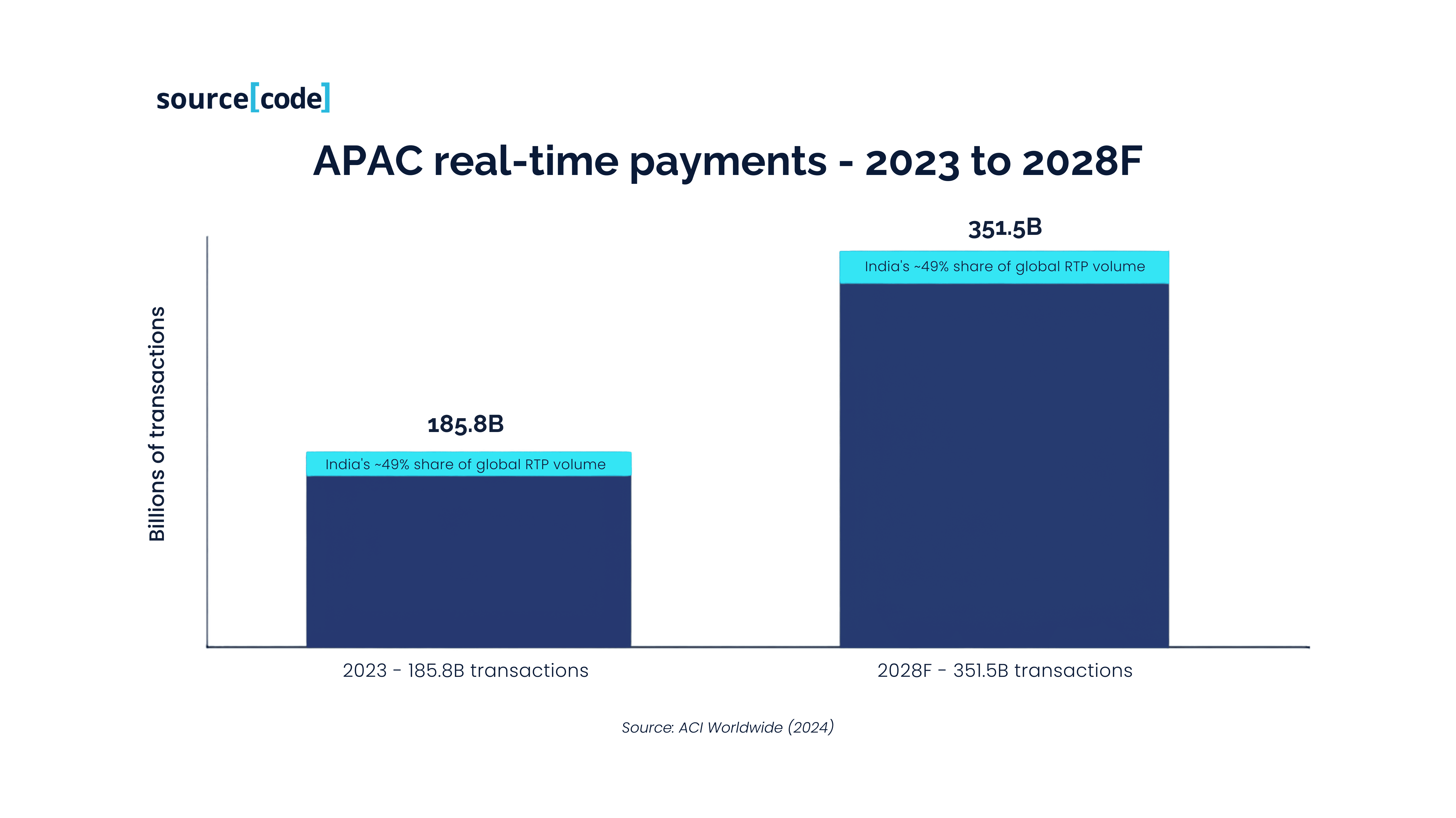
- The region processed 185.8 billion real-time payment transactions in 2023, representing 24% of all electronic payments in APAC, with volumes projected to reach 351.5 billion by 2028 - a 13.6% CAGR (ACI Worldwide, 2024).
- India's Unified Payments Interface (UPI) alone accounts for roughly 49% of global real-time payment transaction volume, and in June 2025 processed 129.3 billion transactions in a single month (International Monetary Fund, 2024; Reserve Bank of India, 2025).
- Digital payments volume in India grew tenfold over the past five years, with McKinsey projecting a further ~35% CAGR through the end of the decade (McKinsey & Company, 2025).
At the same time, the region's payments revenue picture is more sobering. According to the 2025 McKinsey Global Payments Report, APAC payments revenue contracted by 1% in 2024, even as Latin America grew 11%, EMEA 8%, and North America 5% (McKinsey & Company, 2025). Volume is rising; unit economics are collapsing. Roughly 25% of APAC payments revenue now depends on net interest income (NII) on commercial deposits - a structurally exposed source in a rate-normalizing environment.
This is the paradox APAC bank executives must confront: the region is winning the volume of war and losing the margin of war simultaneously. Cross-border is where that contradiction breaks first.
What Has Already Been Built
The APAC cross-border rails are not a future roadmap; they are, in significant part, already live.
Bilateral and multilateral QR linkages. By December 2025, the region had 29 active cross-border payment linkages, together processing 36.2 million transactions worth approximately US$716.4 million (AMRO, 2025). PromptPay-PayNow, PromptPay-DuitNow, PromptPay-QRIS, DuitNow-QRIS, and India's UPI acceptance in Malaysia, Indonesia, the UAE, and France now form a de facto retail cross-border mesh. In the first half of 2025, Malaysia alone recorded 11.8 million cross-border QR transactions worth RM967 million - exceeding the full 2024 total (Bank Negara Malaysia; AMRO, 2025). Indonesia's QRIS cross-border usage rose 225% year-on-year (Bank Indonesia, cited in AMRO, 2025).
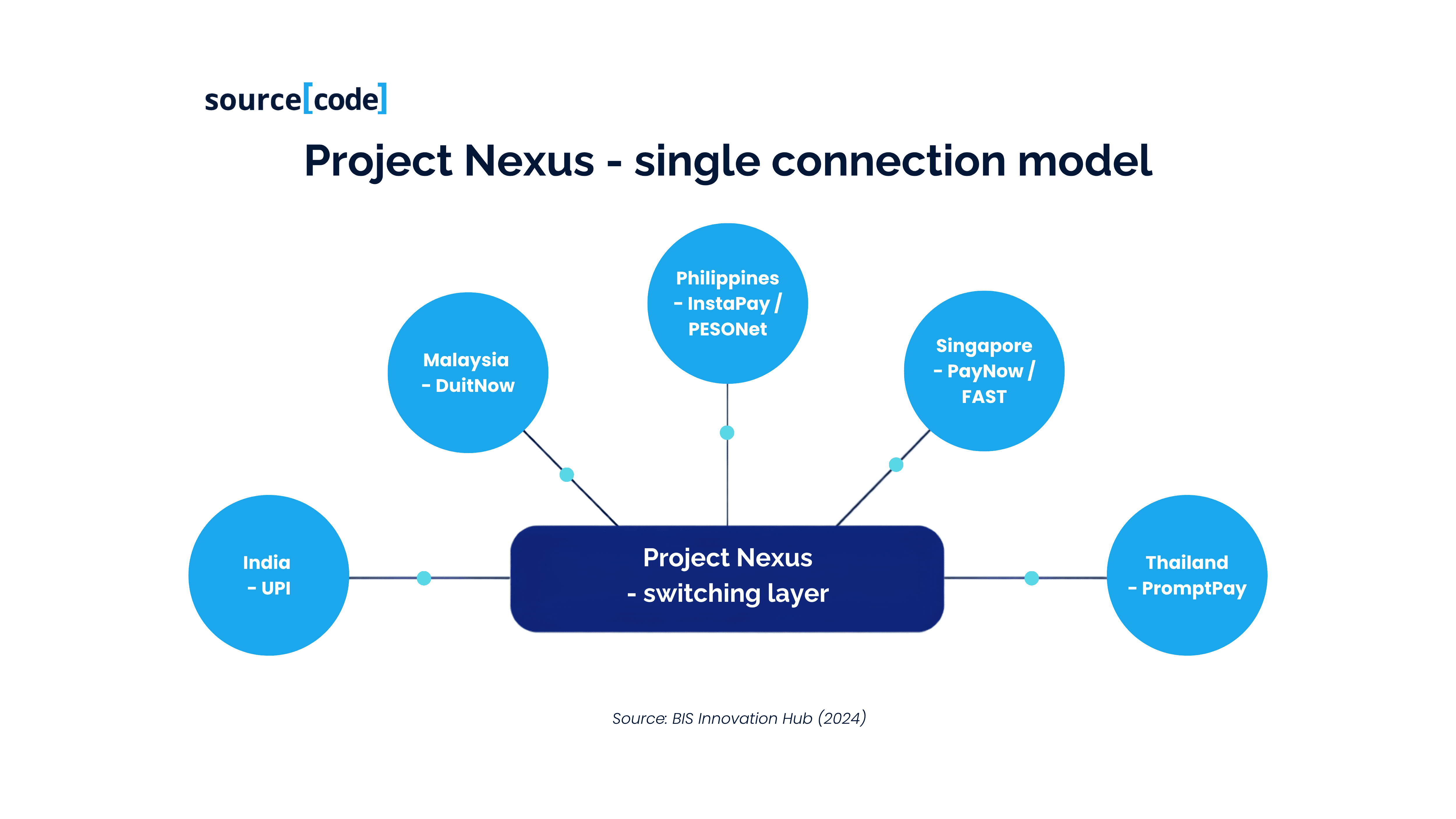
Project Nexus. In 2024, the BIS Innovation Hub, together with the central banks of India, Malaysia, the Philippines, Singapore, and Thailand, completed the technical and legal blueprint for Nexus - a "single connection" model that lets any domestic instant-payments system (IPS) reach any other via a shared switching layer (Monetary Authority of Singapore, 2024). In 2025, the founding central banks incorporated Nexus Global Payments as the managing entity, with the rulebook, ISO 20022 technical implementation guides, and live corridor activation on track through 2026 (The Asian Banker, 2026; Fintech News Singapore, 2025). The design target is end-to-end settlement in 60 seconds or less, at a cost dramatically below correspondent banking.
Regulatory tailwinds. The G20's cross-border payments roadmap targets 75% of international retail and remittance transactions being credited to the end beneficiary within one hour by 2027 (Financial Stability Board, 2024). MAS, HKMA, BNM, BOT, RBI, and Bank Indonesia have each aligned domestic instant-payments policy to that trajectory.
What this means in practice. The interbank plumbing that took correspondent banking decades to construct - nostro-vostro accounts, SWIFT MT messaging, cut-off windows, T+2 FX settlement is being replaced, corridor by corridor, with pre-funded liquidity pools, ISO 20022 rich data, and always-on domestic IPS bridges. The switching cost for a customer to route a payment through a non-bank overlay is approaching zero.
The Strategic Threat: Where Value Migrates
The historic economics of cross-border banking rested on three pillars: opacity, delay, and captive distribution. Instant, interoperable cross-border rails erode all three simultaneously.
Pillar 1 - FX spreads compress toward mid-market. Retail customers using DuitNow-PromptPay routinely see FX quotes within 30-70 basis points of mid-market, compared with the 2-4% typical of card networks or traditional remittance corridors. As transparency norms harden, retention of legacy spreads becomes an active reputational and regulatory risk.
Pillar 2 - Correspondent float shrinks. Pre-funded liquidity pools, in-transit settlement finality, and 24×7 domestic IPS availability compress the balance-sheet float that banks historically monetised on the corridor. For institutions with material trade-finance and treasury franchises, this reprices working capital more than it reprices payments.
Pillar 3 - Distribution disintermediates. The migration of cross-border acceptance to national QR systems and super-app wallets moves the customer relationship away from card-issuing banks. Wise, Airwallex, Nium, dLocal, Currencycloud, Ant International, and Ripple are already operating at scale in APAC corridors. In several ASEAN markets, non-bank wallets now originate more cross-border transactions by count than any single incumbent bank.
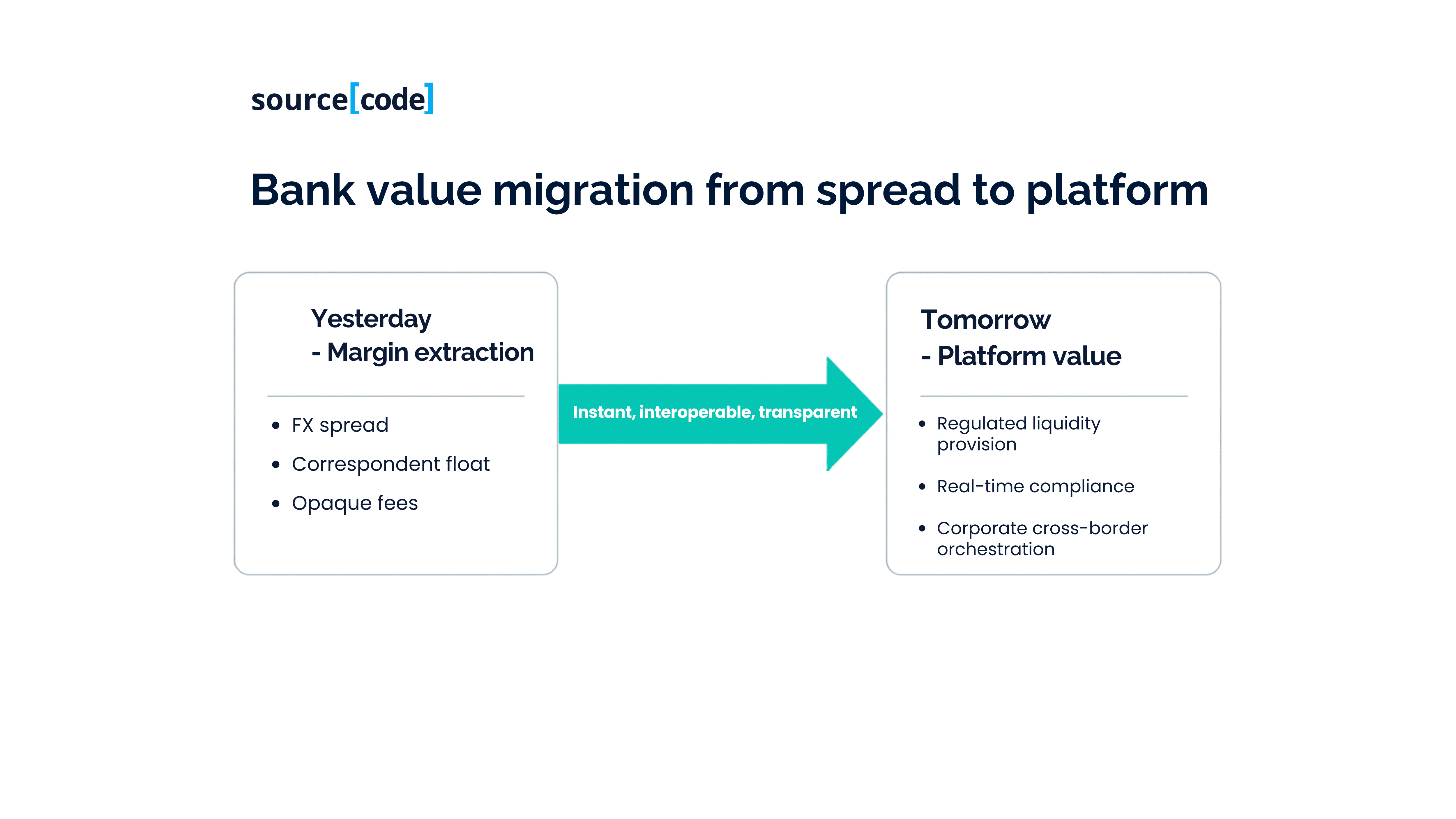
Taken together, these forces do not eliminate the bank's role - but they compress it into three narrower zones of defensible value:
- Regulated liquidity provision. Banks with strong local funding, RTGS access, and central-bank relationships remain the natural providers of pre-funded liquidity in Nexus-style networks. This is a scale business, not a spread business.
- Complex compliance and screening. Sanctions, PEP, source-of-funds, and beneficial-ownership assurance at millisecond latency is a genuine engineering moat - one that most non-bank challengers have not yet cleared for high-value corridors.
- Corporate and wholesale orchestration. Multi-currency treasury, invoice-linked payments, embedded FX hedging, and virtual-account structures for SMEs are natural extensions of a corporate banking relationship - provided the underlying stack can move at instant-payments speed.
Everything else is table stakes or contested ground.
Where APAC BFSI Institutions Are Falling Short
Across engagements with APAC banks and insurers over the past 24 months, four patterns recur.
Legacy payments engines throttle throughput. Message-based, batch-oriented core payment platforms - many built around SWIFT MT and end-of-day cut-offs - cannot economically process 24×7 real-time flows at the volumes APAC IPS growth implies. Retrofitting them creates a per-transaction cost floor that undercuts price competitiveness against digitally native players.
Sanctions and fraud screening remain synchronous and manual heavy. Real-time cross-border requires deterministic latency budgets - typically 300-800 milliseconds end-to-end. Many institutions still route international payments through control queues that operate on a minutes-to-hours SLA. This is the single most common blocker to Nexus corridor readiness.
Fragmented data models prevent ISO 20022 value capture. ISO 20022's richer, structured payment data is one of the strategic gifts of the modernization cycle - enabling remittance-linked invoicing, better reconciliation, and higher-quality AML signal. Yet most APAC banks are still using ISO 20022 as a wire-format wrapper, not a data asset. The information reaches the ledger and stops.
No single accountable owner for the cross-border P&L. Cross-border sits awkwardly between payments, treasury, correspondent banking, digital, and international divisions. Without a re-drawn operating model - with a single P&L owner, product roadmap, and engineering backlog - the response to Nexus fragments into competing projects that each optimize a slice.
Actionable Recommendations for APAC BFSI Leaders
Executives should treat the 2026-2027 window as a decisive planning horizon. The following five actions represent, in our experience, the highest leverage moves.
1. Establish a single cross-border payments operating model. Consolidate accountability under a senior executive - typically at the Group Head of Payments or Chief Payments Officer level - with an explicit P&L, a product roadmap through 2028, and a joint engineering-and-operations pod. Cross-border is now a platform, not a channel.
2. Rebuild the payments core for 24×7 real-time. Migrate from message-processing engines to event-driven, cloud-native payment platforms that support ISO 20022 natively, expose APIs for orchestration, and can absorb Nexus, SWIFT gpi, domestic IPS, and card-network flows on a common pipeline. Where a wholesale replacement is not feasible in the window, adopt a strangler-fig architecture with a modern payment orchestration layer in front of legacy engines.
3. Move sanctions and fraud screening in-line and in-memory. Introduce sub-500-millisecond screening pipelines with graph-based entity resolution, machine-learning risk scoring, and deterministic sanctions matching. Manual review queues should be the exception, not the default path. This is a pre-condition for Nexus and multi-corridor operation; without it, cross-border SLAs cannot be met.
4. Rebuild the FX and liquidity engine for pre-funded corridor operation. Move from bank-by-bank nostro management to a corridor-level liquidity view, with intraday funding, automated rebalancing, and treasury APIs that let corporate clients self-serve currency and settlement instructions. This has as much impact on ROE as any front-end investment.
5. Reposition the corporate cross-border proposition. Move upmarket, not down-market. Retail cross-border is heading toward commoditization; the defensible ground is the mid-market and enterprise treasury: multi-currency virtual accounts, embedded invoice payments, cross-border payroll for regional workforces, and API-first payables/receivables for SEA-headquartered corporates expanding across the region.
For insurers and asset managers, the parallel implication is often overlooked: cross-border premium collection, claims disbursement, and multi-currency policy settlement all inherit the same rails. Insurers that treat instant cross-border as an ops upgrade - rather than a customer-proposition upgrade - will forfeit the margin available in cross-border expat, corporate, and travel lines.
Real-World Examples
India (UPI International). The National Payments Corporation of India (NPCI) has extended UPI acceptance to Bhutan, Nepal, Sri Lanka, Mauritius, the UAE, Singapore (PayNow), Malaysia, Indonesia, and France. UPI's global merchant footprint is functioning as a de facto tourist-and-diaspora rail - a case study in how a domestic IPS, when opened, becomes an international brand asset (National Payments Corporation of India, 2025).
Thailand-Singapore (PromptPay-PayNow). The world's first live IPS-to-IPS linkage remains the reference implementation for multilateral extension. Bank of Thailand and MAS have publicly reported material adoption in the tourist and remittance corridors - proof that domestic IPS interoperability can be commercially and operationally viable at scale (Monetary Authority of Singapore, 2024; Bank of Thailand, 2025).
Malaysia (DuitNow cross-border). Bank Negara Malaysia's cross-border QR growth - 11.8 million transactions worth RM967 million in H1 2025 alone - demonstrates that once the rails exist, latent demand materialises very quickly, without material marketing spend (AMRO, 2025).
Wholesale (mBridge). The multi-CBDC bridge project involving the People's Bank of China, HKMA, Bank of Thailand, Central Bank of the UAE, and the Saudi Central Bank has moved from proof-of-concept toward operational use, showing that even wholesale correspondent settlement is now being contested by CBDC-linked designs (Bank for International Settlements, 2024).
The lesson across cases is consistent: once the rail exists, volumes ramp faster than incumbents forecast, and margin structures compress faster than incumbent models assume.
The sourceCode Perspective
In our work with APAC BFSI clients, the failure mode is rarely a lack of ambition - it is the mismatch between the speed of the market rewiring and the cycle time of legacy programme delivery. Cross-border transformation programmes that were sensibly scoped for 36-48 months in 2022 are now overtaken by market change every 6-9 months.
Three engineering shifts consistently accelerate delivery:
- Composable payment platform architecture that isolates the orchestration layer, screening layer, and connectivity layer as independently deployable services - allowing Nexus, SWIFT, and domestic-IPS onboarding to proceed on independent tracks without recoupling to a monolithic release train.
- Event-driven, ISO 20022-native data pipelines that unlock structured payment data for AML, reconciliation, and customer-facing analytics - turning the modernization investment into a data asset, not just a wire upgrade.
- AI-augmented screening and reconciliation - graph analytics for entity resolution, ML-based anomaly detection, and LLM-assisted investigation - deployed inside deterministic latency budgets, not as batch overlays.
These are not exotic capabilities; they are, however, engineering-culture capabilities. Institutions that build them in-house - or through deeply embedded delivery partnerships - retain the strategic optionality that outsourced package implementations quietly surrender.
sourceCode partners with banks, insurers, and fintechs across Australia and Southeast Asia on exactly this problem set: modernizing core payment platforms, engineering real-time compliance and orchestration layers, and building the data foundations that turn regulated payment flows into differentiated products.
Conclusion
Cross-border payments in APAC are moving from a product-and-margin business to a platform-and-scale business. The domestic IPS growth curve, the ASEAN QR interoperability mesh, and Project Nexus together mean that by 2027, sub-minute, low-fee, transparent cross-border payment will be table stakes across a corridor covering nearly a third of the world's population.
For incumbent APAC banks and insurers, the strategic question is not whether to participate - non-participation is not a stable option - but how to migrate the P&L from margin extraction to platform economics before the transition is complete. The winners will be the institutions that treat the next 24 months as a genuine engineering programme, not a regulatory compliance exercise, and that rebuild their payments stack for the instant, interoperable, always-on world that is arriving whether they are ready or not.
The corridor is opening. The question is who owns the traffic on it.
Looking to assess your institution's readiness for Project Nexus and the next wave of APAC cross-border modernization? Talk with sourceCode about designing a real-time payments architecture that keeps your bank on the profitable side of the rewiring.
FAQ
What is Project Nexus? Project Nexus is a multilateral cross-border payments platform led by the Bank for International Settlements (BIS) Innovation Hub. It connects domestic instant-payment systems (IPS) via a single switching layer so that a payment can flow from one country's IPS to another in under 60 seconds. The founding participants are India (UPI), Malaysia (DuitNow), the Philippines (PESONet/InstaPay), Singapore (FAST/PayNow), and Thailand (PromptPay), with live go-live targeted through 2026 (BIS, 2024; The Asian Banker, 2026).
How large is APAC's real-time payments market? APAC processed 185.8 billion real-time payments transactions in 2023, growing at a projected 13.6% CAGR to reach 351.5 billion by 2028 (ACI Worldwide, 2024). India alone accounts for approximately 49% of global real-time payment volume.
What does Project Nexus mean for commercial banks? It compresses correspondent-banking float, transparency-limited FX spreads, and legacy remittance fees. Banks that reposition around regulated liquidity provision, real-time compliance, and corporate cross-border orchestration retain a defensible role; banks that defend legacy spreads will lose share to non-bank wallets and payment institutions.
How should banks prepare technically? Priority moves are: an event-driven, ISO 20022-native payment core; sub-500-millisecond sanctions and fraud screening; corridor-level liquidity management with intraday rebalancing; and consolidation of cross-border P&L accountability under a single senior executive.
Is Nexus compatible with SWIFT and card networks? Nexus is designed as an additional rail, not a replacement. Most global banks will operate SWIFT, card networks, domestic IPS, and Nexus concurrently - which is precisely why orchestration and normalized ISO 20022 data are strategic.
References
ACI Worldwide (2024) Prime Time for Real-Time 2024. Available at: https://www.aciworldwide.com/real-time-payments-report (Accessed: 16 July 2026).
AMRO (2025) Powering Payments: The Role of Technology in ASEAN's Regional Payment Connectivity Initiative. ASEAN+3 Macroeconomic Research Office. Available at: https://amro-asia.org (Accessed: 16 July 2026).
Bank for International Settlements (2024) Project Nexus: Enabling Instant Cross-Border Payments. Available at: https://www.bis.org/about/bisih/topics/fmis/nexus.htm (Accessed: 16 July 2026).
Bank for International Settlements (2024) Project mBridge - Update. BIS Innovation Hub.
Bank of Thailand (2025) Cross-border Payment Linkages. Available at: https://www.bot.or.th/en/financial-innovation/digital-finance/digital-payment/cross-border-payment.html (Accessed: 16 July 2026).
Financial Stability Board (2024) G20 Roadmap for Enhancing Cross-Border Payments: Consolidated Progress Report. Basel: FSB.
Fintech News Singapore (2025) Project Nexus Empowers APAC Financial Institutions to Achieve G20 Cross-Border Payment Targets. Available at: https://fintechnews.sg (Accessed: 16 July 2026).
International Monetary Fund (2024) UPI Recognised as the World's Largest Real-Time Payment System. Washington, DC: IMF.
McKinsey & Company (2025) The 2025 McKinsey Global Payments Report: Competing Systems, Contested Outcomes. Available at: https://www.mckinsey.com/industries/financial-services/our-insights/global-payments-report (Accessed: 16 July 2026).
Monetary Authority of Singapore (2024) Project Nexus Completes Comprehensive Blueprint for Connecting Domestic IPSes Globally. Media release, July. Available at: https://www.mas.gov.sg (Accessed: 16 July 2026).
National Payments Corporation of India (2025) UPI International Acceptance - Country Reference. Mumbai: NPCI.
Reserve Bank of India (2025) Annual Report 2024-25. Mumbai: RBI.
The Asian Banker (2026) Project Nexus to Transform Global Payments, Going Live in 2026. Available at: https://www.theasianbanker.com (Accessed: 16 July 2026).