The Sovereign Cloud Dilemma: How APAC BFSI Should Navigate Data Residency, Resilience, and Hyperscaler Concentration in 2026
Cloud is no longer a technology decision in Asia-Pacific banking, insurance, and financial services. It is a prudential decision, a sovereignty decision, and increasingly a board-level resilience decision. On 1 July 2026, the Australian Prudential Regulation Authority's CPS 230 Operational Risk Management standard fully commenced, forcing every APRA-regulated entity to codify its dependency on cloud service providers, define tolerance levels for disruption, and prove it can maintain critical operations through the failure of any single third party (APRA, 2023). Six months earlier, on 8 January 2026, the Hong Kong Monetary Authority issued its Practice Guide on Cloud Adoption, elevating the 2022 supervisory expectations into a codified expectation of design (HKMA, 2026). Across the strait, the Monetary Authority of Singapore continues to sharpen its Guidelines on Outsourcing and Technology Risk Management, while Indonesia's OJK, Vietnam's PDPD, and Malaysia's PDPA amendments have each tightened data localization obligations for regulated institutions.
The paradox for APAC BFSI leaders is now unavoidable. The regulatory environment is pushing institutions to intensify oversight of a very small number of hyperscale providers: AWS, Microsoft Azure, and Google Cloud, that the Financial Stability Board's survey of nearly 300 financial institutions has already identified as systemically concentrated (FSB, 2024). At the same time, the same regulators expect banks and insurers to accelerate AI, real-time payments, and digital experience programs whose economics only work at hyperscale.
The winners in this environment will not be the institutions that build the biggest private cloud or that retreat to on-premises hosting. They will be the institutions that treat sovereign cloud not as a product category but as a design discipline: an architectural pattern that combines residency, portability, cryptographic control, and operational transparency across a small number of trusted providers. This article sets out how boards and technology leaders in APAC should think about that discipline in 2026 and where the traps lie.
Why Sovereignty Moved from Legal to Prudential
For most of the last decade, "data sovereignty" was a legal-and-compliance conversation, largely defined by data-protection statutes and outsourcing contracts. Two shifts have moved it into the prudential domain.
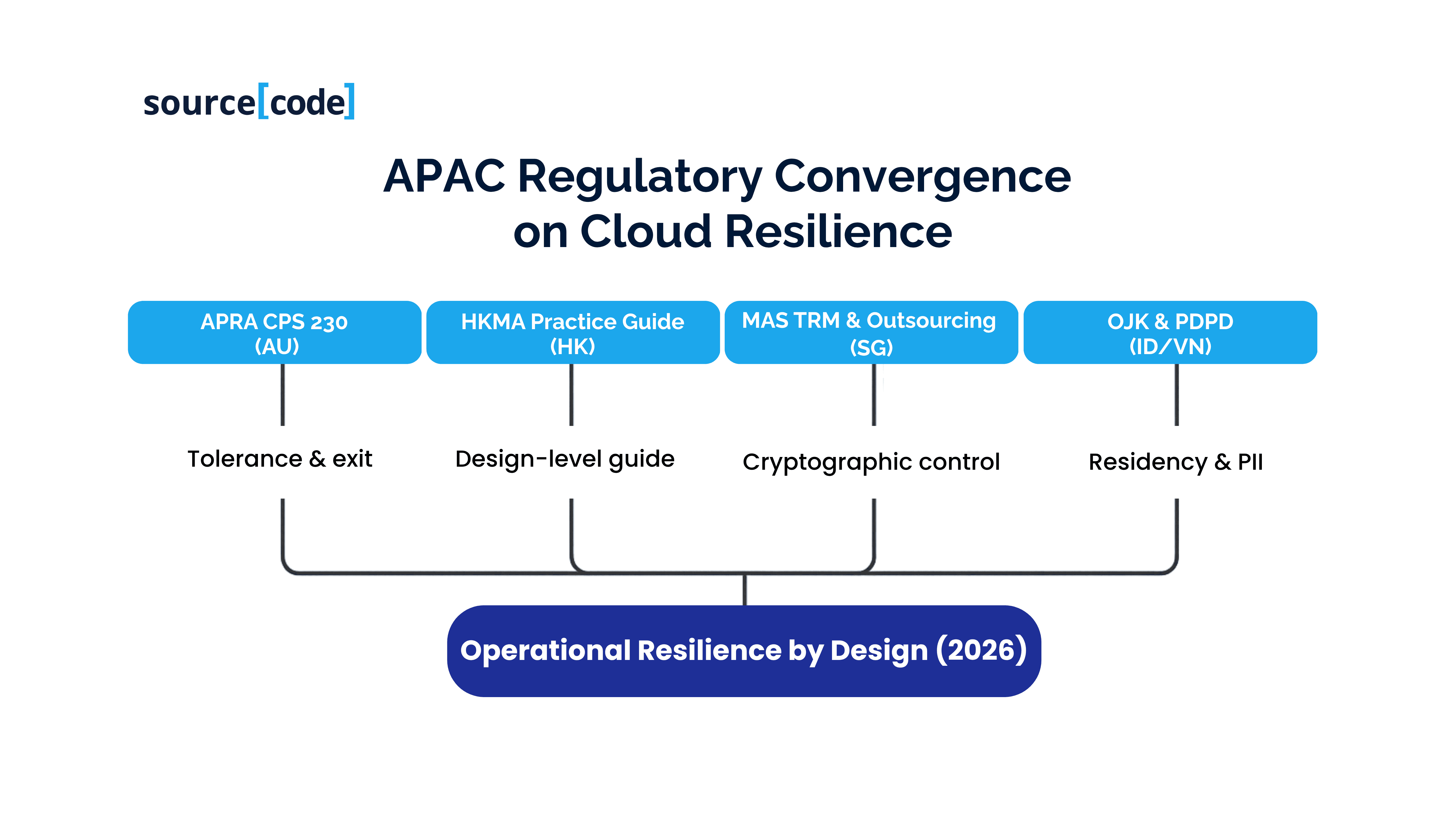 The first is the regulatory pivot from outsourcing compliance to operational resilience. APRA's CPS 230 explicitly requires regulated entities to identify critical operations, set tolerance levels for disruption, and maintain the ability to operate through the failure of a material service provider (APRA, 2023). The HKMA's January 2026 Practice Guide extends its 2022 cloud circular into a design-level expectation, including exit planning, portability, and effective supervisory access (HKMA, 2026). The Bank for International Settlements' Financial Stability Institute has documented how supervisors globally are converging on this posture (BIS, 2024).
The second is the emergence of cloud concentration as a stability question. In its 2024 report on third-party dependencies, the FSB found that a small set of hyperscale providers underpins a growing share of financial-sector infrastructure across jurisdictions, and that the same names appear in nearly every institution's material-outsourcing register (FSB, 2024). Global market share data confirms the point: AWS, Microsoft Azure, and Google Cloud together hold roughly two-thirds of worldwide cloud infrastructure spend, and their share of financial-sector workloads is higher still (Synergy Research Group cited in industry press, 2026).
For APAC, the picture is sharper. Asia-Pacific is the fastest-growing sovereign cloud region globally, expanding at roughly 25 per cent annually according to multiple market analysts (Precedence Research, 2025). Yet 51 per cent of APAC banks still identify legacy infrastructure as a modernization constraint, and 50 per cent cite fragmented data platforms, both figures above the US and European averages (Moody's, 2025). The result is an uncomfortable middle ground: the region is consolidating onto the same hyperscalers that regulators are naming as systemic, while carrying more technical debt than peer regions.
The Current Challenge: Four Pressures Colliding
Executives responsible for cloud strategy in APAC BFSI are now managing four pressures simultaneously.
Residency and localization obligations are diverging, not converging. Indonesia's OJK regulations require that certain electronic systems supporting financial services be located in Indonesian territory unless specifically approved; Vietnam's Personal Data Protection Decree and the 2024 Data Law introduced localization requirements for defined categories of data; Malaysia's amended PDPA sharpened cross-border transfer conditions. Singapore and Hong Kong remain more permissive but expect documented control. There is no single "APAC" sovereign posture, a multinational bank operating across six markets will need six residency stances.
Prudential expectations are shifting from control to demonstrable resilience. CPS 230 and the HKMA Practice Guide both require institutions to prove - not assert - that critical operations can survive a hyperscaler outage. That is a very different bar to "we have a good outsourcing contract." It requires runbooks, tested failover, and evidence of exit rights that would actually work in a real disruption.
Concentration risk is a governance issue, not a procurement issue. When three providers underpin your payments platform, your fraud engine, and your customer analytics, board risk committees can no longer treat cloud strategy as an operational technology topic. It is a stability topic that belongs alongside liquidity and credit concentration.
Economics are asymmetric. The applications that most need sovereign cloud characteristics: core banking, general ledger, financial-crime engines, often benefit least from hyperscale elasticity. Meanwhile, the applications with the strongest hyperscale economics: generative AI, real-time analytics, and personalization are precisely the ones that create the deepest data-gravity lock-in.
Key Trends Shaping 2026
Four trends will define the sovereign cloud conversation in APAC BFSI over the next eighteen months.
From single providers to multi-plane architectures. Leading institutions are moving away from binary "cloud vs. on-premises" debates toward a three-plane model: a sovereign plane for regulated data and critical operations, a hyperscale plane for elastic and AI workloads, and an edge or private plane for latency-sensitive and highly confidential functions. The design discipline is not to eliminate the hyperscaler but to make each plane individually recoverable.
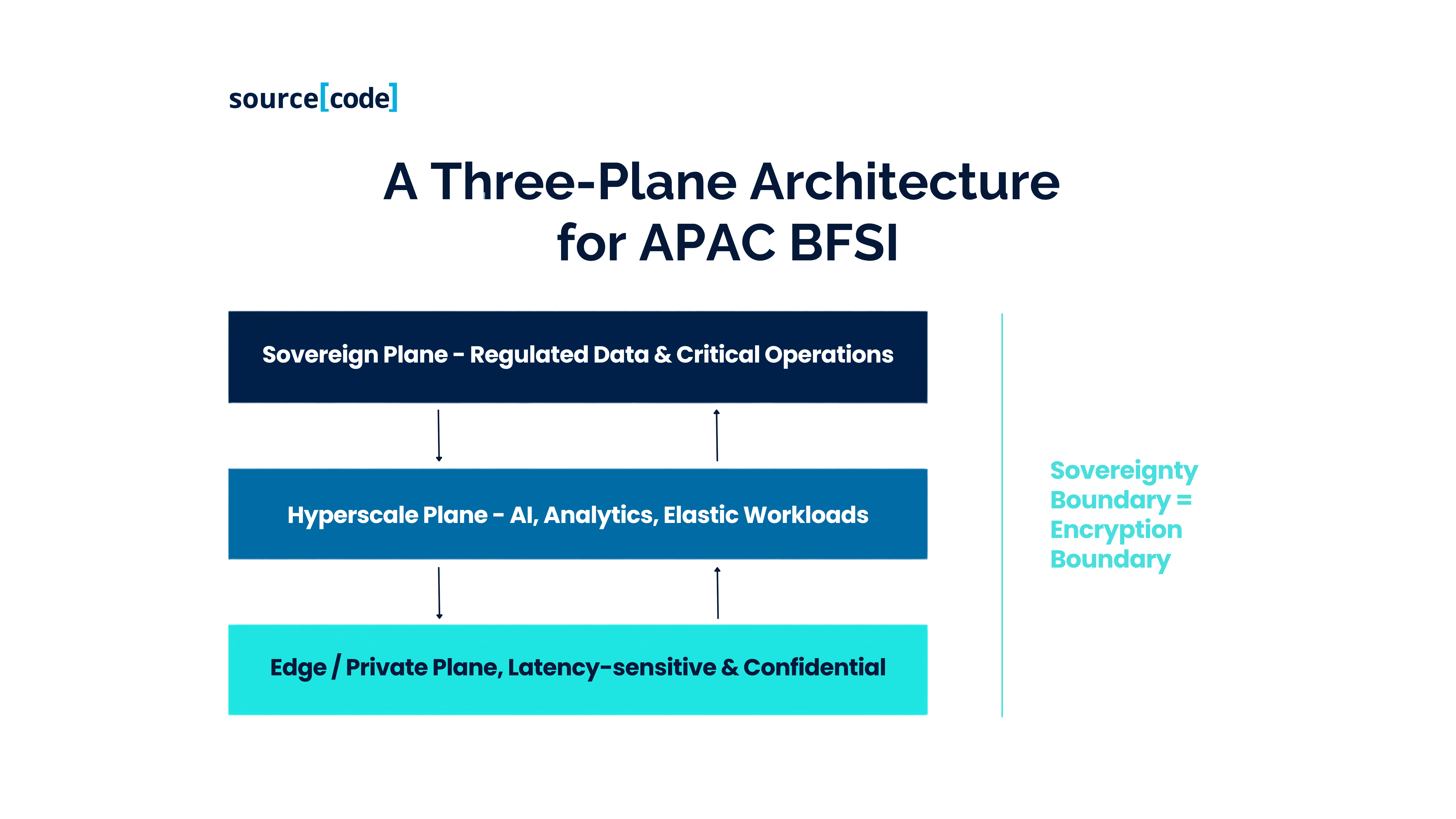
Cryptographic sovereignty as a first-class control. Confidential computing, external key management, and bring-your-own-key (BYOK) with hardware security modules held outside the hyperscaler are moving from proof-of-concept to production. In effect, the encryption boundary, not the physical data center, becomes the sovereignty boundary. This is the direction MAS and HKMA guidance is pointing regulated institutions.
Portable landing zones over provider-native landing zones. Regulators want evidence of exit; provider-native landing zones are, by construction, hard to exit. The 2026 architectural center of gravity is shifting toward provider-agnostic control planes: Kubernetes-based platforms, open data formats, and infrastructure-as-code that can be re-deployed on a different hyperscaler within a defined recovery time objective.
Regional sovereign offerings maturing. Hyperscalers are responding with jurisdiction-specific sovereign offerings, dedicated Australian and Southeast Asian regions with independent operational controls, local key management, and contractual assurances against foreign-government access. These offerings are not a silver bullet, but they materially change the risk profile for regulated data.
What the Best Institutions Are Actually Doing
The distinction between institutions that will thrive under CPS 230 and its regional analogues and those that will spend the next two years in remediation lies in five choices.
First, they have made an explicit classification of workloads by sovereignty tier, not by application. Every workload is tagged: regulated data on Tier 1 (sovereign controls), operational data on Tier 2 (hyperscale with cryptographic sovereignty), non-sensitive workloads on Tier 3 (hyperscale-native). This classification drives architectural choice, not the other way around.
Second, they have separated the control plane from the data plane. Identity, secrets, keys, and audit logs sit on infrastructure whose availability is not correlated with the primary hyperscaler. If AWS is down, the ability to see that AWS is down, and to fail over, does not depend on AWS.
Third, they have invested in exit-tested landing zones. It is no longer sufficient to have an exit clause in a contract. Leading institutions run an annual or semi-annual exit rehearsal for at least one material workload, generating evidence that CPS 230 or HKMA supervisors can rely on.
Fourth, they have moved to platform engineering as a delivery model. Sovereign cloud is not sustainable if every application team must solve residency, key management, and observability individually. Institutions that succeed operate an internal developer platform that encodes sovereignty controls as defaults, so that engineers cannot inadvertently deploy regulated workloads to a non-compliant region.
Fifth, they have made third-party risk a real-time function. Supplier questionnaires and annual reviews have been replaced by continuous telemetry: SBOM ingestion, real-time incident feeds, and integration into the institution's own resilience monitoring. Under CPS 230, the regulator will expect an APRA-regulated entity to know its material provider's incident before the media does.
Real-World Examples
Australia's four major banks have publicly disclosed the scale of the CPS 230 remediation programs, spanning contract re-papering, exit testing, and cloud landing-zone redesign. Industry commentary suggests the aggregate one-time cost across the sector is measured in the hundreds of millions of Australian dollars, a useful benchmark for peers in Hong Kong and Singapore whose regulators have signaled similar expectations (APRA, 2023; industry press, 2026).
In Singapore, several regional banks have re-architected their AI and analytics estates on a "confidential AI" pattern: model training on hyperscale infrastructure, but with data encrypted using externally held keys, so that even the cloud provider's operators cannot read customer records in the clear. This has proven acceptable to MAS supervisors as a way to combine hyperscale AI economics with sovereign control (aligned with MAS TRM Guidelines, 2021).
In Indonesia, tier-2 banks that initially resisted cloud adoption because of OJK's residency requirements have moved onto locally hosted hyperscale regions with operational controls managed by Indonesian-resident personnel - an arrangement that satisfies OJK expectations while unlocking the AI and analytics capabilities previously available only to Tier 1 banks.
Insurance offers different lenses. In Australia and Hong Kong, insurers modernizing legacy policy administration have leant heavily on sovereign-tier private cloud for the system of record while placing customer-facing distribution and claims automation on hyperscale, a pragmatic split that preserves board-level control of the actuarial and financial systems.
Actionable Recommendations for Boards and Executives
Boards and executive committees should ensure that the next twelve months deliver, at a minimum, the following.
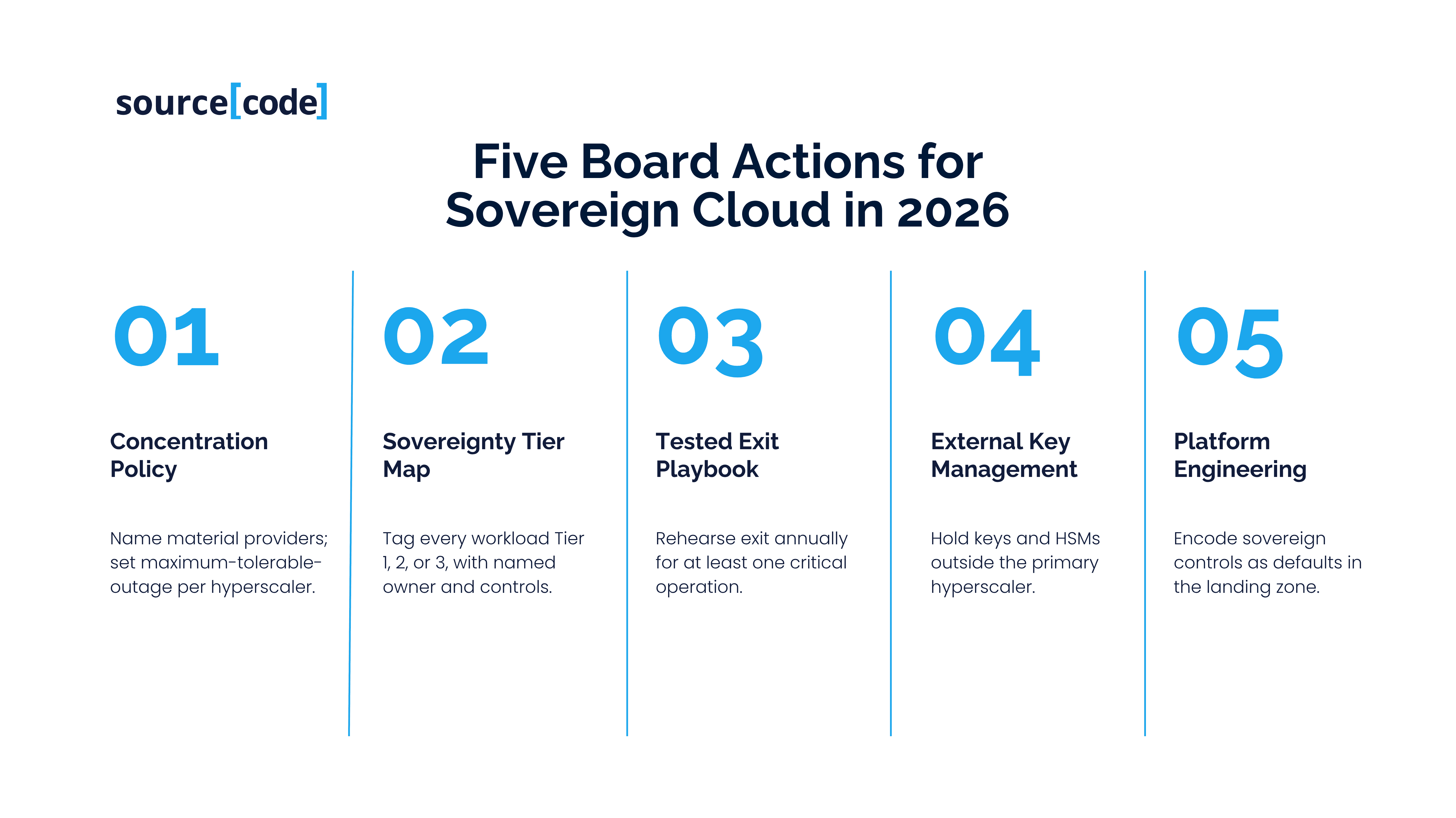
A board-approved cloud concentration policy that names the material providers, quantifies the exposure by critical operation, and sets a maximum-tolerable-outage per hyperscaler. This is the CPS 230 anchor, and it is what APRA, HKMA, and MAS will ask for.
A sovereignty tier map across the application portfolio, agreed by the CIO, CDO, CRO, and General Counsel. Every application is Tier 1, Tier 2, or Tier 3, with a defined control set for each tier and an owner accountable for keeping the tag current.
A tested exit playbook for at least one material workload per year. Exit is a muscle, not a document. Institutions that have never tested their exit will discover, under regulatory scrutiny that it does not work.
An externally controlled key management posture for all Tier 1 and most Tier 2 workloads. If the same hyperscaler holds both the ciphertext and the keys, the institution has not achieved sovereignty; it has achieved compliance theatre.
A platform engineering capability that treats sovereignty controls as defaults. If sovereignty is optional at deployment time, it will be optional in production. Encode residency, key management, logging, and network policy in the landing zone itself.
The sourceCode Perspective
At sourceCode we work with banks, insurers, and fintechs across APAC to translate these prudential expectations into architecture. Our observation from the field is that the institutions moving fastest are the ones that treat sovereign cloud as an engineering problem rather than a procurement problem. Contract clauses do not survive a real outage. Architecture does.
The most effective programs we have supported combine three capabilities in parallel: a sovereign landing zone with codified controls, an exit-tested application pattern for at least one critical operation, and a platform engineering team that makes sovereign defaults easier to consume than non-sovereign ones. This is where our BFSI engineering practice concentrates - cloud landing zones, platform engineering, and modernization of core and mid-office systems that must comply with CPS 230, the HKMA Practice Guide, MAS TRM, and the localization regimes across Southeast Asia.
Sovereign cloud, done well, does not slow modernization. It is what makes modernization defensible.
Conclusion
Sovereign cloud in APAC BFSI has moved from a compliance topic to a design discipline. The 2026 regulatory environment: CPS 230 in Australia, the HKMA Practice Guide in Hong Kong, MAS and OJK expectations across Southeast Asia, no longer accepts the assertion that a good outsourcing contract equals resilience. Supervisors want evidence: tested exits, cryptographic control, and demonstrable ability to survive the failure of any one provider.
The strategic question for boards is not whether to use hyperscale cloud. It is whether the institution has the engineering discipline to use it sovereignly. Institutions that answer that question well over the next eighteen months will unlock the AI and real-time capabilities that will differentiate over the next decade of APAC banking and insurance. Those that answer it poorly will find themselves either paying for very expensive remediation or ceding capability to more disciplined competitors.
Looking to translate CPS 230, HKMA, and MAS cloud expectations into a defensible architecture without slowing your AI and modernization roadmap? Talk with sourceCode about building sovereign-by-design landing zones, exit-tested platforms, and the engineering capability APAC BFSI resilience now requires.
Frequently Asked Questions
What is sovereign cloud for banking? Sovereign cloud for banking is an architectural pattern, not a single product, that ensures regulated data and critical operations remain under the legal, cryptographic, and operational control of the regulated institution and its home jurisdiction, even when hyperscale infrastructure is used underneath.
Does CPS 230 prohibit the use of AWS, Azure, or Google Cloud? No. APRA's CPS 230 does not prohibit hyperscaler use. It requires regulated entities to identify critical operations, understand their dependency on material service providers, set tolerance levels for disruption, and be able to maintain critical operations through the failure of any material provider (APRA, 2023).
What did the HKMA change on 8 January 2026? The HKMA issued a Practice Guide on Cloud Adoption that codifies its 2022 supervisory expectations into a design-level guide covering governance, third-party risk, data protection, exit planning, and portability for authorized institutions in Hong Kong (HKMA, 2026).
How do MAS Guidelines on Outsourcing treat public cloud? MAS Guidelines on Outsourcing explicitly support the use of cloud services, including public cloud, provided institutions perform a risk-based assessment and self-assess against MAS's minimum expectations for outsourcing contracts, oversight, and business continuity.
What is the biggest single mistake APAC banks make on sovereign cloud? Assuming that residency solves sovereignty. Residency addresses where the bytes sit; sovereignty additionally requires cryptographic control, operational transparency, and a tested exit path.
Reference
APRA (2023) Prudential Standard CPS 230 Operational Risk Management, Australian Prudential Regulation Authority. Available at: https://www.apra.gov.au/standards/cps-230 (Accessed: 12 July 2026).
BIS (2024) Managing cloud risk, Financial Stability Institute Insights on policy implementation, Bank for International Settlements. Available at: https://www.bis.org/fsi/publ/insights53.pdf (Accessed: 12 July 2026).
FSB (2024) Third-party dependencies in cloud services, Financial Stability Board. Available at: https://www.fsb.org/uploads/PIFS.pdf (Accessed: 12 July 2026).
HKMA (2026) Practice Guide on Cloud Adoption, Hong Kong Monetary Authority Banking Regulatory Document Repository, 8 January 2026. Available at: https://brdr.hkma.gov.hk/eng/doc-ldg/current/20260108-3-EN (Accessed: 12 July 2026).
MAS (2018, updated) Guidelines on Outsourcing, Monetary Authority of Singapore. Available at: https://www.mas.gov.sg (Accessed: 12 July 2026).
MAS (2021) Technology Risk Management Guidelines, Monetary Authority of Singapore. Available at: https://www.mas.gov.sg (Accessed: 12 July 2026).
McKinsey & Company (2025) Global Banking Annual Review 2025, McKinsey & Company. Available at: https://www.mckinsey.com/industries/financial-services (Accessed: 12 July 2026).
Moody's (2025) The APAC advantage: How the region's banks are building decision advantage through people and culture - not just technology, Moody's Analytics. Available at: https://www.moodys.com/web/en/us/insights/banking/the-apac-advantage.html (Accessed: 12 July 2026).
Precedence Research (2025) Sovereign Cloud Market Size to Hit USD 651.43 Billion by 2035, Precedence Research. Available at: https://www.precedenceresearch.com/sovereign-cloud-market (Accessed: 12 July 2026).
IDC (2025) Cloud Adoption in Asia/Pacific Financial Services - Results from the 2025 Industry AI and Cloud Path Survey, International Data Corporation. Available at: https://my.idc.com (Accessed: 12 July 2026).