source[code] | BFSI Technology Insight | 8 September 2026
Key Takeaways
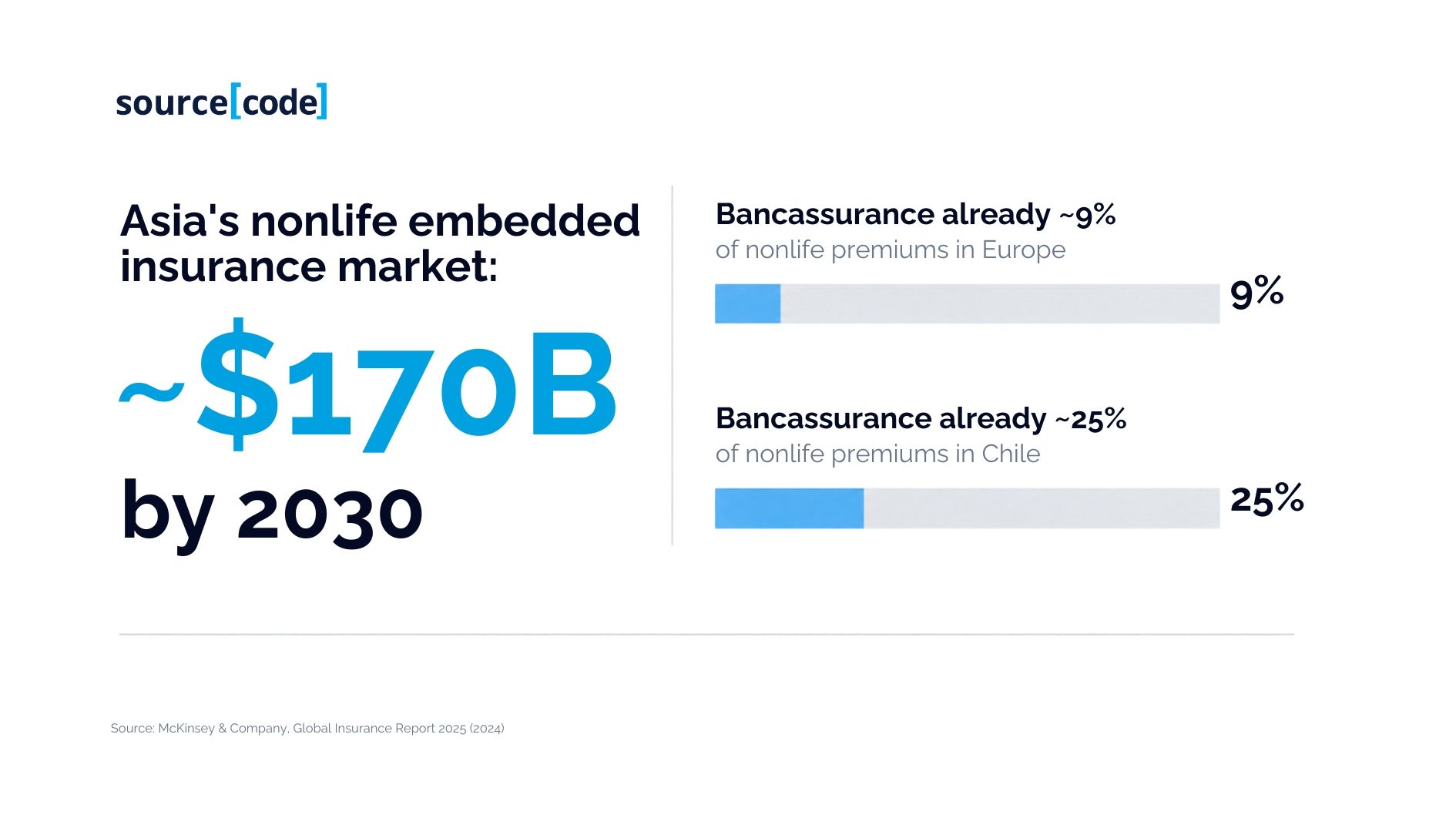
- Bancassurance is not a niche add-on to insurance distribution - it already accounts for roughly 9% of nonlife premiums in Europe and as much as 25% in markets like Chile, and Asia's nonlife embedded insurance market (which overlaps heavily with bank-led distribution) is projected to reach approximately $170 billion by 2030 (McKinsey & Company, 2024).
- Most bank-insurer pairs in APAC still run these partnerships on point-to-point integration built for the pilot phase, not the scaled portfolio it becomes - and regulators are adding complexity, not removing it, by requiring explicit customer consent for every data disclosure between bank and insurer (Baker McKenzie, 2024).
- Integration debt in bancassurance rarely shows up as a systems failure first. It shows up as a customer who was sold a policy the bank's systems can't confirm, or a commission reconciliation that takes weeks instead of days - evidence consistent with bank-side service gaps in underwriting handling and product guidance flagged directly by banking staff themselves (Swiss Re Institute, 2023).
- Large exclusive bancassurance deals - AIA's 15-year, HKD 5,070 million (~USD 650 million) exclusive tie-up with Bank of East Asia across more than 140 branches is one visible example - commit both parties to transaction volumes over a decade or more that the integration built at deal signing was never sized for (Hubbis, 2021).
- The fix is not "more integration" in the abstract. It is knowing which of four specific load points - transaction, data, product, and regulatory - will break first at your partnership's actual growth trajectory, and building for that point deliberately rather than discovering it in production.
The Growth Story Is Well Told. The Systems Story Isn't
The commercial case for bancassurance in Asia has been made repeatedly, and made well. Roland Berger's regional analysis describes bancassurance as remaining "one of the most significant channels of insurance distribution in Asia" in the post-pandemic period, pointing to the region's expanding middle class, persistent protection gaps, and high household savings rates as structural tailwinds that aren't going away (Roland Berger, 2023). McKinsey's most recent global insurance report quantifies the channel's reach outside Asia as a reference point - bancassurance already represents about 9% of nonlife premiums in Europe and as much as 25% of the market in Chile - while projecting Asia's nonlife embedded insurance market, which draws heavily on bank distribution, to reach roughly $170 billion by 2030 (McKinsey & Company, 2024). A separate McKinsey analysis of embedded insurance in Asia estimates that by 2030 around two-thirds of embedded growth will come from premium migrating out of traditional channels, agency and bancassurance included, into partnership-based distribution (McKinsey & Company, 2023).
None of this is controversial inside a bank or insurer's strategy function. What gets far less attention is what happens to the plumbing underneath a bancassurance partnership once it stops being a pilot and starts being a material revenue line for both sides.
Consider the shape of a typical large bancassurance deal. AIA's exclusive 15-year life distribution agreement with Bank of East Asia, signed in 2021 for HKD 5,070 million (approximately USD 650 million), gave AIA exclusive access to sell through more than 140 BEA branches across Hong Kong and the Greater Bay Area (Hubbis, 2021). A deal structured this way is not a marketing arrangement with an insurance product bolted on - it is a decade-plus commitment to a transaction volume that neither party's existing systems were built to absorb on day one, because on day one they didn't need to. The integration that supported the first thousand policies a month was, by design, adequate for the first thousand. It was never re-engineered for the fifty-thousandth.
Why The Integration Gap Stays Invisible Until It Isn't
This is the part of the bancassurance story that gets skipped in board decks and analyst notes, and it matters most to the people actually running the technology on both sides of the partnership.
Most bank-insurer integrations in the region were not designed as integration layers at all. They were designed as a series of point-to-point connections - a file transfer here, a manual reconciliation spreadsheet there, an API built for one product line and awkwardly extended when the next one launches. That's a rational way to start a partnership. It is a poor way to run one at scale, and it survives as long as it does because its failure mode is slow and diffuse, not sudden and visible.
Swiss Re's research into the Southeast Asian bancassurance model is instructive here, precisely because it wasn't set out to study technology at all - it was a customer and channel satisfaction survey. The operational strain shows up anyway. Bank representatives selling insurance products identified underwriting handling, insufficient product tailoring, and inadequate product guidance as their primary obstacles, with the report recommending "more simple underwriting and onboarding processes" as the fix (Swiss Re Institute, 2023). Read that finding as a systems problem rather than a training gap, and it describes exactly what happens when underwriting logic, product rules, and case status live in the insurer's system while the person accountable for explaining them to the customer is standing in a bank branch with no real-time visibility into any of it.
This is the core dynamic: integration debt in bancassurance does not announce itself as an IT ticket. It announces itself as a customer complaint about a policy that hasn't been confirmed, a bank relationship manager who can't tell a customer why a claim is delayed, or a finance team on either side reconciling commission statements by hand because the transaction volume has outgrown the spreadsheet someone built in year one. By the time it reaches an IT backlog with a name and a priority level attached, the business impact - in complaints, in reconciliation headcount, in the trust between the bank and insurer's operating teams - has usually been accumulating for a year or more.
Regulatory structure compounds this rather than simplifying it. Baker McKenzie's 2024 survey of bancassurance regulation across APAC confirms that data sharing between bank and insurer is consent-gated in most major markets - the bank must obtain explicit customer consent before disclosing customer information to the insurance partner, a requirement the survey documents across China, Malaysia, the Philippines, and other jurisdictions (Baker McKenzie, 2024). That is a reasonable and necessary privacy protection. It is also, from an architecture standpoint, a hard requirement that a point-to-point integration built around a one-time data extract was never designed to enforce continuously, especially where a customer's consent status can change and needs to propagate across both organisations' systems in something close to real time.
Point-to-point Versus A Real Integration Layer: The Architectural Reality
It's worth being precise about what "point-to-point" actually means in a bancassurance context, because the term undersells how much manual process typically sits underneath it.
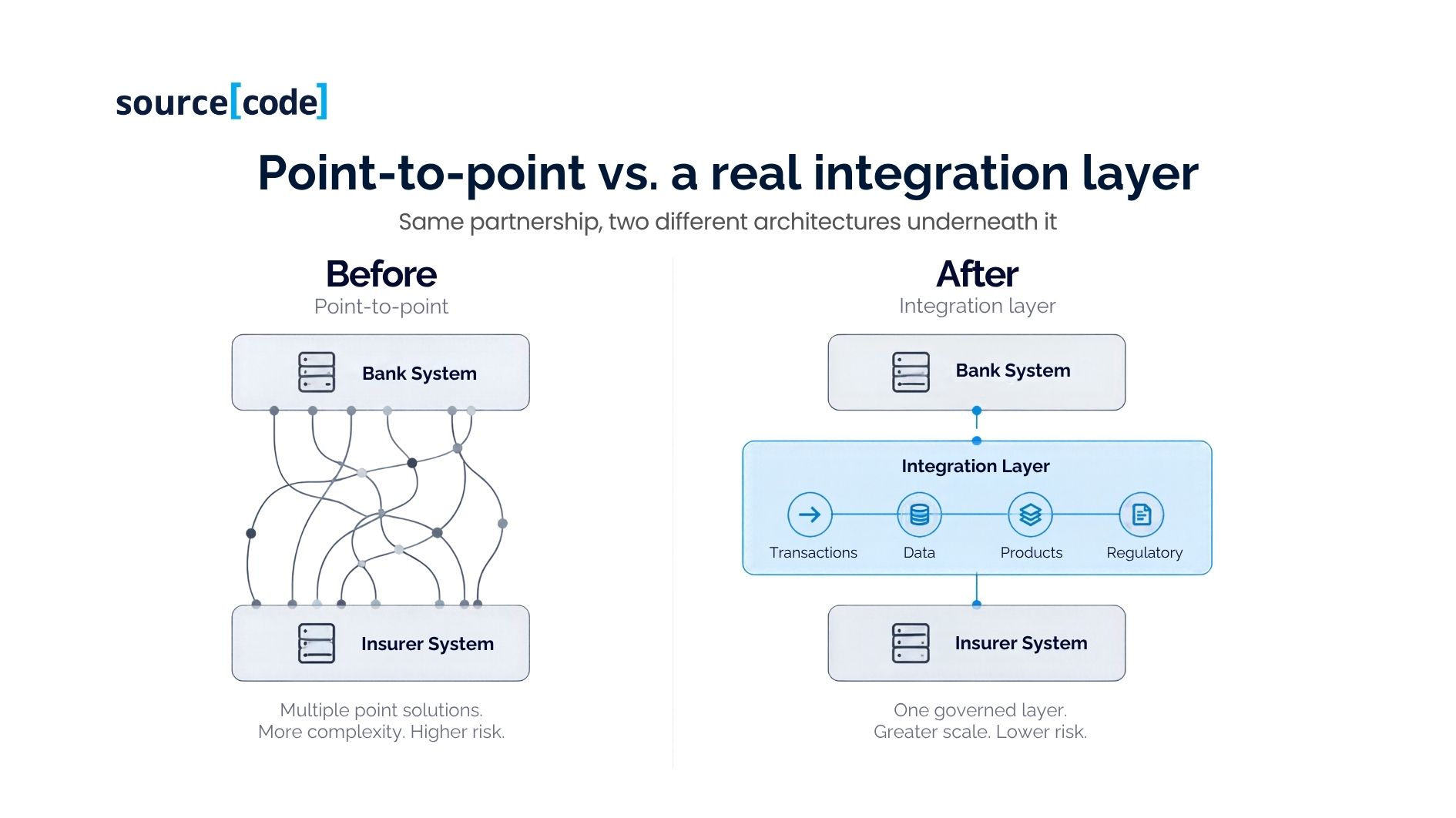
A point-to-point bancassurance integration usually looks like this: a batch file of leads or applications moves from the bank's channel systems to the insurer's new-business system once or twice a day; underwriting decisions come back on a similar cadence, often requiring manual re-keying at one end; policy confirmation and commission data are reconciled through a shared spreadsheet or lightweight portal someone checks weekly; and product or pricing changes on the insurer's side require a change request to the bank's front-end team, queued alongside every other IT request the bank is running. Each connection was built to solve one problem at one point in time. None was designed with the others in mind, and none was sized for the transaction volume the partnership carries three or five years in.
A real integration layer treats the relationship as infrastructure, not a series of point solutions. Four things distinguish it in practice. First, policy and application status is available to both organisations in near real time, not on a batch cycle, so a bank relationship manager and an insurer's underwriter see the same case state. Second, consent and customer data flow through a governed, auditable channel rather than a one-off extract, so the consent requirement Baker McKenzie documents across APAC jurisdictions is enforced structurally, not left to manual compliance checks (Baker McKenzie, 2024). Third, commission and reconciliation data reconcile automatically against a shared transaction ledger rather than being rebuilt by finance teams on each side from separate source systems. Fourth, product and pricing changes propagate through a defined interface rather than a change-request queue, so a new rider or repriced product doesn't need weeks of coordinated IT work before it can go live in-branch.
None of this is exotic. Insurers who have thought seriously about operational integration into a bank's channel have described the requirement in almost identical terms for over a decade: seamless technological interfaces that make bancassurance workflows - forms, applications, underwriting - electronically available through the bank's core systems, rather than sitting alongside them (RGA, 2014). What has changed since that was written is not the definition of the problem, but the cost of not solving it, because the volume running through these partnerships today is an order of magnitude larger than when most of the underlying integrations were designed.
The Counterpoint: Not Every Partnership Needs A Platform
It would be dishonest to present this as a case for building a full integration layer on day one of every bancassurance relationship. The trade-offs deserve honest treatment, not a caveat buried at the end.
Point-to-point integration is the right starting architecture for a genuinely new or small partnership. Building governed, real-time data pipelines and automated reconciliation for a pilot selling a few hundred policies in its first year is over-engineering - it adds cost, vendor dependency, and delivery risk to a relationship that hasn't proven its commercial case yet. A platform-first approach carries its own execution risk, too: McKinsey's analysis of embedded insurance build-outs in Asia found governance and internal coordination failures, not technology choices, were the more common cause of project delays and cost overruns, with organisational silos between product, IT, and distribution teams causing as much damage as any architectural decision (McKinsey & Company, 2023). A well-built integration layer deployed into a poorly coordinated organisation will still underperform.
There's also a real sequencing question with no universal answer. Investing early in integration infrastructure assumes the partnership scales as projected - and bancassurance deals, like any distribution partnership, sometimes don't. The more defensible position isn't "build the platform first" but "know your volume trajectory well enough to time the investment before point-to-point architecture becomes the constraint on growth, rather than after." That timing judgment is what most bank-insurer pairs are currently making by accident rather than by design - which is the gap this piece is describing.
The Bancassurance Strain Map
Deciding when point-to-point integration stops being adequate is not a single yes/no question - it depends on which part of the partnership hits its limit first. In implementation work across bank-insurer partnerships, we've found it useful to separate the question into four independent load points, because each one fails at a different volume threshold and for a different reason. This is source[code]'s framework for that assessment.
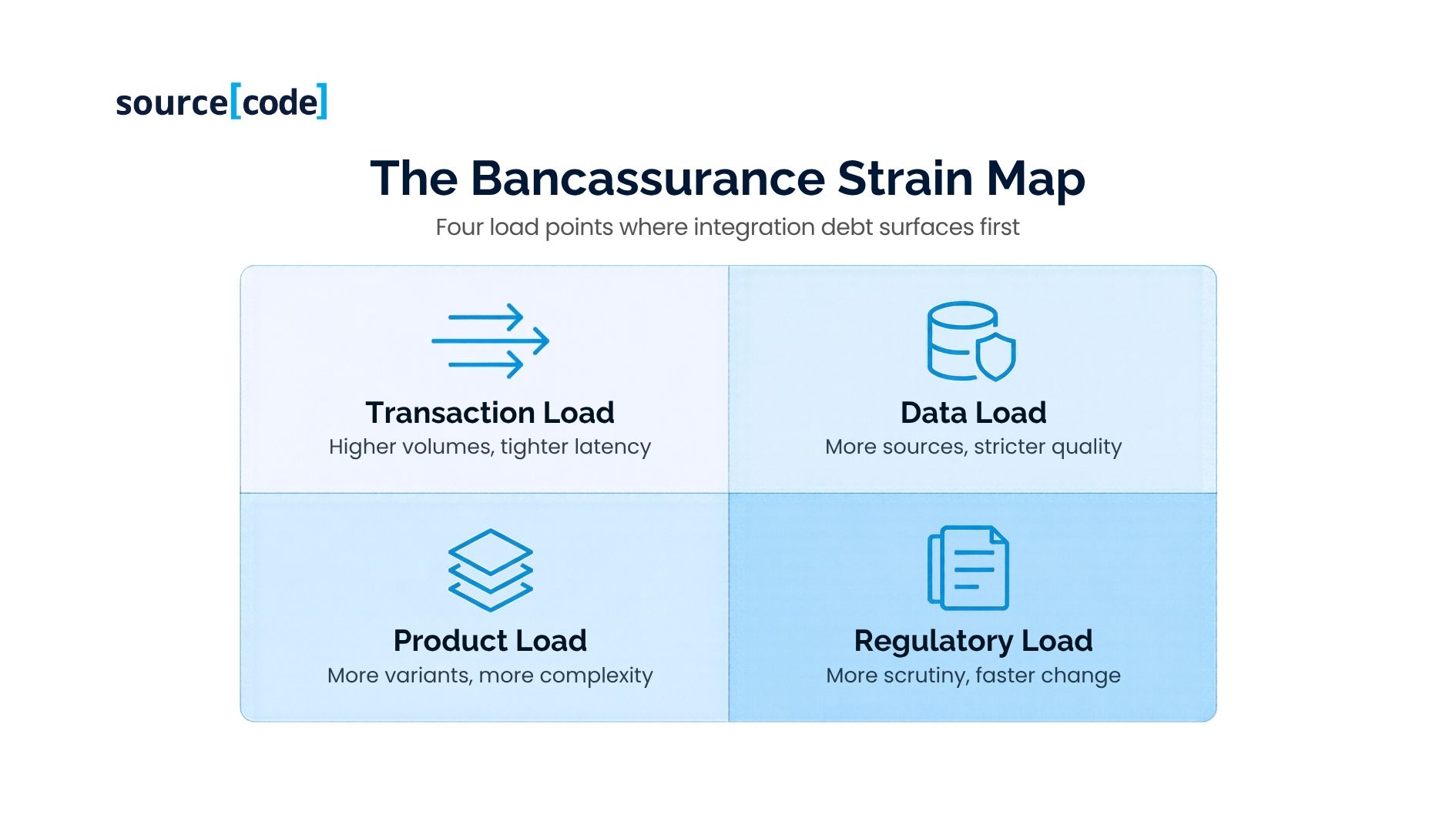
1. Transaction Load - the volume of policies, applications, and endorsements moving between systems per day. Point-to-point batch processing typically holds up until daily volumes make same-day reconciliation impossible; past that point, delays compound daily rather than resetting each cycle.
2. Data Load - the volume and sensitivity of customer data, and consent state, that must stay synchronised and auditable across both organisations. This load point breaks earliest in jurisdictions with strict consent-disclosure rules, because every product cross-sell or renewal touches data governance, not just sales (Baker McKenzie, 2024).
3. Product Load - the rate at which new products, riders, or repriced offers need to go live in the bank channel. A partnership selling one static product can run on manual change requests indefinitely; a partnership adding products quarterly cannot, because each change queues behind the bank's general IT backlog.
4. Regulatory Load - the number of jurisdictions, product lines, and reporting regimes the partnership spans. A single-market, single-product deal carries light regulatory load; a multi-country embedded arrangement - the kind McKinsey expects to drive a majority of Asia's embedded insurance growth by 2030 (McKinsey & Company, 2023) - carries reporting and audit obligations that point-to-point architecture has no natural place to manage.
The practical use of the Strain Map is diagnostic, not prescriptive: a partnership under high Transaction Load but low Regulatory Load has a different, cheaper fix than one under high Data Load and high Regulatory Load simultaneously. Mapping a specific partnership against all four before committing to an integration investment is what turns "we probably need better systems" into a scoped, sequenced piece of work.
The source[code] Perspective
Across the bancassurance integration work we've been part of, the pattern is consistent: the request rarely arrives framed as an architecture problem. It arrives as a request to fix reconciliation delays, or to stop a specific category of customer complaint, or to speed up how quickly a new product can go live in-branch. The architecture conversation follows once it becomes clear that the symptom and the last twelve months of point-to-point patches are related.
That sequencing isn't a failure of planning on the client's part - it's the expected shape of how integration debt actually surfaces in a live partnership, which is exactly why treating the four load points as a standing diagnostic, rather than a one-time build decision, tends to hold up better than a platform project scoped once and left alone.
Conclusion
Bancassurance's commercial trajectory in Asia is well documented and, on the evidence available, still climbing - from Roland Berger's structural growth case to McKinsey's specific projections for nonlife premium share and embedded market size (Roland Berger, 2023; McKinsey & Company, 2024; McKinsey & Company, 2023).
What's under-documented is that the technology underneath most of these partnerships was sized for their starting volume, not their current or projected one, and that the resulting strain surfaces first as customer and reconciliation problems rather than as a clearly labelled IT issue. Point-to-point integration is a legitimate way to start a bancassurance partnership; it is rarely a viable way to run one that has scaled into a material, multi-year, multi-jurisdiction revenue line for both sides.
The organisations managing this well aren't the ones that built a platform on day one - they're the ones that can name, in advance, which of the four load points their partnership's growth trajectory will hit first, and are building for that specific point deliberately rather than discovering it in a backlog of customer complaints.
If you're assessing where your bancassurance partnership's integration is under strain, get in touch to talk through your architecture. Talk to us here!
Frequently Asked Questions
What is the difference between point-to-point integration and a real integration layer in bancassurance? Point-to-point integration connects a bank and an insurer's systems through individual, often manual links - batch file transfers, spreadsheet-based reconciliation, one-off API calls built per product. A real integration layer treats the partnership as shared infrastructure: near-real-time case status, governed and auditable consent/data flows, automated commission reconciliation, and a defined interface for product and pricing changes (RGA, 2014; Baker McKenzie, 2024).
Why don't banks and insurers notice integration problems earlier? Because the failure mode is diffuse rather than sudden. It shows up first as customer complaints about unconfirmed policies, delayed claims communication, or slow commission reconciliation - operational friction that gets attributed to service quality or process, not to the underlying systems, until volume makes the pattern impossible to ignore (Swiss Re Institute, 2023).
How big is the bancassurance and embedded insurance opportunity in Asia? McKinsey estimates Asia's nonlife embedded insurance market - which overlaps significantly with bank-led distribution - will reach approximately $170 billion by 2030, and separately projects that around two-thirds of embedded insurance growth in Asia by 2030 will come from premium migrating out of traditional channels including bancassurance (McKinsey & Company, 2024; McKinsey & Company, 2023).
Does every bancassurance partnership need a full integration platform? No. Point-to-point integration is appropriate for a new or small partnership still proving its commercial case. The judgment call is timing: knowing which of the transaction, data, product, or regulatory load points your partnership's growth trajectory will hit first, and investing ahead of that point rather than after point-to-point architecture becomes the constraint.
What role does data privacy regulation play in bancassurance integration design? A significant one. Most major APAC jurisdictions require explicit customer consent before a bank discloses customer information to an insurance partner, and that consent status can change over time. Baker McKenzie's 2024 regulatory survey documents this requirement across markets including China, Malaysia, and the Philippines - a continuous governance obligation that point-to-point, one-off data extracts are poorly suited to enforce (Baker McKenzie, 2024).
What is the source[code] Bancassurance Strain Map? It's a four-part diagnostic - Transaction Load, Data Load, Product Load, and Regulatory Load - for identifying which part of a bancassurance partnership's technical infrastructure will reach its limit first, so integration investment can be scoped and sequenced against the specific pressure point rather than treated as a single undifferentiated "systems upgrade."
Reference List
Baker McKenzie (2024) Asia Pacific Regulatory Landscape and Issues in Bancassurance, 2024 Edition. Available at: https://resourcehub.bakermckenzie.com/en/-/media/asia-pacific-regulatory-landscape-and-issues-in-ba/files/publications/apac-regulatory-landscape-and-issues-in-bancassurance-2024.pdf (Accessed: 8 September 2026).
Hubbis (2021) AIA announces exclusive 15-year bancassurance partnership with the Bank of East Asia. Available at: https://www.hubbis.com/news/aia-announces-exclusive-15-year-bancassurance-partnership-with-the-bank-of-east-asia (Accessed: 8 September 2026).
McKinsey & Company (2023) Why Asian insurers are ideally positioned for embedded market gains. Available at: https://www.mckinsey.com/industries/financial-services/our-insights/insurance/why-asian-insurers-are-ideally-positioned-for-embedded-market-gains (Accessed: 8 September 2026).
McKinsey & Company (2024) Global Insurance Report 2025: The Pursuit of Growth. Available at: https://www.mckinsey.com/~/media/mckinsey/industries/financial%20services/our%20insights/global%20insurance%20report%202025/global-insurance-report-2025-the-pursuit-of-growth.pdf (Accessed: 8 September 2026).
RGA (2014) Unlocking Bancassurance Protection: Five Strategic Work Streams. Available at: https://www.rgare.com/knowledge-center/article/unlocking-bancassurance-protection (Accessed: 8 September 2026).
Roland Berger (2023) Crossroads of Bancassurance in Asia Pacific. Available at: https://www.rolandberger.com/en/Insights/Publications/Crossroads-of-bancassurance-in-Asia-Pacific.html (Accessed: 8 September 2026).
Swiss Re Institute (2023) Bancassurance in Southeast Asia: Is the Model Viable? Available at: https://www.swissre.com/institute/research/topics-and-risk-dialogues/economy-and-insurance-outlook/bancassurance-southeast-asia-model-viable.html (Accessed: 8 September 2026).