The Underwriting Data Problem Agentic AI Can't Fix
source[code] | BFSI Technology Insight | 10 September 2026
Key Takeaways
-
Agentic AI can orchestrate an underwriting workflow but cannot invent clean, structured, current risk data where none exists; McKinsey finds 60% of insurers still describe their traditional data as "evolving" rather than settled (McKinsey & Company, 2024).
-
Industry commentary is converging on the same diagnosis: "AI is not creating new data problems. It is exposing existing ones" (Carrier Management, 2026).
-
Adoption is more cautious than vendor narratives suggest - only 22% of insurers surveyed expect an agentic AI solution in place by year-end 2026 (Celent, 2025).
-
Gartner's 2026 banking-and-insurance trends research names "decision-ready data" as the precondition for scaling AI safely in regulated workflows, not an afterthought to it (Quantexa, 2026).
-
Agentic AI's fastest genuine value is often on the data foundation itself - automated mapping, profiling and anomaly detection - before it is asked to influence underwriting judgment (McKinsey & Company, 2026).
Every underwriting technology conversation in 2026 arrives at the same pitch: deploy an agent, let it triage submissions, pull third-party data, draft the referral, cut cycle time. The pitch isn't wrong about what agentic AI can do. It's wrong about what most underwriting operations can currently feed it.
What An Underwriting Agent Actually Needs from the data beneath it
Agentic AI's genuine advance over earlier underwriting automation is that it doesn't just score a static input - it plans a sequence of actions, calls tools and data sources, and adapts based on what it finds. That is a meaningfully more capable orchestration layer than the rules engines and single-pass models most carriers have run for a decade.
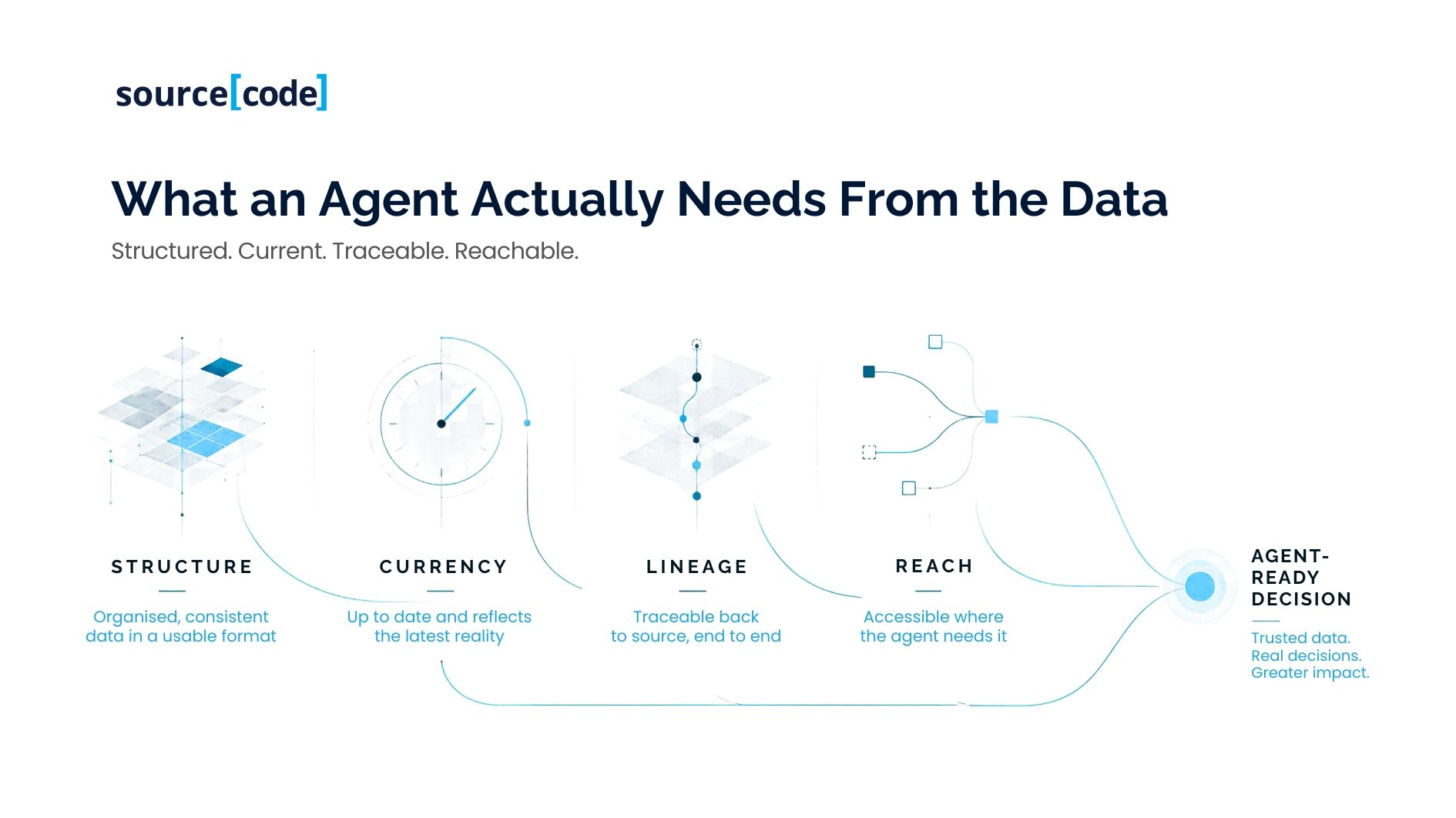
But orchestration capability and data capability are different problems, and agentic AI only solves the first. For an agent to plan and act inside an underwriting workflow - pull exposure data, reconcile it against a submission, flag an inconsistency, route a referral - the data it acts on has to satisfy conditions that have nothing to do with the agent's own sophistication:
- It has to be structured, not trapped in a PDF broker slip, a scanned survey report, or a free-text underwriter note that a human has to interpret before any system can use it.
- It has to be current, not a nightly batch extract or a quarterly bordereaux that is stale by the time the agent reasons over it.
- It has to be traceable, with lineage an underwriter or a regulator can interrogate - where did this number come from, when was it last verified, what transformed it along the way.
- It has to be reachable, meaning the agent has an actual, governed, API-level path to the system of record rather than a shared drive, an email inbox, or a legacy core that only exports via manual extract.
Gartner's 2026 trends research for banking and insurance frames this directly: scaling AI in regulated financial services workflows depends on "decision-ready data, robust governance, and low-latency, explainable decisioning" being in place as infrastructure, not produced on demand by the AI layer itself (Quantexa, 2026). An agent asked to reason over data that fails these conditions doesn't fail cleanly - it produces plausible-sounding output on an unreliable foundation, a worse failure mode for a CUO than a system that simply doesn't run, because it doesn't announce itself.
McKinsey's April 2026 analysis of agentic AI and core modernization makes the difficulty explicit: legacy underwriting systems are not clean data stores waiting to be queried - they are "living socio-technical system[s]" carrying "sparsely documented embedded business rules, batch windows, custom interfaces, and data semantics" (McKinsey & Company, 2026). An agent doesn't get to skip that complexity. It has to be built on top of it, or wait until it's resolved.
Why most underwriting data estates aren't there yet
This is not a hypothetical gap; it is the state most carriers are actually in, and the industry's own research is unusually blunt about it. McKinsey's 2024 survey of insurers found a third had initial generative AI use cases in production and only one in five rated their AI maturity as advanced - while 60% described their traditional, structured data as still "evolving" (McKinsey & Company, 2024). That is a striking sequencing problem in the numbers themselves: more insurers are running AI pilots than are confident their underlying data can support them.
The pattern recurs in research with less incentive to flatter the industry. Coverage of Sollers Consulting's 2026 research put it plainly: fragmented systems, siloed business units and inconsistent data formats are the actual constraint on enterprise AI in insurance, and "AI cannot scale effectively inside fragmented environments built around disconnected systems" (Carrier Management, 2026). Send's 2026 underwriting trends research, drawn from insurers, brokers and reinsurers across the UK, US and international markets, reaches the same conclusion from the practitioner side: AI is "beginning to influence outcomes where insurers have invested in clean data and strong governance," with a widening gap between carriers strengthening those foundations and carriers still constrained by legacy systems (Reinsurance News, 2026, citing Send's Underwriting Trends Report 2026).
For APAC and Gulf underwriting operations specifically, the constraint compounds. Many carriers in both regions run underwriting on policy administration systems that predate current data architecture standards, layered with acquisition-driven fragmentation and, in several Gulf and Southeast Asian markets, broker channels that still deliver risk information as unstructured documents rather than structured feeds. Deloitte's 2026 Global Insurance Outlook notes that even well-resourced European insurers "remain cautious on experimental AI projects, doubling down on data modernization and cloud migration" first (Deloitte Insights, 2025) - a sequencing choice made by carriers with generally more mature data estates than the regional average across APAC and the Gulf. If that is the disciplined path for insurers starting from a stronger position, it is a reasonable default for those starting from a weaker one.
None of this means the data foundation has to be perfect before any AI work begins. Deloitte's guidance is more measured than that: "perfect data hygiene may not be essential for every AI project; however, proper standardization and control can be critical to avoid conflicting results and maintain trust" (Deloitte Insights, 2025). The bar is standardization sufficient that an agent's output can be trusted and defended - and for a meaningful share of underwriting data estates in the region, that bar isn't cleared yet.
The gap between agent-framework hype and data-foundation reality
Most of the current underwriting AI conversation happens one layer above the actual constraint. Vendor evaluations compare orchestration frameworks, model choices, and agent-to-agent protocols - questions that matter, but that presuppose a data layer those frameworks can safely act on. Few open with an audit of whether the submission and exposure data feeding the agent are structured, current, traceable and reachable in the first place.
The market's own adoption pace is a useful corrective to the framework-first narrative. Celent's 2025 research on agentic AI in insurance found that only 22% of participating insurers expected to have an agentic AI solution actually in place by year-end 2026, even as underwriting was identified as one of the functions most likely to lead adoption (Celent, 2025). That gap between hype and deployment is not primarily an agent-capability problem - commercially available orchestration tooling has advanced quickly. It is a readiness problem the vendor pitch rarely interrogates.
Practitioners closer to the data are saying so directly. As one insurtech CEO put it in reporting on how carriers are responding: "Anyone can build technology - and many people have. What you cannot build quickly is the data the model learns from" (Digital Insurance, 2026). A chief product officer at a US specialty insurer made the competitive argument explicit: "proprietary data relationships with distribution partners and vendors - not modeling tools, which will soon be universally accessible - will determine competitive advantage" (Digital Insurance, 2026). For a CUO evaluating agentic AI vendors, framework selection is close to commoditized; the data foundation is not, and is where the real differentiation - and the real risk - sits.
Where agentic AI's value is genuinely real - when the data is ready
None of this is an argument against agentic AI in underwriting - it's an argument about sequencing, and the evidence for genuine value where the data foundation exists is concrete rather than theoretical.
Deloitte's 2026 outlook cites AIG's deployment of a generative AI underwriting assistant, built with Anthropic and Palantir, that ingests and prioritises every new excess-and-surplus submission, allowing the team to review more policies without adding headcount (Deloitte Insights, 2025). That works because it is scoped to a data environment - E&S submission intake - made tractable enough for an agent to act on reliably.
There is also a more direct, underused case: pointing agentic AI at the data foundation itself rather than at underwriting decisions. McKinsey's 2026 analysis notes that agentic AI applied to core modernization work - automated mapping, extract-transform-load, profiling, anomaly detection and synthetic test-data creation - can "surface issues earlier and compress data readiness timelines," with productivity improvements in the 20-60% range on that preparatory work (McKinsey & Company, 2026). That is a materially different use case from an agent influencing a risk decision, and it is the one most underwriting organisations with an unresolved data foundation should evaluate first: use agentic AI to accelerate the data readiness work, not to skip past it.
The Data Readiness Ledger
Before committing budget to an agentic AI underwriting initiative, source[code] uses a simple discipline with CUOs and heads of underwriting: run the target risk data through four ledger entries before the framework conversation starts. An initiative that fails two or more is not ready to hand decisions - or even decision support - to an agent, whatever the vendor promises.
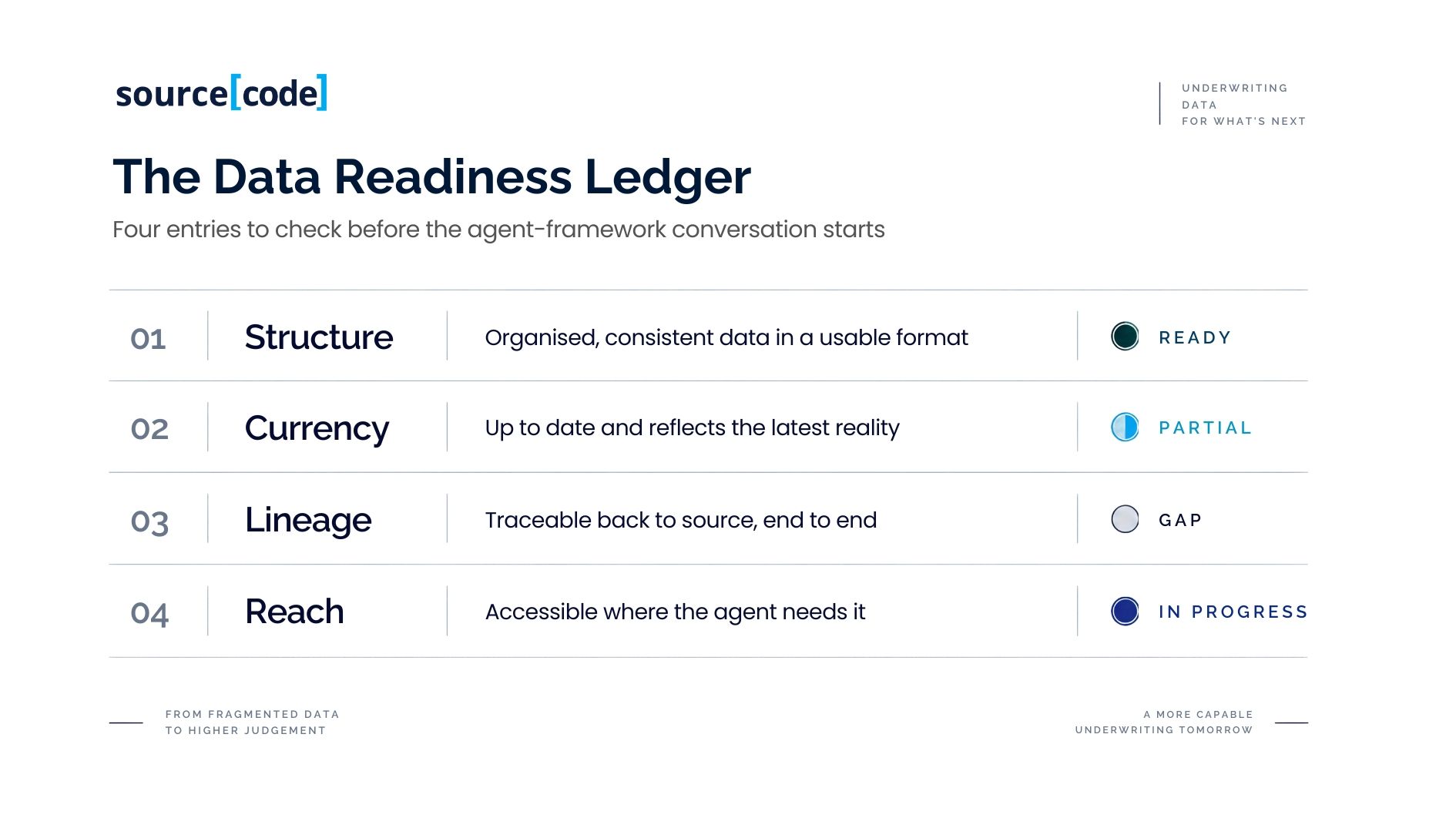
Structure - Is the risk data already machine-readable at the point of use, or does a human still have to read a PDF, an email, or a scanned document first? If structuring only happens after a person intervenes, the agent has nothing to act on until that step is solved.
Currency - How old is "current" in practice - real time, nightly batch, or a quarterly bordereaux? An agent reasoning over stale data produces confident, timely-looking output built on a number that was already wrong.
Lineage - Can you show where a given data point came from, when it was last verified, and what transformed it - in a form an auditor or regulator would accept? If lineage has to be reconstructed manually after the fact, it isn't infrastructure yet; it's forensics.
Reach - Does the agent have a governed, API-level path to the system of record, or does someone still extract and hand over data manually? An agent dependent on a person to fetch its inputs isn't automating the workflow - it's moving the bottleneck to whoever still holds the keys.
The source[code] perspective
Working across underwriting technology programmes in APAC and the Gulf, we see the same pattern repeat: the agent-framework decision gets made in weeks, and the data foundation work that determines whether it can be trusted gets discovered - usually mid-pilot - to be a multi-quarter effort nobody scoped.
The fix isn't slowing agentic AI ambition; it's sequencing it correctly, running the readiness assessment before the framework selection rather than after the first pilot stalls. Carriers that treat structure, currency, lineage and reach as the actual project - with the agent as the payoff, not the starting point - tend to ship something durable.
Carriers that start with the agent tend to ship a fast, confident demonstration of exactly how unready their data was. Talk to us for further discussion!
Conclusion
Agentic AI is a genuine advance in how an underwriting workflow can be orchestrated - but orchestration capability has outpaced data capability across most of the industry, and that gap is the real constraint on value, not the choice of agent framework.
The research is consistent from multiple independent angles: insurers rating their own data as still "evolving," adoption numbers running well behind the hype, decision-ready data framed as precondition rather than output, and practitioners naming proprietary, well-governed data - not modelling tooling - as the actual source of competitive advantage.
For a Chief Underwriting Officer setting 2027 budget, the highest-leverage question isn't which agentic platform to select. It's whether the risk data that platform would act on is structured, current, traceable and reachable enough to trust the output - and if not, whether the first phase should target the data foundation rather than the agent.
Frequently Asked Questions
Can agentic AI fix poor-quality underwriting data on its own? No. It can orchestrate workflow steps and call tools more capably than earlier automation, but it cannot generate clean, structured, current risk data that doesn't already exist in usable form. Where the underlying data is fragmented or stale, an agent produces confident-looking output on an unreliable foundation (McKinsey & Company, 2026; Carrier Management, 2026).
Why do insurers keep running AI pilots if their data isn't ready? Pilots are often scoped narrowly enough to sidestep the broader data problem. McKinsey's 2024 research found a third of surveyed insurers already had initial generative AI use cases in production, while 60% described their traditional data as still "evolving" (McKinsey & Company, 2024).
What does "data readiness" actually mean for an underwriting AI initiative? At minimum, that the risk data an agent would act on is structured (machine-readable), current (near real time), traceable (lineage an auditor can verify), and reachable (governed system access, not manual extraction). Gartner's 2026 research frames "decision-ready data" as the precondition for scaling AI in regulated workflows, not a byproduct of it (Quantexa, 2026).
Is agentic AI adoption in underwriting actually happening, or is it mostly hype? It's happening, but more cautiously than vendor messaging suggests. Only 22% of insurers surveyed by Celent expected an agentic AI solution in place by year-end 2026, even though underwriting was flagged as a leading use case (Celent, 2025). Real deployments exist - Deloitte cites AIG's generative AI underwriting assistant for E&S submission triage - but they tend to be scoped to data environments made tractable first (Deloitte Insights, 2025).
Should a CUO pause agentic AI initiatives until data quality is fixed? Not pause - resequence. A useful near-term application of agentic AI is accelerating the data foundation work itself: automated mapping, profiling and anomaly detection, which McKinsey's 2026 research associates with productivity gains of 20-60% (McKinsey & Company, 2026). That is lower-risk than pointing an agent directly at underwriting decisions before the data is ready.
How should APAC and Gulf underwriting leaders think about regional data readiness? Both regions carry a higher-than-average concentration of legacy policy administration systems and, in several markets, broker channels that still deliver risk information as unstructured documents. Deloitte notes that even better-resourced European insurers are "doubling down on data modernization and cloud migration" ahead of scaling experimental AI (Deloitte Insights, 2025) - a discipline that applies at least as strongly to carriers starting from a less mature baseline.
Reference List
Carrier Management (2026) AI Is Exposing Insurance's Data Problem. Available at: https://www.carriermanagement.com/news/2026/06/03/288586.htm (Accessed: 10 September 2026).
Celent (2025) Shedding Light on Agentic AI in Insurance. Available at: https://www.celent.com/en/insights/shedding-light-on-agentic-ai-in-insurance (Accessed: 10 September 2026).
Deloitte Insights (2025) 2026 Global Insurance Outlook. Available at: https://www.deloitte.com/us/en/insights/industry/financial-services/financial-services-industry-outlooks/insurance-industry-outlook.html (Accessed: 10 September 2026).
Digital Insurance (2026) Insurers are retraining AI, insourcing data to regain control. Available at: https://www.dig-in.com/news/insurers-are-retraining-ai-insourcing-data-to-regain-control (Accessed: 10 September 2026).
McKinsey & Company (2024) The potential of gen AI in insurance: Six traits of frontrunners. Available at: https://www.mckinsey.com/industries/financial-services/our-insights/insurance-blog/the-potential-of-gen-ai-in-insurance-six-traits-of-frontrunners (Accessed: 10 September 2026).
McKinsey & Company (2026) Can agentic AI (finally) modernize core technologies in insurance? Available at: https://www.mckinsey.com/industries/financial-services/our-insights/can-agentic-ai-finally-modernize-core-technologies-in-insurance (Accessed: 10 September 2026).
Quantexa (2026) Scale AI in Financial Services with Gartner's Top Data & Analytics Trends for 2026. Available at: https://www.quantexa.com/resources/gartner-s-2026-data-analytics-trends-in-banking-and-insurance/ (Accessed: 10 September 2026).
Reinsurance News (2026) Insurers must strengthen data, connectivity & governance to scale underwriting: Send. Available at: https://www.reinsurancene.ws/insurers-must-strengthen-data-connectivity-governance-to-scale-underwriting-send/ (Accessed: 10 September 2026).