The Resilience Dividend: Why APAC BFSI Leaders Are Turning CPS 230, HKMA OR-2 and MAS TPRM Into Competitive Advantage
Operational resilience in APAC banking, insurance and financial services has crossed a threshold. Australia's targeted amendments to APRA Prudential Standard CPS 230 took effect on 1 July 2026 (APRA, 2026a). Hong Kong's OR-2 full-compliance deadline lapsed in May 2026 (HKMA, 2024). Singapore's Monetary Authority closed consultation on its most significant Third-Party Risk Management (TPRM) overhaul in a decade on 20 April 2026 (MAS, 2026a; Baker McKenzie, 2026). What began as a post-pandemic regulatory recalibration has hardened into an executive mandate that reshapes technology strategy, procurement, engineering practice and board-level accountability.
Three forces are converging. First, the cost of getting resilience wrong is now empirically measurable and rising: the 2024 CrowdStrike incident alone caused an estimated USD 5.4 billion in Fortune 500 damages (Parametrix, cited in Reuters, 2024), while 84% of surveyed organizations reported outage-related revenue loss of at least USD 10,000 in the past twelve months (Cockroach Labs, 2025). Second, systemic concentration in the cloud layer: AWS, Microsoft and Google now account for 63% of enterprise cloud infrastructure spending (Synergy Research, cited in SafeSecurity, 2026) - has turned single-vendor faults into industry-wide events, as the October 2025 AWS US-EAST-1 and Google Cloud Service Control outages demonstrated. Third, third-party breaches now represent 30% of all reported incidents, double the level of two years ago (Verizon DBIR, cited in Swif, 2026).
For CEOs, CIOs, CDOs and boards across APAC BFSI, the strategic question is no longer whether to invest in operational resilience. It is whether the current investment produces evidence of resilience or only documentation of it. Institutions that can prove resilience under test conditions will earn what we describe in this paper as a resilience dividend: lower capital charges under Basel-aligned operational risk regimes, faster regulatory approvals, stronger customer trust, and a widening gap versus peers who continue to treat resilience as a compliance workstream.
This paper synthesizes regulatory developments, industry data and engineering practice to set out what APAC BFSI leaders must do next.
From Compliance Artefact to Competitive Moat
For most of the past decade, operational resilience has been discussed in the language of policy documents, business continuity plans, and disaster recovery runbooks. That language is now insufficient. Regulators across APAC and beyond have moved decisively from asking institutions to describe resilience to demanding they demonstrate it through mapped critical operations, defined tolerance levels, scenario-tested severe events and evidence-backed third-party arrangements (BIS, 2021).
The Bank for International Settlements set the international baseline with its 2021 Principles for Operational Resilience, and regulators have since localized those principles into binding standards: APRA's CPS 230, the HKMA's Supervisory Policy Manual module OR-2, MAS's Business Continuity Management and forthcoming TPRM Guidelines, the EU's Digital Operational Resilience Act (DORA), and the UK PRA's operational resilience policy. What differentiates the current wave is convergence: the definitional building blocks - critical operations, tolerance for disruption, severe but plausible scenarios, material service providers - are now broadly harmonized across jurisdictions (BIS, 2021; APRA, 2025; HKMA, 2022).
This harmonization matters strategically. For any BFSI institution operating across two or more APAC jurisdictions, resilience investment can now be architected once and evidenced many times. That is a rare regulatory tailwind, and the institutions that recognise it will convert a compliance obligation into a durable capability.
The APAC Regulatory Landscape in 2026
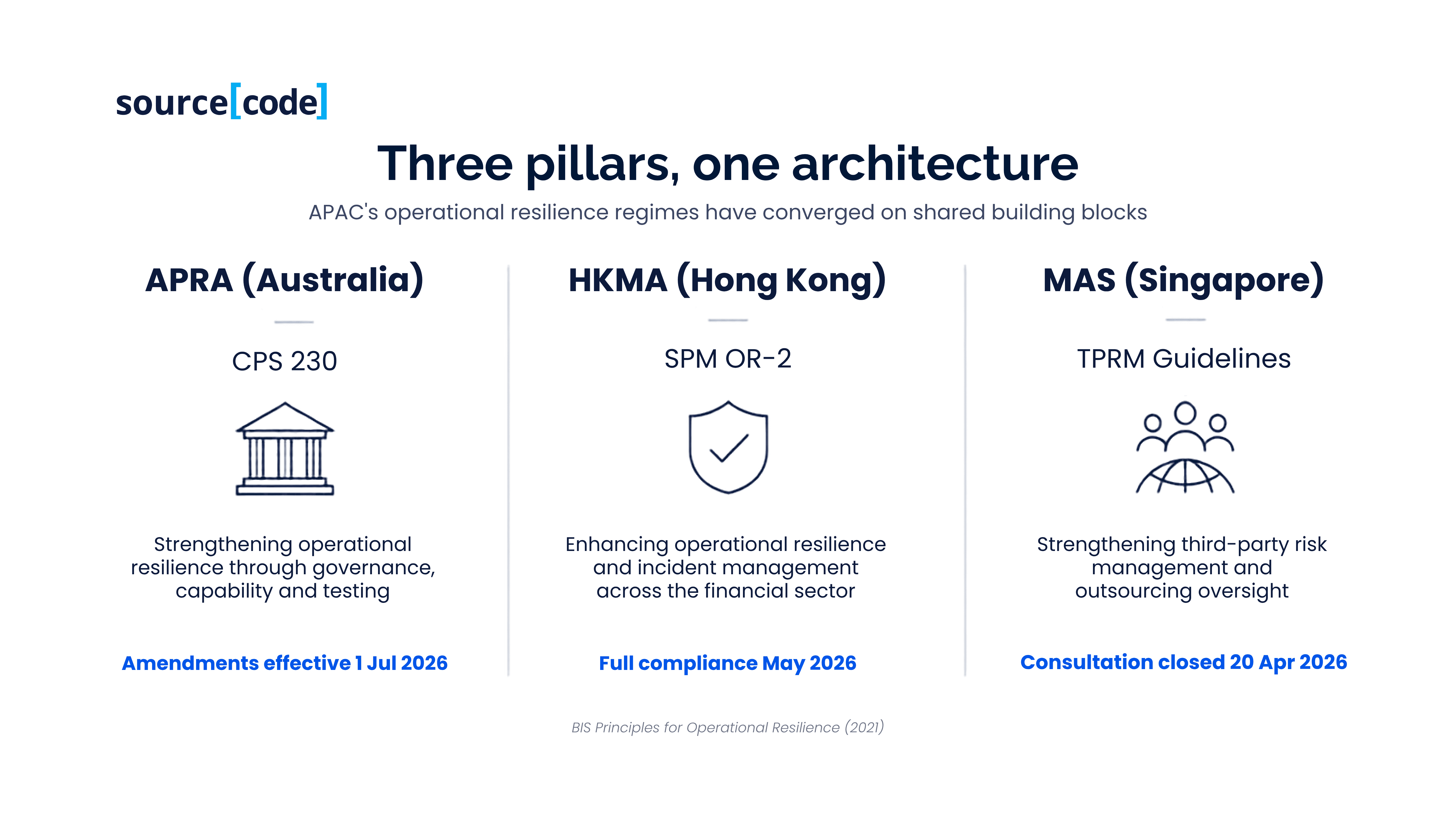
Australia - CPS 230 in force, amendments live from 1 July 2026
CPS 230 came into effect on 1 July 2025 for all APRA-regulated entities, with a 12-month extension for non-significant financial institutions on business continuity and scenario analysis requirements (APRA, 2025). On 30 April 2026, APRA released final targeted amendments to CPS 230, the accompanying Prudential Practice Guide CPG 230, and a Material Service Provider Register template. The amendments took effect on 1 July 2026 and provide limited exemptions from specific contractual requirements for material arrangements with certain categories of non-traditional service providers, including central banks and clearing and settlement facilities, where contractual compliance is not practicable (APRA, 2026a; Regulation Tomorrow, 2026).
The direction of travel is unambiguous: broader definition of material service providers, register-level transparency, and stronger board-level accountability for tolerance decisions.
Hong Kong - OR-2 fully operational since May 2026
HKMA's OR-2 timeline followed a "1+3" model: framework in place by May 2023, full operational resilience by May 2026 (HKMA, 2022). Ahead of the deadline, HKMA reported that all Hong Kong banks had established relevant frameworks, more than two-thirds of critical operations had been mapped, and about half of scenario testing had been completed (HKMA, 2024). Post-May 2026, HKMA has signaled that supervisory focus shifts to sustaining resilience within business-as-usual, with third-party and cyber risks remaining priority areas (HKMA, 2025).
Singapore - MAS's unified resilience regime takes shape
On 6 March 2026, MAS released two landmark consultation papers: Proposed Guidelines on Third-Party Risk Management and Updated Guidelines on Operational Risk Management (MAS, 2026a; Baker McKenzie, 2026). The proposed TPRM Guidelines supersede the existing Guidelines on Outsourcing and extend supervisory expectations from outsourced services to all third-party arrangements that could materially affect an institution's operations, customers, data security or regulatory obligations. Consultations closed on 20 April 2026, with the final guidelines expected to take effect in phases through 2027.
The wider regulatory perimeter
APAC institutions with European exposure now also fall inside DORA, enforceable from 17 January 2025, with penalties up to 2% of global turnover for financial entities and up to EUR 5 million for critical ICT service providers (European Parliament, 2022). The UK's operational resilience regime completed its transition on 31 March 2025. India's RBI, Japan's FSA and Indonesia's OJK have each issued or refined third-party and cyber-resilience guidance in the past 18 months.
For a regional CIO, the practical implication is a single reference architecture that must satisfy multiple regulators simultaneously, a design constraint that rewards discipline and punishes tactical patchwork.
Why Compliance-First Approaches Are Breaking
Three structural fault lines are exposing the limits of a compliance-first resilience posture.
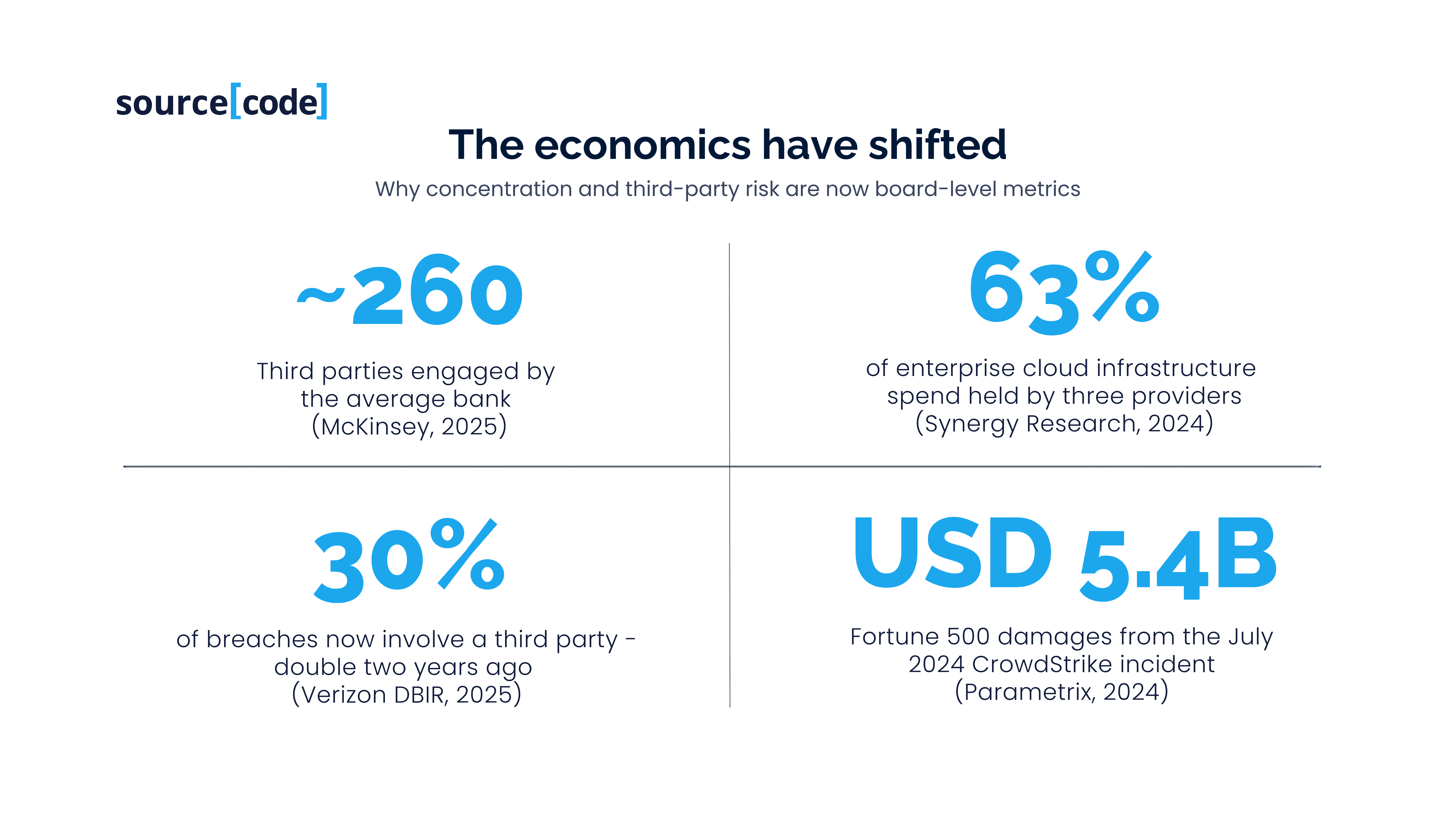
1. Cloud concentration has become systemic. AWS, Microsoft Azure and Google Cloud together accounted for 63% of enterprise cloud infrastructure spend in Q3 2024, up from 61% two years prior (Synergy Research, cited in SafeSecurity, 2026). On 20 October 2025, an AWS US-EAST-1 regional incident disrupted DNS resolution for DynamoDB endpoints and cascaded across dependent services within hours. A subsequent Google Cloud outage in the same quarter, caused by a null-pointer exception in its Service Control authentication system, locked users out of dependent services globally (SafeSecurity, 2026; SureCloud, 2026). Neither event involved a cyber-attack. Both revealed the fragility of assumed independence in multi-tenant infrastructure.
2. The third-party surface is expanding faster than it can be governed. Banks now engage an average of approximately 260 third parties, with wide variation across institutions (McKinsey, 2025). More than 40% of cyber incidents reported to the UK FCA in 2025 involved a third-party provider (BCLP, 2026). Globally, the share of breaches involving a third party has doubled to 30% (Verizon DBIR, cited in Swif, 2026). Traditional outsourcing registers cannot keep pace with fintech partnerships, API integrations, SaaS proliferation and AI vendor stacks, precisely the gap that MAS's expanded TPRM scope is designed to close.
3. Resilience readiness is lagging risk exposure. Cockroach Labs' State of Resilience 2025 found that surveyed organizations experienced an average of 86 outages per year, with one-third reporting per-outage revenue losses of USD 100,000 or more (Cockroach Labs, 2025). Seventy-nine percent of firms admit they are not fully ready to comply with new operational resilience regulations such as DORA and NIS2. Ninety-five percent of executives are aware of existing operational vulnerabilities, yet nearly half have yet to take corrective action (Cockroach Labs, 2025). Accenture's 2025 global cyber survey of 2,286 executives found that only 10% of organizations are prepared to defend against AI-augmented cyber threats (Accenture, 2025).
Compliance frameworks alone will not close these gaps. Only engineered evidence will.
Key Trends Shaping the Next 18 Months
Four trends are reshaping how APAC BFSI leaders will approach resilience through the end of 2027.
Trend 1 - From tolerance statements to tolerance testing. Regulators are moving from accepting tolerance-for-disruption statements to requiring evidence that services can be restored inside them under real conditions. Chaos engineering, controlled failure injection and scenario-based rehearsal are migrating from digital-native platforms into tier-1 banks and insurers (Deloitte, 2025).
Trend 2 - Concentration risk becomes a treasury-grade metric. Boards are beginning to treat cloud, payments and data-provider concentration with the same rigor as counterparty credit concentration. Expect concentration dashboards, exit-plan rehearsals and multi-cloud/multi-region designs to move from PowerPoint into operating reality.
Trend 3 - Third-party governance goes real-time. Static vendor questionnaires are being replaced by continuous monitoring pipelines that combine security posture telemetry, financial-health signals, incident feeds and contractual-obligation checks, feeding directly into the material service provider register.
Trend 4 - Resilience becomes a customer-trust signal. Accenture's Consumer Pulse Survey (2026) reported that 54% of consumers feel "unusually high levels of uncertainty," twice the 24% reported the prior year (Accenture, 2026). In a market where trust is a scarce commodity, published resilience credentials - uptime, incident transparency, third-party disclosure, become brand assets.
The Five Building Blocks of the Resilience Dividend
Our engagement pattern with APAC banks, insurers and fintechs points to five capabilities that separate the resilient from the merely compliant.
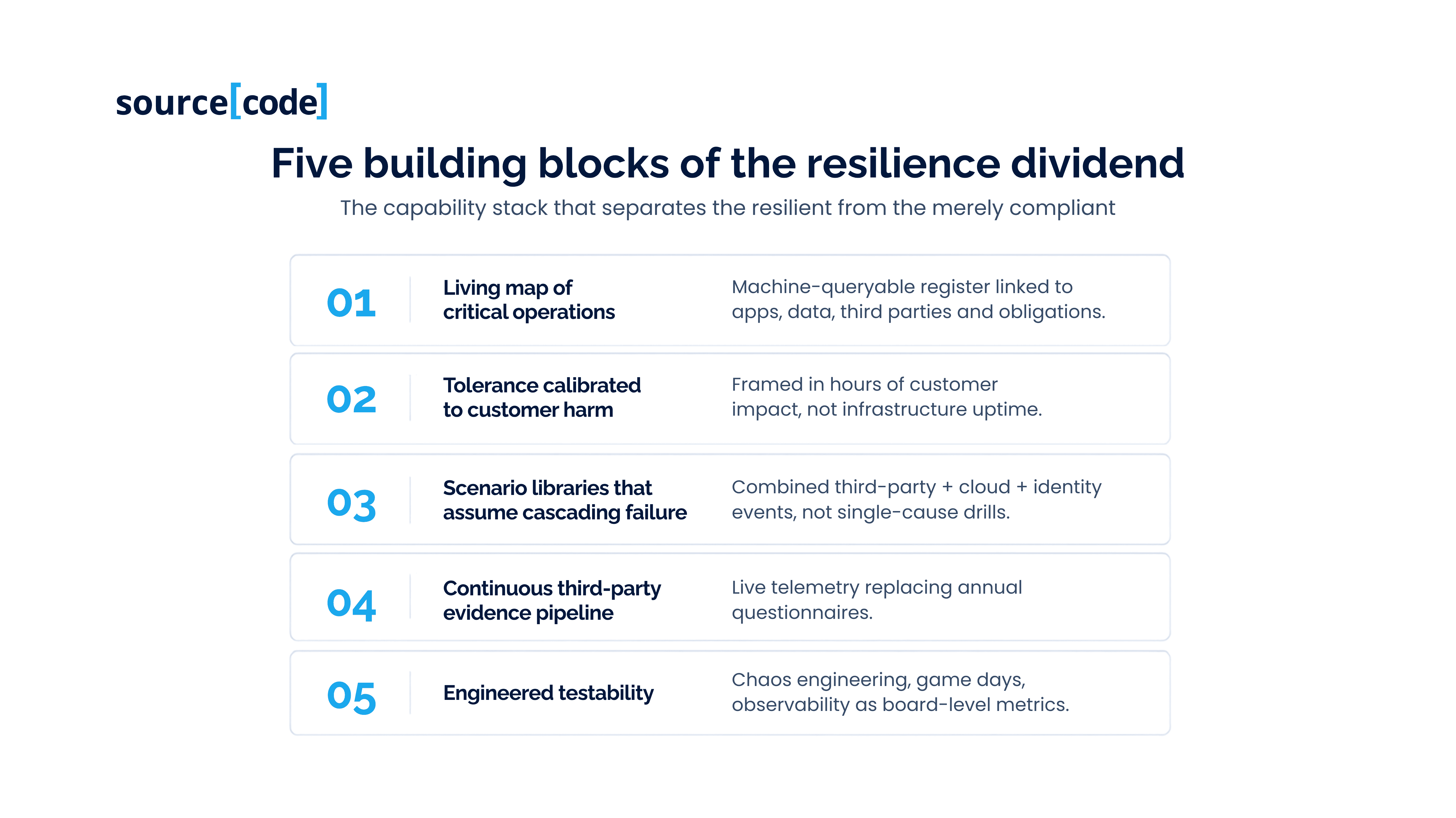
1. A living map of critical operations. The critical operations register should be a machine-queryable object, not a document. Each critical operation is linked to the applications, data stores, network paths, people, third parties, and regulatory obligations it depends on. When any of those dependencies changes, the register updates automatically, and downstream tolerance, testing and reporting artefacts stay in sync.
2. Tolerance levels calibrated to customer harm, not system uptime. Tolerance decisions rooted in "four nines" of infrastructure availability miss the point. Regulators want tolerance framed as maximum permissible customer, market or systemic harm, measured in hours of unavailable payments, delayed claims settlement, or interrupted market data. Well-run tolerance frameworks connect operational metrics directly to customer-outcome metrics.
3. Scenario libraries that assume cascading failure. The 2024 CrowdStrike, 2025 AWS US-EAST-1 and 2025 Google Cloud incidents share a common lesson: severe scenarios are increasingly combined scenarios (third-party plus cloud plus authentication). Scenario libraries must move beyond single-cause events to test correlated, cross-provider disruptions, the exact class of event that a traditional business impact analysis under-weights.
4. A third-party operating model built for continuous evidence. The MAS TPRM proposal and APRA's Material Service Provider Register both point to the same target state: a live, evidence-backed view of every third party that could materially affect a critical operation. Institutions that automate this - pulling telemetry from vendor security ratings, cloud provider status pages, contract systems and incident channels - will spend a fraction of the effort that peers spend on manual questionnaires.
5. Engineering practices that make resilience testable. Chaos engineering, game days, failover drills and observability instrumentation are how resilience gets proven. In 2026 these practices are moving from a nice-to-have into a board-level priority (Avekshaa, 2026). The most advanced APAC banks now run monthly game days on tier-1 services and publish internal scorecards to the board.
Real-World Examples
Australian banking on CPS 230. Leading Australian banks have restructured their third-party operating models around the CPS 230 Material Service Provider Register. Several have consolidated procurement, legal, technology risk and business continuity data into a single vendor-lifecycle platform, moving from annual reviews to continuous risk scoring, a design choice explicitly rewarded by the July 2026 amendments (APRA, 2026a; KPMG Australia, 2025).
Hong Kong scenario testing. In line with HKMA OR-2, Hong Kong tier-1 banks completed critical-operation mapping and scenario testing programmes across payments, trading and wealth-management services during 2024-2026. The exercise revealed that many "independent" services shared underlying vendor dependencies, a discovery that reshaped both architecture roadmaps and vendor contracts (HKMA, 2024; KPMG China, 2024).
Singapore's push beyond outsourcing. In anticipation of the MAS TPRM Guidelines, several Singapore banks have begun classifying SaaS, API partners and AI model vendors under the same governance regime previously reserved for outsourced services, an early move that positions them well for the final rules (MAS, 2026a; Reed Smith, 2026).
Global insurers post-CrowdStrike. The July 2024 CrowdStrike incident, which crashed an estimated 8.5 million Windows workstations globally, produced a wave of endpoint-diversification and staged-rollout initiatives across global insurers with APAC operations. The estimated USD 5.4 billion in Fortune 500 damages catalyzed insurance-side product innovation on systemic-outage cover (Parametrix, 2024).
Actionable Recommendations for APAC BFSI Leaders
Six actions, sequenced across the next 12 months.
Within 90 days. Reconcile the critical operations register against the CIO's application portfolio and the CPO's vendor register. Any mismatch is a resilience blind spot. Ensure board-approved tolerance levels are expressed in customer-outcome units, not infrastructure metrics.
Within 6 months. Run at least one severe scenario that combines a third-party outage with a cloud region incident and an authentication failure. Publish results - including what failed - to the board risk committee. Fund a game-day capability that runs monthly, not annually.
Within 12 months. Stand up a continuous third-party evidence pipeline that pulls telemetry from security-rating vendors, cloud status pages, contractual obligation systems and incident feeds directly into the material service provider register. Retire manual annual questionnaires for material providers.
Structural moves. Elevate resilience ownership out of second-line risk into a joint accountability with the CIO/CTO. Fund a platform-engineering capability whose success metric is time-to-restore critical services under tested scenarios. Rebuild vendor contracts to include mandatory incident data sharing, exit-plan artefacts and joint game-day participation.
Capability moves. Invest in observability, service mesh, feature flags and blue/green deployment as resilience investments, not just DevOps hygiene. Build the internal muscle to run controlled failure injection safely in production. Where the internal muscle is not there yet, partner with a delivery firm that can build it into the operating model rather than deliver it as a report.
The sourceCode Perspective
sourceCode has spent more than a decade helping APAC BFSI clients modernize the platforms that operational resilience regulators now examine. What we observe across our engagements is a consistent pattern: the institutions that struggle with CPS 230, HKMA OR-2 or MAS TPRM are not the ones lacking policies - they are the ones whose critical-operations register cannot be reconciled with the current-state architecture, whose tolerance levels have never survived a real scenario, and whose third-party evidence lives in slide decks.
The engineering answer is not exotic. It combines disciplined domain-driven design of critical operations, cloud-native platform patterns that make failover routine, observability that surfaces real customer-experience metrics, chaos-engineering practice, and a data model that keeps the material service provider register in sync with reality. These are capabilities we build into client operating models, as embedded engineering, platform enablement, and modernization programmes - not as one-off reports.
Our positioning is deliberate. We believe operational resilience is an engineering problem with a governance overlay, not a governance problem with an engineering afterthought. Institutions that internalise that framing will earn the resilience dividend. Those that do not will keep paying the resilience penalty - in outages, regulatory findings, and eroded customer trust.
Conclusion
The APAC regulatory calendar has quietly rewritten the resilience contract between financial institutions and their regulators. CPS 230 is live and amended. HKMA OR-2 has passed its full-compliance deadline. MAS's TPRM overhaul is about to close a decade-old outsourcing chapter. DORA is enforceable. The BIS Principles are the shared vocabulary.
For CEOs, CIOs, CDOs and boards across APAC banking, insurance, financial services and fintech, the strategic choice is between two postures. One posture treats these frameworks as compliance line items to be documented, filed and audited. The other treats them as an opportunity to build engineered resilience that shows up in customer trust, capital efficiency and speed of regulatory approval.
The economy has shifted. Concentration risk is systemic. Third parties are the single largest cyber incident vector. Consumer uncertainty is at a multi-year high. In this environment, resilience is not a cost center, it is a competitive moat, and the institutions that build it first will earn a dividend that compounds.
Looking to move beyond documented compliance to demonstrate resilience across your critical operations, cloud footprint and third-party ecosystem? Talk with sourceCode about designing an engineered resilience capability aligned to CPS 230, HKMA OR-2, MAS TPRM and the BIS principles, built to run, not to file.
Frequently Asked Questions
What is CPS 230 and when did the 2026 amendments take effect? APRA Prudential Standard CPS 230 sets operational risk management, business continuity and service-provider requirements for all APRA-regulated entities. It came into force on 1 July 2025. Final targeted amendments were released on 30 April 2026 and took effect on 1 July 2026, providing limited contractual exemptions for certain non-traditional service providers such as central banks (APRA, 2026a).
What does HKMA OR-2 require of Hong Kong banks in 2026? HKMA's Supervisory Policy Manual OR-2 required Hong Kong banks to develop an operational resilience framework by May 2023 and to become fully operationally resilient by May 2026. Post-deadline, HKMA has shifted supervisory focus to sustaining resilience in business-as-usual, with third-party risk and cyber risk as priority areas (HKMA, 2022; HKMA, 2024).
What is changing under the MAS Third-Party Risk Management Guidelines? The proposed MAS TPRM Guidelines, consulted on from 6 March to 20 April 2026, extend supervisory expectations from outsourced services to all third-party arrangements that could materially affect an institution's operations, customers, data security or regulatory obligations - a significant broadening from the current Outsourcing Guidelines (MAS, 2026a; Baker McKenzie, 2026).
Why is cloud concentration a resilience issue for APAC banks? AWS, Microsoft Azure and Google Cloud together represented 63% of enterprise cloud infrastructure spending in Q3 2024. The October 2025 AWS US-EAST-1 and Google Cloud Service Control outages demonstrated that single-provider faults can cascade across sectors without any cyber attack, making cloud provider selection and exit planning a board-level risk decision (SafeSecurity, 2026).
How should institutions measure operational resilience beyond compliance? Best-practice metrics combine (a) time-to-restore critical operations under tested scenarios, (b) tolerance breaches measured in customer-harm units, (c) third-party incident frequency and severity, and (d) frequency of game days and chaos-engineering exercises. These metrics belong on the board risk dashboard alongside credit, market and liquidity metrics.
References
Accenture (2025) State of Cybersecurity Resilience 2025. Accenture Research. Available at: https://www.accenture.com/us-en/insights (Accessed: 22 July 2026).
Accenture (2026) Consumer Pulse Survey 2026. Accenture Research.
APRA (2025) Prudential Standard CPS 230 Operational Risk Management. Australian Prudential Regulation Authority. Available at: https://www.apra.gov.au/standards/cps-230 (Accessed: 22 July 2026).
APRA (2026a) Response to submissions - CPG 230 Operational Risk Management. Australian Prudential Regulation Authority. Available at: https://www.apra.gov.au/response-submissions-cpg-230-operational-risk-management (Accessed: 22 July 2026).
Avekshaa (2026) Top 10 Chaos Engineering Service Providers in 2026. Available at: https://avekshaa.com/top-10-chaos-engineering-service-providers-helping-enterprises-achieve-resilience-in-2026/ (Accessed: 22 July 2026).
Baker McKenzie (2026) Singapore: MAS Proposes Third-Party Risk Management Guidelines. Available at: https://www.bakermckenzie.com/en/insight/publications/2026/03/singapore-mas-proposes-third-party-risk-management-guidelines (Accessed: 22 July 2026).
BCLP (2026) Cyber Resilience in Financial Services: Navigating Rising Risks and the 2026 Regulatory Shift. Bryan Cave Leighton Paisner. Available at: https://www.bclplaw.com/en-US/events-insights-news/cyber-resilience-in-financial-services-navigating-rising-risks-and-the-2026-regulatory-shift.html (Accessed: 22 July 2026).
BIS (2021) Principles for Operational Resilience. Basel Committee on Banking Supervision. Available at: https://www.bis.org/bcbs/publ/d516.pdf (Accessed: 22 July 2026).
Cockroach Labs (2025) State of Resilience 2025: Confronting Outages, Downtime, and Enterprise Readiness. Available at: https://www.cockroachlabs.com/guides/the-state-of-resilience-2025/ (Accessed: 22 July 2026).
Deloitte (2025) Time to flourish: The future of operational resilience. Deloitte UK. Available at: https://www2.deloitte.com/uk/en/pages/risk/articles/operational-resilience-in-financial-services.html (Accessed: 22 July 2026).
European Parliament (2022) Regulation (EU) 2022/2554 - Digital Operational Resilience Act (DORA). Official Journal of the European Union.
HKMA (2022) Supervisory Policy Manual OR-2: Operational Resilience. Hong Kong Monetary Authority.
HKMA (2024) Journey to Operational Resilience: Mapping and Testing - HKMA-HKAB Industry Sharing Session. Available at: https://www.hkma.gov.hk/eng/news-and-media/speeches/2024/12/20241202-1/ (Accessed: 22 July 2026).
HKMA (2025) Priorities for 2026 and Beyond. HKMA Annual Report 2025. Available at: https://www.hkma.gov.hk/media/eng/publication-and-research/annual-report/2025/07_Priorities_for_2026_and_Beyond.pdf (Accessed: 22 July 2026).
KPMG Australia (2025) APRA's Prudential Standard CPS 230 Operational Risk update. Available at: https://kpmg.com/au/en/insights/industry/apra-prudential-standard-cps-230-operational-risk-updates.html (Accessed: 22 July 2026).
KPMG China (2024) Hong Kong Banking Report 2024: Operational Resilience. Available at: https://kpmg.com/cn/en/insights/2024/07/hong-kong-banking-report-2024/operational-resilience.html (Accessed: 22 July 2026).
MAS (2026a) Consultation Paper on Proposed Guidelines on Third-Party Risk Management. Monetary Authority of Singapore, 6 March 2026.
McKinsey (2025) Operational resilience has become critical. How are banks responding?. Available at: https://www.mckinsey.com/capabilities/risk-and-resilience/our-insights/operational-resilience-has-become-critical-how-are-banks-responding (Accessed: 22 July 2026).
Parametrix (2024) CrowdStrike Outage Insurance Loss Analysis. Cited in Reuters coverage of the July 2024 CrowdStrike incident.
Reed Smith (2026) MAS proposes enhanced risk management requirements for financial institutions. Available at: https://www.reedsmith.com/articles/mas-proposes-enhanced-risk-management-requirements-for-financial-institutions/ (Accessed: 22 July 2026).
Regulation Tomorrow (2026) APRA finalises targeted amendments to CPS 230 Operational Risk Management. Available at: https://www.regulationtomorrow.com/2026/05/apra-finalises-targeted-amendments-to-cps-230-operational-risk-management/ (Accessed: 22 July 2026).
SafeSecurity (2026) 8 Third-Party Risk Examples Every 2026 Security Team Should Know. Available at: https://safe.security/resources/blog/8-third-party-risk-examples-every-2026-security-team-should-know/ (Accessed: 22 July 2026).
SureCloud (2026) Third-Party Risk in 2026: The Hidden Cyber Threat. Available at: https://www.surecloud.com/blog-hub/third-party-risk-cybersecurity-2026 (Accessed: 22 July 2026).
Swif (2026) Financial Services Cybersecurity Statistics for 2026: Breach Costs, Top Threats, and Third-Party Risk. Available at: https://www.swif.ai/blog/financial-services-cybersecurity-statistics (Accessed: 22 July 2026).